Portuguese
  Spanish


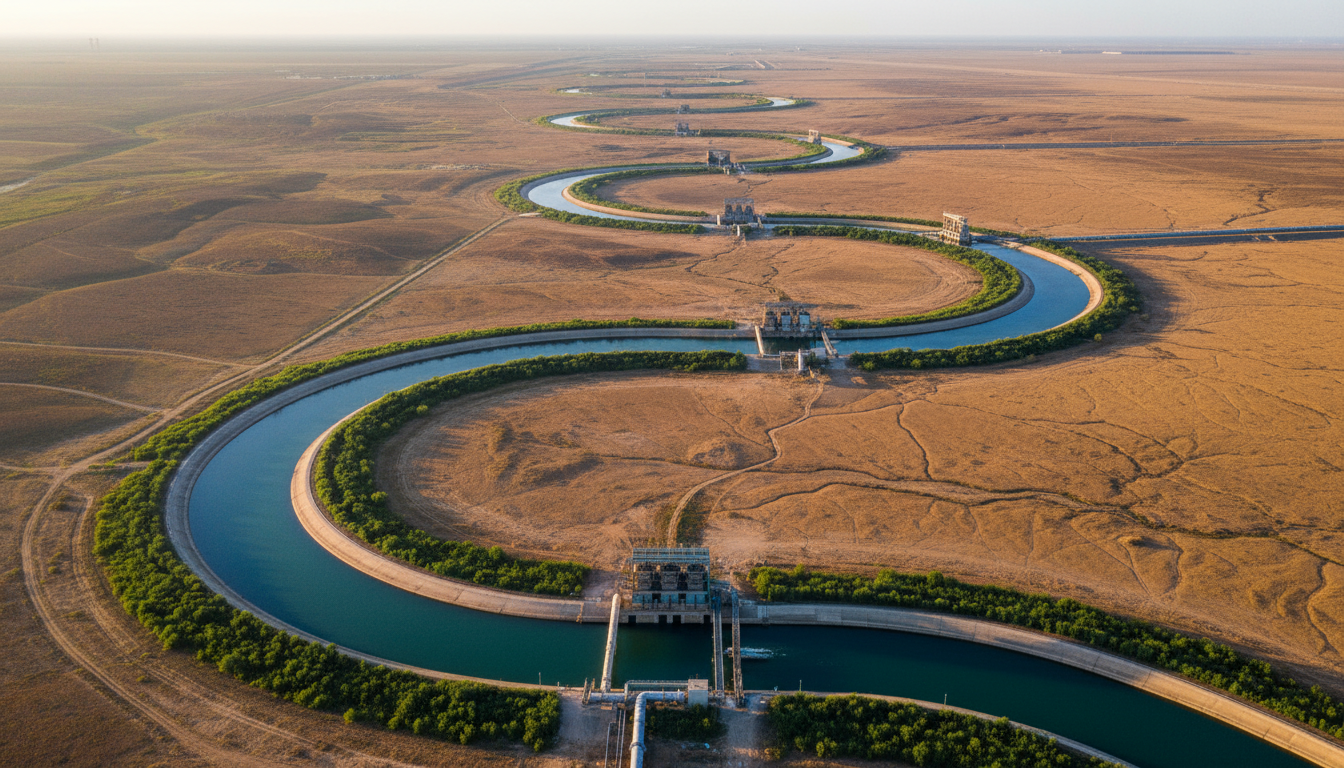


The world’s largest artificial river cost US$ 79 billion, extends for 2,700 kilometers of canals, tunnels, and aqueducts, and has already transferred 76.7 billion cubic meters of water from the humid south to the arid north of China, transforming the water map of an entire country
While northern China faced one of the planet’s worst water crises, with the Yellow River drying up in entire sections and tributaries of the Hai River disappearing for most of the year, Chinese engineers designed something no other country had even attempted: an artificial river in China capable of moving water on a continental scale.
The South-to-North Water Diversion Project, known as SNWD, officially began construction in 2002. Since then, it connects four river basins through more than 2,700 kilometers of canals, tunnels, and aqueducts.
According to Brazil’s Ministry of Regional Development, which visited the project on a technical mission, it is the largest water security undertaking in the world.
-
China’s Engineered Bamboo: The “Material of the Future” Stronger Than Steel and a Sustainable Wood Alternative

-
Egypt’s “New Nile”: 170 km Artificial River Aims to Turn Desert into Farmland, but Water Supply Concerns Loom
-
Eni Acquires 25% Stake in Chilean Lithium Project, Plans to Invest Up to $225 Million in Eco-Friendly Extraction Method
-
Unable to secure a mortgage as a self-employed single mother, she designed her own floating home from a 20-meter boat and now lives “off-grid” with her two children and solar panels on an English canal.



The system benefits about 185 million people in densely populated and industrialized regions of northern China. In addition, it has already transferred 76.7 billion cubic meters of water by April 2026.
The three routes of China’s artificial river that cross the country from end to end
The project operates through three main routes: East, Central, and West. Together, they will have the capacity to transfer 44.8 billion cubic meters of water per year when fully completed.
The East route extends for 1,112 kilometers of canals and tunnels. It utilizes the ancient Beijing-Hangzhou Grand Canal, the world’s oldest artificial waterway. It has been operating since 2013 with an annual capacity of 14.8 billion cubic meters.
On this route alone, engineers installed 13 pumping stations with more than 100 sets of motor pumps. The total power in some sections exceeds 454 megawatts.

Giuseppe Vieira, Brazil’s National Secretary for Water Security, described what he saw during a technical visit: “We had the opportunity to visit some pumping stations, which have more than 13 stations installed only on the eastern branch. These 13 total more than 100 sets of motor pumps installed and operating.”
The Central route, on the other hand, runs between 1,264 and 1,400 kilometers from the Danjiangkou reservoir to Beijing. The flow occurs mostly by gravity, without the need for pumping.
This route crosses the Yellow River through two large underground tunnels. Furthermore, it supplies 70% of all water coming out of Beijing’s taps — a fact that reveals the Chinese capital’s dependence on this system.

The West route is still in the planning phase. When completed, it will have the capacity to transfer 17 billion cubic meters per year, but it faces significant technical and environmental challenges.
Impressive numbers: US$ 79 billion and 330,000 people relocated
The total cost of the project has already exceeded US$ 79 billion. This value makes China’s artificial river the most expensive water infrastructure project in human history.
To enable construction, the Chinese government had to relocate 330,000 people who lived along the canal route. The resettlement involved entire communities that lost their land to make way for the project.
When all routes are completed in 2050, the system will have a full capacity of 44.8 billion cubic meters of water per year. This volume is equivalent to supplying entire countries the size of Portugal or Switzerland.

Other Chinese megaprojects like the 164-kilometer Danyang-Kunshan bridge also impress with their scale. However, none of them move a resource as essential as drinking water.
Comparison with the São Francisco: China’s artificial river is 50 times larger
To gauge the scale, one only needs to compare it with Brazil’s São Francisco River Integration Project. The Brazilian transposition cost US$ 3 billion and extends for 477 kilometers.
The Chinese system is more than 50 times larger in length, 50 times greater in annual volume, and 26 times more expensive. While the PISF benefits 12 million Brazilians in the Northeast, the Chinese diversion serves 185 million.
According to the Ministry of Regional Development, the visit to the project serves as a reference to expand technical cooperation between Brazil and China in the area of water security.
Giuseppe Vieira stated that the MIDR team “had the opportunity to learn about the world’s largest water security undertaking, which transports water from the Yangtze River from more favored regions to less favored regions of China.”
Environmental challenges and the risks that persist after 24 years of work
Despite the impressive numbers, the project carries considerable challenges. Water pollution remains a permanent risk, especially on routes that cross industrial regions.
The impacts on local ecosystems are still being evaluated. The preservation of springs and banks receives continuous investment, with public leisure areas created along the canals.
Furthermore, the West route faces technical and environmental obstacles that delay its completion. More ambitious proposals from Chinese academics diverge from the government’s more modest versions.
Other extreme engineering works in China, such as the 4,000-ton drilling machine, show that the country continues to invest in continental-scale infrastructure.
As reported by Revista Oeste, the total length of the system can reach 2,700 km when all routes are operational.
It is worth noting that data on the project varies among sources. Some indicate a length of 1,200 km for specific sections, while others cite 2,700 km for the complete system. Furthermore, the mark of 76.7 billion cubic meters transferred represents an accumulation since the start of operations, not the annual volume.
The total completion of the project is expected only by 2050, with the West route still in its initial phase. Until then, China’s artificial river will continue to be the largest water project in history — a system that literally redrew the map of a country to ensure the survival of nearly 200 million people.