Portuguese
  Spanish


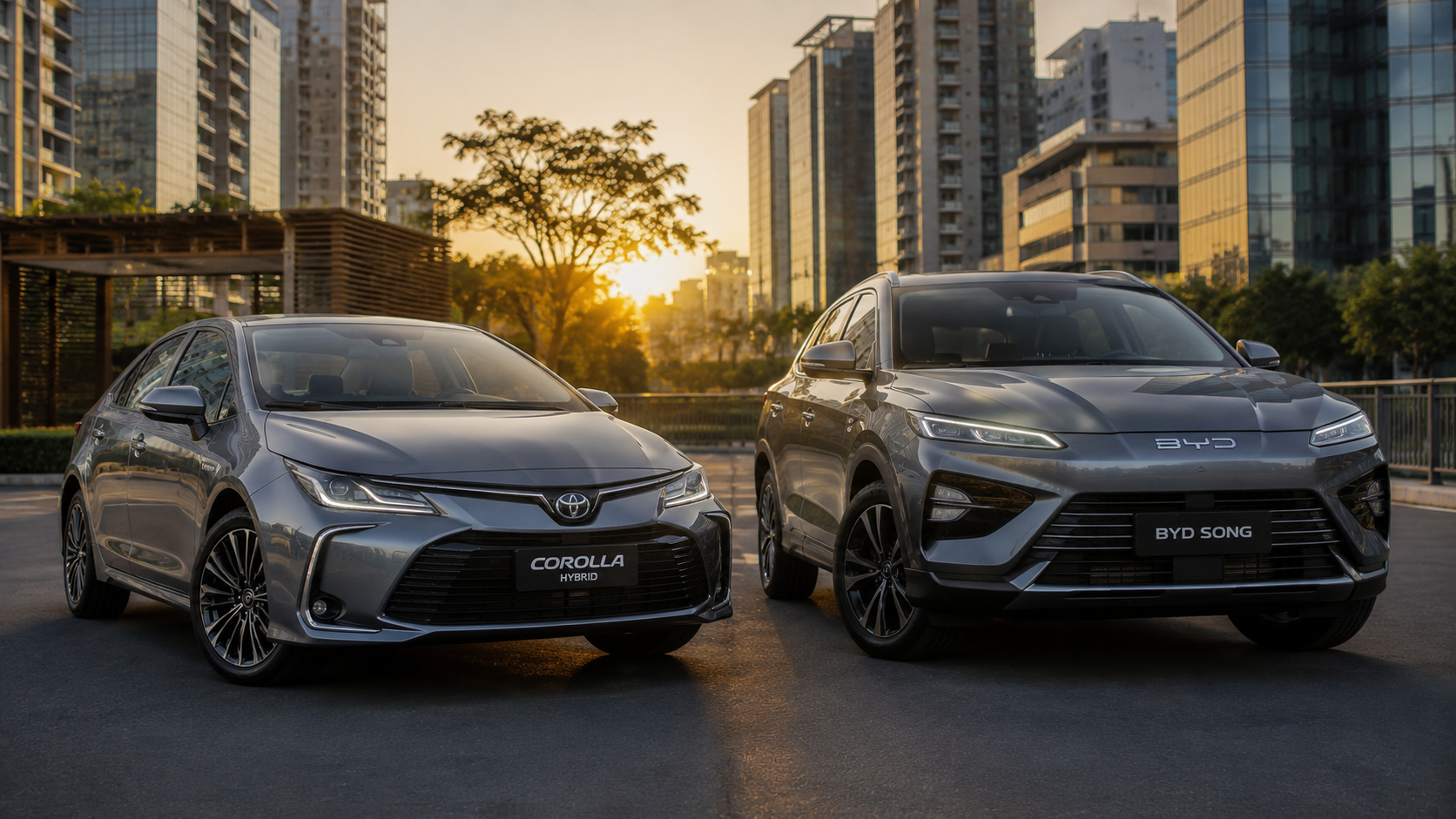

Historic reduction in the price of one of the country’s best-selling hybrids moves the automotive sector, pressures competitors, and creates new opportunities for consumers seeking economy, technology, and better cost-benefit in Brazil
The price war among automakers in Brazil gained a new and decisive chapter in May 2026. In a strategic move that surprised the market, Toyota decided to react strongly to the growing presence of Chinese brands and announced a significant discount on the Corolla GLi Hybrid. The information was released by “Gridmidia,” according to a report signed by Jamille Novaes, highlighting an impressive reduction of over R$ 45 thousand on the model.
This type of movement does not happen by chance. On the contrary, it reflects an increasingly fierce dispute between automotive industry giants, especially in the electrified vehicle segment. In this scenario, the Corolla Hybrid emerges as a key piece in Toyota’s strategy to face direct rivals, such as the BYD Song and the BYD King, which have also been adopting aggressive pricing policies.
Toyota bets on a R$ 45,885.74 discount to reposition Corolla Hybrid
First, the exact value of the reduction applied by Toyota stands out: R$ 45,885.74 on the Corolla GLi Hybrid. This number not only impresses but also positions the sedan as one of the most competitive options within the hybrid segment in Brazil.
-
Hilux’s little sister: Toyota relaunches the Land Cruiser 70 in the 2027 lineup with over 40 years of production, a 2.8 turbo diesel engine with 201 hp and 51 kgfm, a six-speed automatic transmission, and a renewed retro look.

-
Automatic, economical, and known for reliability: with a 1.5 engine of up to 110 hp, CVT transmission, seven airbags, and fuel consumption of up to 15.9 km/l, this used hatchback appears as a rational alternative to Polo, HB20, and Onix; meet the Toyota Yaris XLS 2020.
-
He surpassed the Tera, Creta, and Tracker: With a TSI engine of up to 150 hp, 6-speed automatic transmission, and a 373-liter trunk, the Volkswagen T-Cross was the best-selling SUV in June, with 11,753 registrations.

-
It looks factory-made, but it came out of a workshop: a mechanic from Pernambuco builds a handcrafted “mini Toyota,” drives it through the streets, and the video goes viral on social media, leaving residents astonished.



Furthermore, this discount is primarily aimed at the PCD (People with Disabilities) public, who already benefit from tax incentives. This way, the model becomes even more accessible, expanding its reach and reinforcing the Japanese automaker’s strategy to maintain its relevance in a transforming market.
On the other hand, this movement also highlights something important: there is significant room for negotiation within the automotive sector. In other words, even with more advanced technologies, such as hybrid systems, prices can be aggressively adjusted when there is competitive pressure.
Consequently, consumers now have more power of choice, something that until recently was limited when it came to electrified vehicles.
BYD responds with discounts of up to R$ 41 thousand and intensifies dispute
Meanwhile, BYD, which has been rapidly gaining ground in Brazil, did not stand still. The Chinese automaker had already announced significant cuts to its models to attract new customers and consolidate its presence in the country.
Among the highlights are:
- BYD Song Pro GL with a R$ 41 thousand discount
- BYD King GL with a R$ 37 thousand reduction
These values had already been attracting attention in the market. However, Toyota’s response, with an even larger discount on the Corolla Hybrid, completely changes the game.
Furthermore, this dispute shows how the Brazilian automotive sector is entering a new phase. Now, it’s not enough to just offer technology — it’s necessary to combine innovation with competitive pricing.
Thus, both Toyota and BYD demonstrate that they are willing to forgo larger margins to gain market share, something that directly benefits the end consumer.
What changes for the consumer with this price war?
Given this scenario, the impact for those considering buying a new car is extremely positive. This is because direct competition among automakers tends to generate a series of benefits, both immediate and medium-term.
First, there is a significant increase in negotiation power. Even outside of specific PCD conditions, consumers can get better deals at dealerships.
Furthermore, there is a clear trend of price flexibility. In other words, promotions and discounts are becoming more common, even in traditional retail.
Another important point is the domino effect. When an automaker aggressively reduces prices, other companies are practically forced to react to avoid losing competitiveness.
Finally, this movement encourages the adoption of electrified vehicles in Brazil. With more accessible prices, hybrid and electric models cease to be a niche and become part of the reality for a larger number of consumers.
Therefore, May 2026 could represent a strategic moment for those looking to trade in their car. After all, offers of this level were considered practically impossible until recently.
Would you take advantage of this moment to trade in your car, or do you still think prices might drop even further in the coming months?