Portuguese
  Spanish


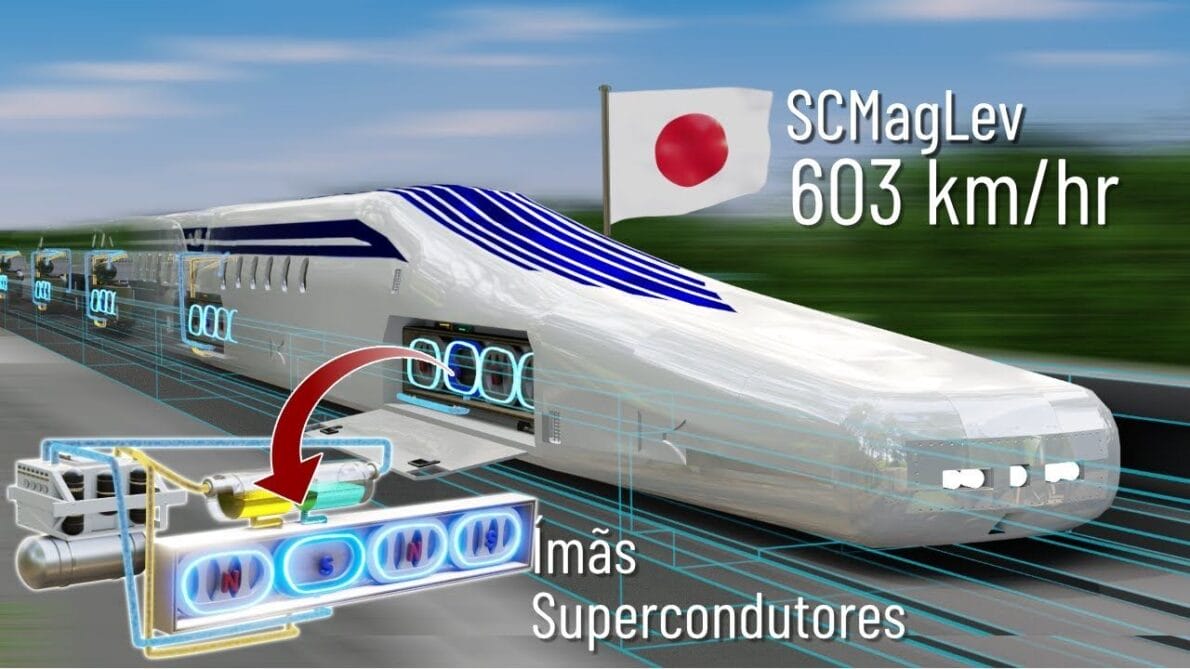


The Amazing Magnetic Levitation Technology That Allows The Japanese Maglev Train To Reach 600 Km/H.
Buried deep within the Japanese mountains, there is a 43-kilometer stretch that is part of the world’s first Maglev train intercity line, connecting Tokyo and Osaka. With the power of superconducting magnets, these trains float above the tracks without any physical contact, meaning less wear and the ability to operate in any weather conditions.
How Does The Maglev Train Work?
The secret lies in magnetic levitation. There are two main methods: pulling the train up using attractive forces or pushing it using repulsive forces. Japan opted for the latter, creating a passively stable system — ideal for an earthquake-prone region.
Superconducting magnets onboard the train interact with coils installed on the tracks. As the train moves, these coils experience a variable magnetic field, generating a force that levitates the train 10 centimeters above the tracks. However, this levitation only occurs when the train reaches speeds above 100 km/h; until then, it uses wheels that retract when magnetic levitation comes into action.
-
Brazil Plans $160 Billion Investment to Revitalize Railways and Reduce Reliance on Long-Distance Trucking

-
Retired Railway Workers in Brazil Preserve Locomotive for 52 Years, Now See It Donated by the Government

-
Railway returns to prominence in Brazil after STF approval: a R$ 25.2 billion project promises to save R$ 9 billion in freight, transport 50 million tons per year, and transform Sinop into a logistics powerhouse for agribusiness.
-
Retired trains leave European tracks and become tons of steel, aluminum, and copper in dismantling yards where recycling exceeds 90%, but batteries, composites, and electronics create a new frontier of railway waste.


And How Does It Accelerate Without Touching The Tracks?
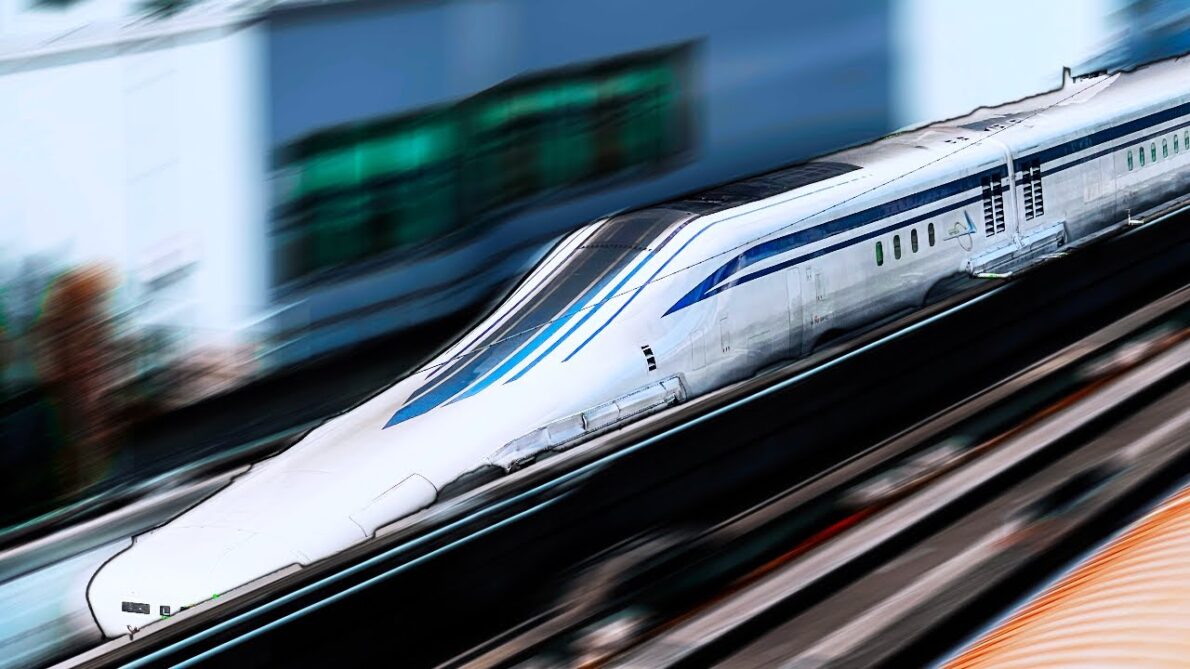
Instead of conventional motors, the Maglev train uses linear motors. Coils on the tracks are energized in sequence, creating magnetic fields that attract and repel the train’s magnets, propelling it forward. To brake, the process is reversed, and the system can even recover energy during deceleration.
Challenges And Achievements
One of the major challenges was containing the magnetic fields so they wouldn’t affect passengers. Engineers developed special shields that reduce the magnetic field inside the cabin to safe levels, similar to the Earth’s natural magnetic field.
Additionally, the construction is a monumental undertaking. About 86% of the route between Tokyo and Nagoya will be in tunnels, which increases costs and complexity. But the benefits are enormous: reduced travel time, lower environmental impact compared to airplanes, and significant technological advancement.
The Future Of Transportation?
Despite economic challenges, Japan is determined to lead this revolution in railway transportation. The Maglev train is not just an engineering feat, but a vision of what the future may offer us.
Will this incredible technology of the Maglev train spread across the world and change the way we travel? Share your thoughts in the comments!