Portuguese
  Spanish


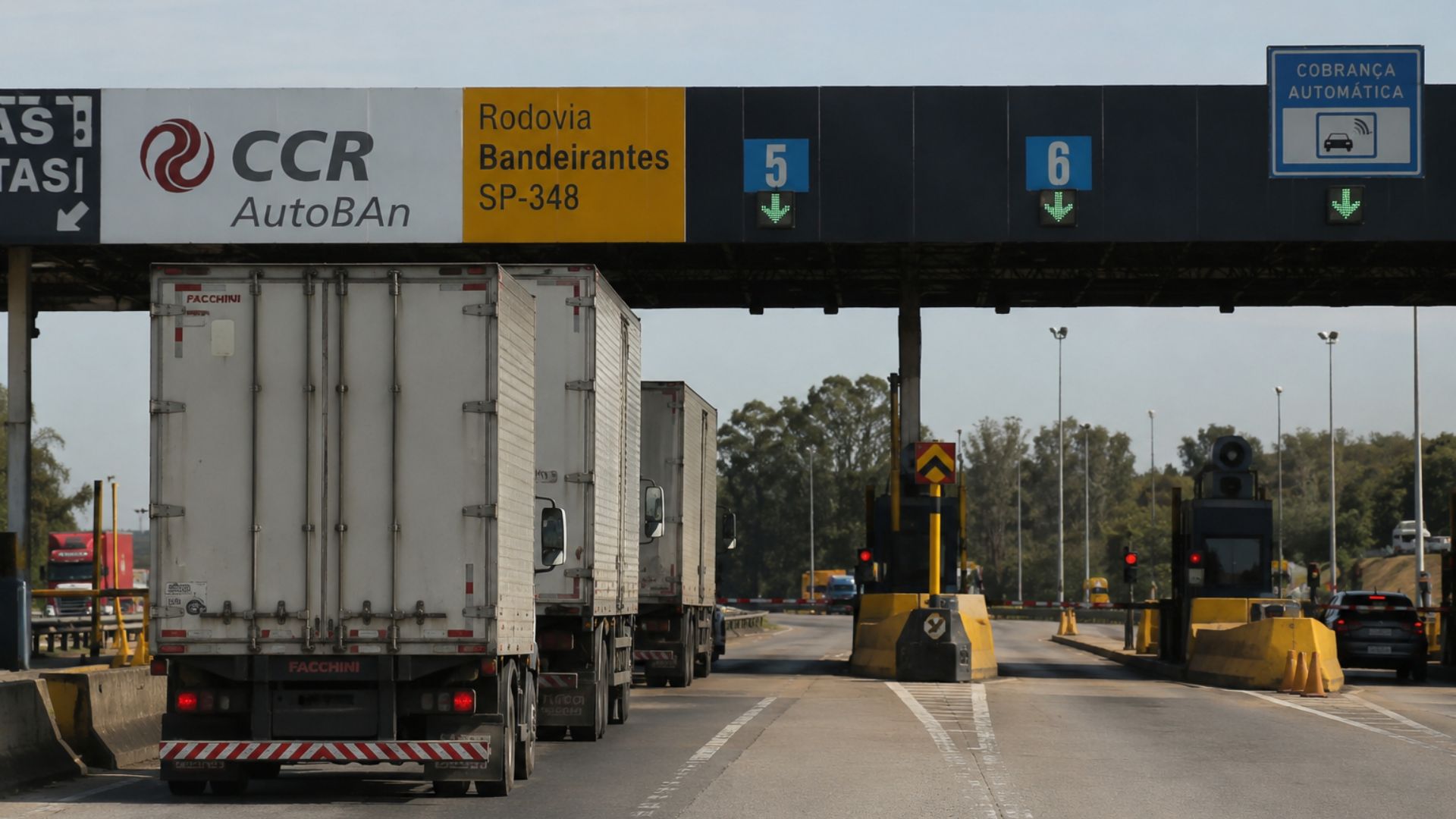

The advancement of automatic tolls on Brazilian highways has expanded the use of inspection technologies, while drivers have resorted to new methods to hide license plates and avoid charges. The increase in evasions has reignited discussions about operational failures, suspended fines, and challenges of the Free Flow system.
A new practice adopted by truck drivers has begun to concern concessionaires and traffic authorities on federal highways, especially in sections with automatic toll collection, where drivers partially hide the vehicle’s license plate to make identification by cameras difficult.
While the Free Flow system advances in the country as an alternative to traditional toll plazas, the number of evasion attempts also grows, already exceeding 6 million records on federal highways in the last three years, according to sector data.
In addition to known maneuvers in conventional booths, such as passing without paying or taking advantage of the vehicle in front, some drivers have resorted to hiding their license plates to escape automatic collection made by electronic reading.
-
End of an era in Brazil: beloved sedan by Brazilians is discontinued despite having a 2.0 engine with 151 hp, CVT transmission, 466-liter trunk, and up to 650 km of range.

-
New Law Proposal in Brazil Could Heavily Penalize Drivers: Dangerous Overtaking May Become a Serious Offense with Fines Increased Tenfold and a 12-Month License Suspension; Update on 2026 Progress

-
Electric Revolution: Watts W125 Motorcycle Offers 160 km Range, 90 km/h Speed, and Affordable Price Starting at $3,000
-
General Motors Replaces Over a Thousand Workers with 50 Cobots at Electric Vehicle Plant, UAW Union Criticizes Move Amid Industry’s Automation Push




Besides passing without paying the fare at conventional booths, some drivers try to stick close to the vehicle in front or hide identification data to escape the cameras.
Trick used by truck drivers worries concessionaires
Among the methods recently identified, one of the most commented involves the use of the step originally installed on the front grille of trucks, a piece that can be irregularly displaced to partially cover the vehicle’s license plate when passing through tolls.
With compromised identification, cameras installed at traditional toll plazas and electronic gantries fail to correctly record vehicle data, hindering the automatic issuance of charges and also the eventual application of penalties related to evasion.
The practice caught the attention of concessionaires because it does not require improvised equipment or complex alterations to the truck’s structure, as the cabin component itself ends up being used as a visual barrier against electronic reading systems.
The feature is already part of the cabin and, when used irregularly, functions as a visual obstacle against image recognition-based inspection systems.
Even so, driving with a covered license plate or with part of the vehicle not in accordance with traffic rules can result in a violation notice.
The Brazilian Traffic Code (CTB) provides for penalties for irregularities linked to vehicle identification and toll evasion.
Fine for toll evasion and license plate concealment

Toll evasion is classified as a serious infraction.
The penalty is R$ 195.23, plus five points on the National Driver’s License.
The rule also applies to conduct such as crossing a road block without authorization or failing to pay the due fare.
In the case of a covered license plate, the irregularity can lead to the driver being framed under infractions provided for in the CTB, depending on the situation verified by inspection.
Concealment makes vehicle identification difficult and can prevent the driver from being held accountable.
In addition to the fine amount, the concessionaire can register the unpaid fare as a debt.
Thus, the violation notice does not eliminate the toll charge, which remains linked to the vehicle’s passage through the concessioned section.
Cameras and electronic monitoring expand inspection
To try to reduce fraud, concessionaires have intensified the use of smart cameras, automatic license plate reading, and integrated monitoring systems capable of identifying vehicles that pass without making the mandatory fare payment.
Arteris, which manages highways in the South and Southeast, reported that it uses electronic monitoring to identify vehicles that pass without paying.
The technology allows for recording images, consulting evasion history, and forwarding data to the agencies responsible for issuing violation notices.
The system also helps identify repeat offenses, especially in sections with heavy circulation of trucks and commercial vehicles.
According to the concessionaire, monitored toll plazas in São Paulo, Rio de Janeiro, Minas Gerais, Santa Catarina, and Paraná already have such tools.
The company states that the combination of electronic enforcement and data analysis has reduced incidents on some of the managed highways.
In November 2025, Arteris recorded a drop of 11.25% in evasions compared to the same month in 2024, from 187.8 thousand to 166.7 thousand occurrences.
In December, even with an increase in year-end traffic, the reported reduction was 6.6%.

Free Flow System returns to the center of the debate
Free Flow began operating in Brazil in March 2023, in Rio de Janeiro, as an alternative to traditional tolls.
In this model, vehicles pass through gantries installed on the highway, and charges are made by license plate reading or electronic identification.
The system’s promise is to reduce queues, improve traffic flow, and eliminate stops at physical toll plazas.
However, the change also raised questions about payment deadlines, official inquiry channels, and the application of fines for those who do not regularize the fare.
The topic returned to the center of the debate in April 2026, when the federal government announced the suspension of 3.4 million fines related to Free Flow.
The measure gave drivers 200 days to settle overdue fares without receiving fines or points on their driver’s license.
The decision was presented as a transition phase to adapt users to the new model.
The government informed that the suspension would apply to fines related to non-payment within the deadline, provided that the debts were regularized according to the established rules.
Evasions on federal highways remain high
With the expansion of automatic booths and electronic gantries on Brazilian highways, enforcement has become increasingly dependent on correct license plate reading to ensure the collection of circulation fees.
Without the physical barrier of the traditional toll plaza, correct vehicle identification became central to billing.
Therefore, hiding the license plate became a direct attempt to bypass the system.
On Free Flow highways, the camera needs to identify the vehicle to generate the charge, and any obstacle on the license plate can compromise the registration.
Surveys cited by the sector indicate that evasions on federal highways increased from 3.9 million to over 6 million in the last three years.
The number reinforces pressure on concessionaires and public bodies to improve enforcement.
Meanwhile, drivers also demand more clarity on payment channels and deadlines.
The existence of fake websites and scams related to electronic tolls has increased the need for official communication, especially for those who do not use an automatic tag.
Enforcement tries to separate failures and frauds
The dispute surrounding Free Flow involves two main points: ensuring fare collection and avoiding undue penalties.
To function correctly, the system needs to register the passage, identify the vehicle, and offer accessible means for payment.
When the driver alters the license plate or uses parts of the vehicle to prevent reading, the practice ceases to be an operational failure and becomes irregular conduct.
In such cases, electronic enforcement can be combined with images, passage history, and communication to traffic authorities.
The advancement of technology on highways tends to increase detection capabilities.
Even so, effectiveness depends on integration between concessionaires, enforcing bodies, and customer service channels, to separate non-payment due to lack of knowledge from deliberate attempts at fraud.