






 Portuguese
  Spanish
  3 min of reading
  0 comments


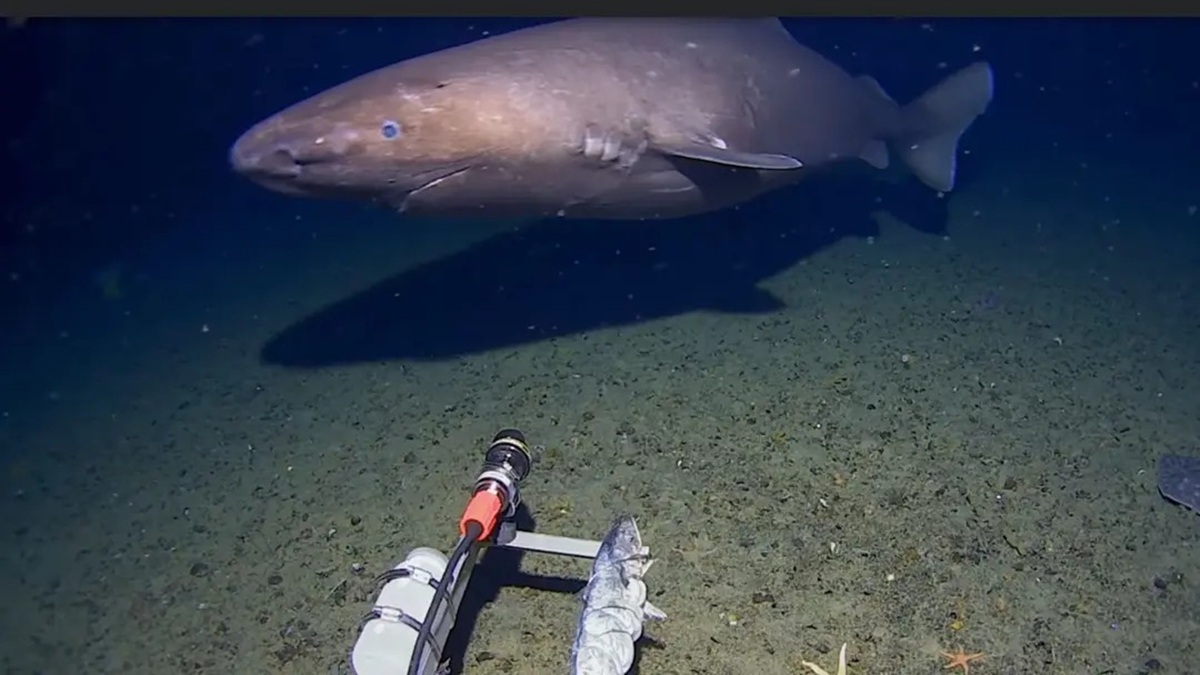
Record Of Great White Shark Up To 4 Meters At 490 Meters Depth, In Waters Of 1.27°C In The Antarctic Ocean, Near The South Shetland Islands, Challenges The Historical Rule That Pointed To Absence Of The Species South Of 60 Degrees Latitude
A great white shark measuring up to 4 meters was recorded in January 2025 at 490 meters depth in the Antarctic Ocean, near the South Shetland Islands, south of 60 degrees latitude, altering the historical rule regarding the absence of sharks in the region.
Unprecedented Record Of The Great White Shark In The Antarctic Seafloor
Researchers from the Minderoo-UWA Deep Water Research Center in Australia released images of a sleeper shark patrolling the completely dark seafloor. The great white shark briefly appeared illuminated by the camera’s spotlight like a “clumsy barrel”.
The sighting occurred in a section of water slightly warmer than the surrounding layers. According to researcher Alan Jamieson from the team, the descent was made without the expectation of finding sharks, due to the general rule that they are not found in Antarctica.
-
Helicopter Drops 180 Tons of Sand and Gravel on Swedish River to Revive Ecosystem Damaged by Decades of Exploitation

-
Brazilian Company Launches Retro Smartphone with 48 MP Camera, T9 Keyboard, and Privacy Features for Social Media-Free Use

-
Self-Taught Chinese Farmer Builds 5-Ton Submarine from Scrap, Launches It in Anhui River
-
Invisible Induction Technology Enables Wireless Power for Blenders, Coffee Makers, and Air Fryers, Reducing Countertop Cables





He stated that it was not a small animal but “a huge piece of shark,” describing them as true tanks.
Depth, Temperature And Location Of The Sighting
The great white shark was observed at 490 meters, equivalent to 1,608 feet, in waters with a temperature of approximately 1.27°C. In another part of the report, the depth is described as approximately 500 meters, or 1,640 feet.
The camera was positioned off the South Shetland Islands in the Antarctic Ocean. It is estimated that the animal measures between 3 and 4 meters long. The region exhibits sharp stratification up to 1,000 meters.
This stratification occurs because dense, icy currents from the depths do not mix easily with the cooler meltwater near the surface. The great white shark was found patrolling the warmer corridor along the sloped seafloor.
Unexpected Presence And Gap In Scientific Documentation
The extreme cold and unique chemical composition of the waters led experts to believe that sharks could not survive there. The discovery altered this assumption by recording the animal at such southern latitudes.
The researchers found no previous records of sharks in the Antarctic Ocean. Independent biologist Peter Kyne from Charles Darwin University stated that no shark had ever been documented at such extreme latitudes.
The images also showed a motionless ray, a relative of the shark, resting on the seafloor. The presence of the ray was expected, as flat relatives are known to thrive at these latitudes.
Limited Monitoring And Possible Explanations
The discovery raises questions about the origin of the great white shark in the region. As research cameras operate only during the brief summer, 75% of the year remains unmonitored.
There is a possibility that they have been local residents of Antarctica for centuries, hiding in the deep darkness. Another hypothesis mentioned is that ocean warming is pushing species further south.
With climate change, species are shifting their habitats to find temperatures suitable for survival. By remaining in the warmer range between distinct layers, the great white shark is able to survive in an extremely cold environment.
The researchers believe these sharks feed on carcasses of giant squids and whales that sink to the seafloor. The sighting could redefine the ecology of the Antarctic Ocean.
If they are permanent residents, they represent an until-then unknown part of the Antarctic food chain, enhancing the understanding of the region’s biodiversity and highlighting a significant gap in current scientific knowledge.





Be the first to react!