Portuguese
  Spanish


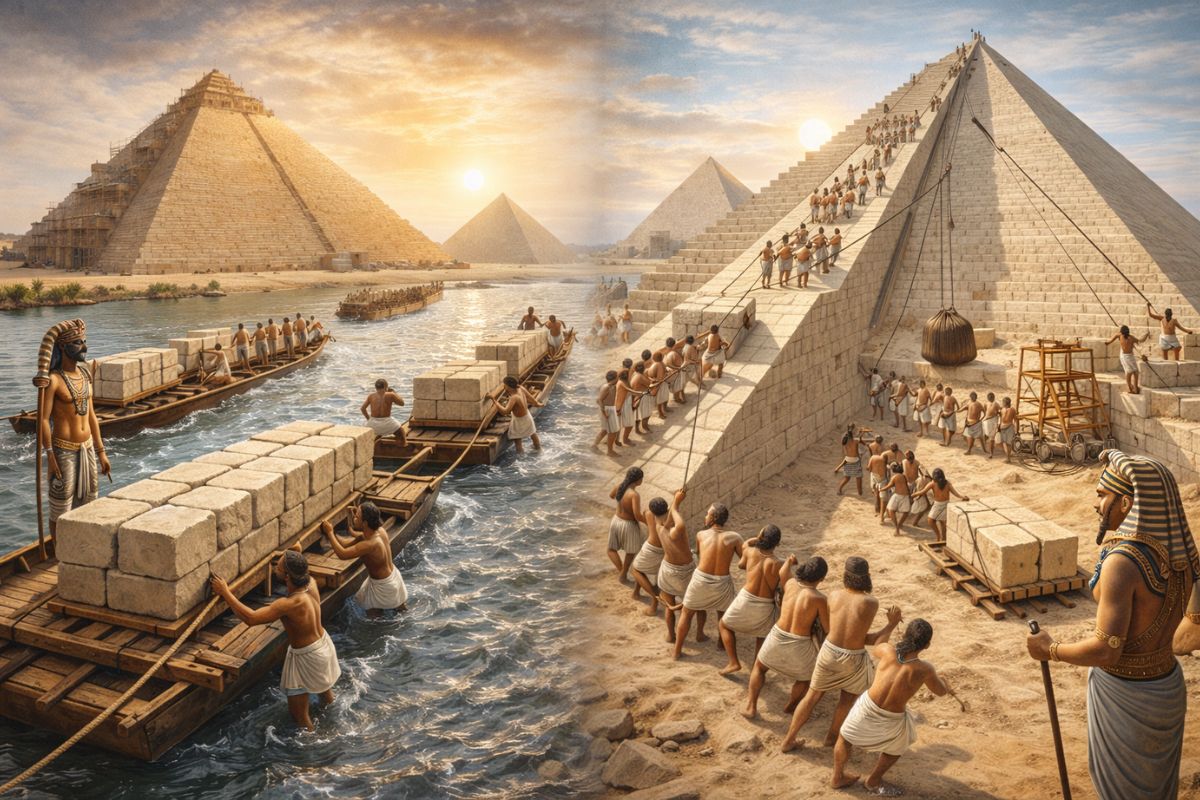


An algorithm calculated that embedded ramps on the edges of the pyramid would allow it to be completed in 14 to 21 years. Another study in Nature suggests that the Great Gallery was a counterweight ramp. Both dispense with impossible technologies.
The Great Pyramid of Giza has 2.3 million stone blocks, a base of 230 meters on each side, and a height of 147 meters. It was built around 2,560 BC, during a reign that lasted about 27 years. To meet this deadline, the builders needed to position one block every few minutes, every day, for decades. No theory until now had demonstrated, with verifiable calculations, how this was possible without technologies that the Egyptians clearly did not have.
Two studies published in high-impact scientific journals in 2026 offer different answers to this problem, and both start from the same premise: the Egyptians needed nothing more than what they already had.
What does the model of integrated ramps to the edges propose?

The engineer and researcher Vicente Luis Rosell Roig from the Polytechnic University of Valencia in Spain published in npj Heritage Science, part of the Springer Nature group, a study that uses a three-dimensional computational model to test a specific hypothesis: ramps embedded in the very edges of the pyramid.
-
Advancement in the industry: Brazilian company creates ultralight material comparable to steel and paves the way for hydrogen cylinders up to 70% lighter, with a direct impact on logistics, the energy industry, and national competitiveness – learn about Forza Composites

-
In Brazil’s backyard: Tesla, by Elon Musk, announces official operations in Uruguay, where electric vehicles already make up 20% of new cars but still leaves out the largest market in the region.

-
This Mars rover may finally reveal if life ever existed on Mars.
-
A nearly 70-year-old Chinese inventor has registered 90 patents and created a device that stores water in the roots, helping seedlings survive drought while trying to transform the arid slopes of the Loess Plateau into green areas without relying on heavy irrigation.


The idea is that the builders left open strips along the outer edges of each face during the lifting of the blocks. These strips functioned as spiraling ramps. As construction progressed, the lower sections were filled with finishing blocks from top to bottom, eliminating any visible trace at the end of the work.
The algorithm created by Rosell Roig calculates the ideal slope, the width of the strips, and the pace of block placement. The results indicate that construction could be completed between 13.8 and 20.6 years, within the 20 to 27 years window accepted by Egyptologists when including the phases of planning, transport, and organization.
The most relevant aspect of this study is that the geometry of the proposed ramps coincides with anomalies already detected by the ScanPyramids project, which uses cosmic rays to map empty spaces within the structure. The corridor identified on the north face and the pronounced wear on the southeast corners of the pyramid correspond to points where, according to the model, the flow of blocks would be most intense.
“Technologies of the Ancient Reign excluded iron tools, heavy transport with wheels and compound pulleys, but allowed copper chisels, water-lubricated sleds, ropes, levers, and barges on the Nile,” wrote Rosell Roig in the study. The technological limitation is not an obstacle in the model. It is an input parameter.
What does the counterweight model propose in the Great Gallery?

A second study, published in the journal Nature, adopts a radically different approach. Instead of external or embedded ramps, the proposal suggests that internal structures of the pyramid, especially the Great Gallery and the Ascending Corridor, functioned as inclined ramps along which counterweight systems slid.
The Great Gallery is a space approximately 47 meters long and 8.5 meters high, with walls that narrow towards the top. Its function has never been definitively explained by Egyptology. The study argues that the inclination, width, and orientation of the Great Gallery and the Ascending Corridor form a single continuous system compatible with the operation of a weight and gravity-based lifting mechanism.
In practice, heavy blocks would be lifted by means of ropes connected to counterweights that slid through these internal passages. This system would function like a primitive pulley, multiplying the available force without requiring technologies that the Egyptians did not possess.
This hypothesis offers an explanation for one of the greatest enigmas of construction: how granite blocks weighing up to 60 tons were positioned 70 meters high in the king’s chamber. No model based exclusively on external ramps has been able to demonstrate that this was feasible with the labor and materials available at the time.
Why are these studies different from previous theories?


The history of theories about the construction of the pyramids is long and not always rigorous. Over the decades, explanations have been proposed that ranged from giant external ramps, which would require more material than the pyramid itself, to hypotheses about hydraulic, electromagnetic technologies, and even extraterrestrial intervention.
What differentiates the two studies from 2026 is the method. Both are published in peer-reviewed journals, both utilize computational modeling with measurable parameters, and both are limited to technologies that were proven to be available in the Ancient Egyptian Kingdom.
Rosell Roig made all the computational code and data from his model available on the Zenodo platform, allowing other researchers to test, critique, and modify the parameters. This level of transparency is rare in studies about pyramid construction and allows the hypothesis to be verified independently.
The Wadi al-Jarf Papyri, discovered in 2013, also support central elements of both theories. These documents, written by the inspector Merer over 4,500 years ago, describe the logistics of transporting limestone blocks using barges on the Nile, taking advantage of the river’s annual floods to move heavy loads to the construction site.
What does Egyptology already consider resolved about the pyramids?
Despite the persistence of the construction mystery, several points are considered established by the scientific community. The dating of the pyramid around 2,560 B.C. is anchored in inscriptions, records of workers, and analysis of organic materials found in the structure.
The workforce was not composed of enslaved individuals. This idea, popularized by Greek accounts written more than two thousand years after the construction, has been debunked by excavations that revealed workers’ villages with bakeries, breweries, dormitories, and even medical care. Records found in the workers’ own tombs show that many took pride in their work and identified themselves by teams with names like “Friends of Khufu.”
The organization of the labor force was complex and hierarchical, with records of payments, schedules for time off, and food distribution. This administrative structure is, in itself, one of the greatest achievements of the Ancient Kingdom, as impressive as the pyramid it produced.
Why does the debate about the pyramids remain relevant?
The Great Pyramid is not just an object of historical curiosity. It represents one of the most complex logistical problems ever solved by humanity, and the way it was solved continues to generate insights for contemporary engineering.
Rosell Roig’s model, for example, uses artificial intelligence and pattern recognition techniques originally developed for industrial applications. The fact that these tools can be applied to a 4,500-year-old problem demonstrates that the distance between ancient and modern engineering is smaller than it seems.
If the Egyptians managed to coordinate thousands of workers, move millions of tons of stone, and build a structure that stands after 45 centuries using only copper, rope, and water, the question is not how they did it. It’s why, with everything we have at our disposal, so many modern projects can’t even meet deadlines. What do you think about that?