Portuguese
  Spanish


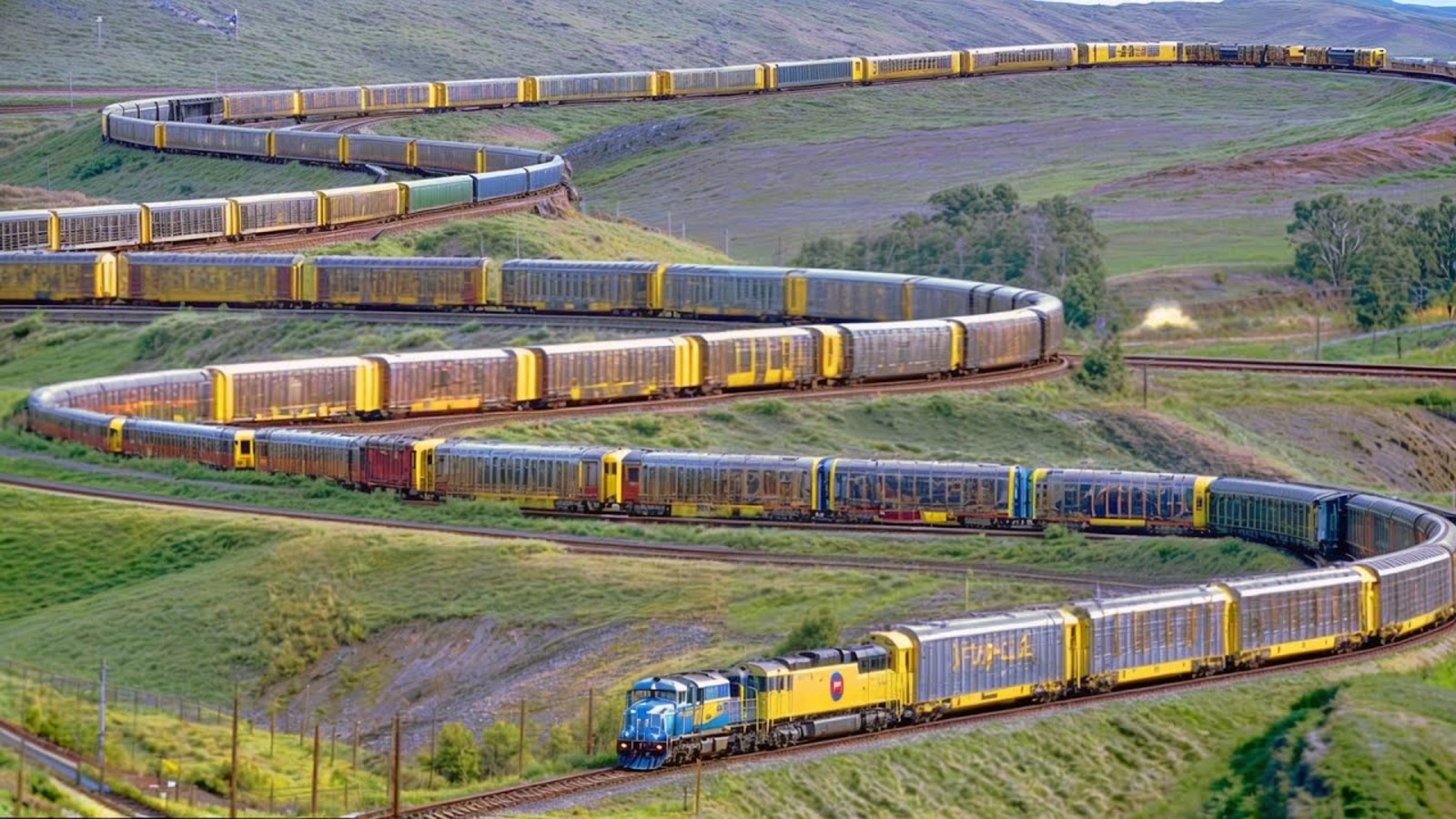

With 7.3 Km In Length And 682 Cars, The BHP Train Marked World Railway Engineering And Entered The Guinness In 2001
Trains always impress with their grandeur. Their extensive compositions give a sense of power and strength. However, a specific model surpassed all limits and entered world history. In 2001, the Australian mining company BHP put into operation a train that was 7.3 kilometers long, the longest ever recorded by the Guinness. For comparison, the train is much longer than Copacabana beach, which has a length of 4.15 km from end to end.
This giant of transportation consisted of 682 cars loaded with iron ore. To move such a structure, the company needed eight locomotives.
The feat gained worldwide attention and marked an important technological advance in the railway sector.
-
At 17, she hand-painted her first watercolor design for school uniforms; her brand grew without investors, sold 135,000 pieces, and aims for $3 million in revenue by 2026.

-
Shell Discovers Intact Early 19th-Century Wooden Shipwreck in the Gulf of Mexico at Over 1,300 Meters Deep
-
Brazilian Entrepreneur Turns Door-to-Door Jewelry Sales into a Family Business Empire with Over 70 Stores

-
$75 Million Bridge in Brazil Opens to Connect Cities, Create Jobs, and Cut Travel Time from 30 to 2 Minutes; Spanning 1.24 km, It’s Among the Country’s Largest and Ends Decades of Ferry Queues.





A Technological Experience
The BHP 3143 was developed as a test. The company, which in 2013 became the largest mining company in the world by revenue, invested in an innovation called Locotrol 3.
This system allowed for controlling locomotives distributed throughout the composition, making it feasible to operate such an extensive train.
With the technology, BHP was able to integrate eight locomotives in a coordinated manner. When loaded, the colossus reached 99 thousand tons.
The most important thing is that, even with the absurd weight, the controls remained stable and functioned as expected.
The Man Behind The Machine
To lead this challenge, BHP appointed Tom Forest, a veteran engineer with over 20 years of experience on the company’s railway. He was responsible for operating all eight locomotives by himself.
The defined route connected Newman to the port of Hedland, in southwestern Australia. The journey took 5 hours and 40 minutes.
However, a failure in the transmission interrupted the operation before completion. Despite this, the result was considered satisfactory because the main objective was to test the new technology.
In addition to the world record, the experiment served to assess safety measures and confirm the locomotives’ power.
Lessons Learned And Impact
Each of the eight locomotives had 6 thousand horsepower. Engineers were also able to verify the accuracy of the computer models that had simulated the performance of the composition. Therefore, the test provided valuable data for the future of mining and heavy transport.
The most important thing is that the train showed it would be possible to further increase BHP’s logistical capacity. Even dismantled after the experiment, the 3143 left lasting lessons.
A Milestone In Railway Engineering
The record of 7.3 kilometers still impresses with its boldness. The train was not only an achievement to feature in the Guinness but also a practical example of engineering strength.
With its grandeur, BHP’s composition became a symbol of innovation and forward-thinking. It represented a company’s ability to challenge limits and turn theory into reality.
Thus, the BHP 3143 entered history as the longest train ever built. An accomplishment that combined technology, human experience, and the power of Australian railways.
With information from Dário do Litoral.