






 Portuguese
  Spanish


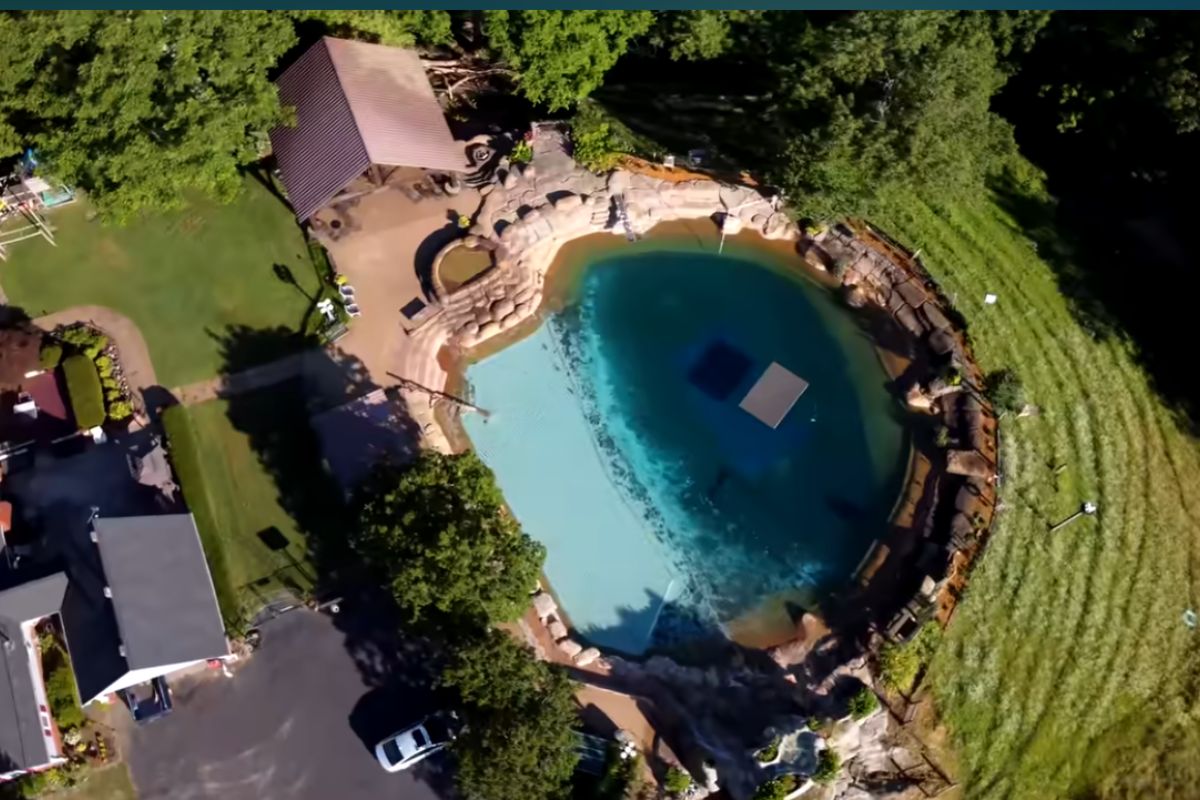
The Absurd 500,000-Gallon Pool Became A Decades-Long Project In The Backyard: 29 Years Between Plastic Liners, Rubber, And Shotcrete, Until It Reached 1.9 Million Liters, With A Waterfall, Rope Swing, And Its Own Filtration System, In Addition To 18 Loads Of Sand In The Shallow Area.
When Micky describes the absurd 500,000-gallon pool in his own backyard, the detail that stands out the most is not just the volume of 1.9 million liters, but the scale of persistence. He says he spent 29 years adjusting the structure, landscaping, and a filtration system designed to work his way.
The project, according to him, started as a hobby while running a furniture store and carrying an old obsession with swimming and diving deeply with plenty of space, refusing to accept the aesthetics of a flat concrete slab. This is why the waterfall and the rope swing are included as stage elements, not just decoration.
29 Years Of Construction And Three Different “Layers” Until The Concrete

The chronology of the backyard looks like an outdoor laboratory. Micky claims he started digging on Labor Day in 1993, still at 39 years old, and that the first version relied on a very heavy agricultural plastic liner, weighing about 3,000 pounds, stretched with the help of neighbors.
-
How Many Outlets Should Each Room Have? Guidelines Suggest 6 to 10 in the Kitchen, One Every 3.5 Meters in Living Rooms, and Specific Recommendations for Bedrooms, Bathrooms, Laundry Rooms, and Outdoor Areas

-
Family Turns Homemade Cheese Bread Recipe into a $17 Million Frozen Foods Business with 200 Tons Monthly Production and Over 1,400 Clients

-
Ancient 4,000-Year-Old City in Brazil Grew Wealthier and Reduced Inequality, Study Finds
-
Lost Page from Archimedes Palimpsest Resurfaces in French Museum After Decades, May Reveal Hidden Mathematical Calculations with X-ray and Multispectral Imaging




This plastic would have lasted approximately five years before being replaced by a rubber coating.
The second “layer” lasted for 14 years, and it was during this time that the waterfall took shape and that much of the rock began to sit above the waterline, consolidating the appearance of an artificial lake.
When the rubber gave way, the most definitive stage came: shotcrete, which he describes as the solution that has been there for about 10 years without problems.
At this point, the “do what you can” turns into maintenance engineering, as each replacement changes the weight, sealing, and how the filtration system needs to work.
Dimensions, Sand, And The Decision To Escape The “Pool Standard”

To understand why he calls it the absurd 500,000-gallon pool, Micky uses a simple reference: about 95 feet in both directions at the widest point.
It is not a catalog measure; it is a backyard measure, designed to fit the lot and allow areas with different functions.
The shallow part is treated like an internal beach. He talks about 18 loads of sand and says that the water level there is enough to walk without “bumping the bottom” uncomfortably, creating a space where children and adults can stand before advancing to the deep section.
The very separation between shallow and deep was designed with aesthetics in mind, not just safety.
Instead of ropes marking the zones, he says he sought a natural setting, with plants chosen by his wife and elements that resemble a stream.
The waterfall becomes the central point: you can sit behind it, look through it, and let the water fall over your body.
Waterfall, Rope Swing, And The Logic Of Old-School Entertainment

The waterfall does not appear as a final decoration but as part of the idea of the place’s personality.
Micky suggests that he wanted rocks, waterfalls, and currents, avoiding the feeling of a “technical rectangle,” and this explains why the waterfall is seen as a functional resource, not just for photos.
The rope swing follows the same logic.
Since he didn’t have a large tree, he decided to install a telephone pole, anchored with about 3 meters of concrete, and says that the structure has been in the same spot for 22 years.
In his accounting, the rope swing is more useful than a diving board because it serves both as a play feature and for entering the water with momentum.
This set of choices creates a type of leisure that recalls an interior backyard: rope, rocks, water, mud, and the sound of splashes.
It is a deliberate contrast with clubs and standardized pools, helping to explain why the project took so long to “close” in the owner’s mind.
Water To Fill, Chlorine To Maintain, And An Invoice That Never Closes
The scale comes at a price that does not show up in the photo.
To fill 1.9 million liters, he says he dug a well because he knew he would consume more water than he wanted to buy from the utility company. The well, according to him, produces about 7 to 8 gallons per minute.
With this flow, the filling math becomes a routine of months.
He claims that, because it is an absurd 500,000-gallon pool, it takes about three months with the system running 24 hours a day, seven days a week, to go from empty to full level, and this has happened three times over the years.
For maintenance, the constant cost pointed out as the heaviest is chlorine, and the weekly scale becomes a sort of toll for the dream.
Micky talks about something like 100 pounds of tablets per week, with consumption equivalent to a barrel every two weeks, in addition to an electricity bill of around US$ 200 per month throughout the year.
The total cost, he admits, is a sum he cannot close because it has been diluted over 29 years.
Sand Filtration System, Gravity, And An Idea That “Wouldn’t Work”
The technical heart of the backyard is the filtration system.
He says he designed and built everything, from pumping to waterfalls, and that his solution deviated from the standard that pool builders usually sell, with larger motors and heavier pumps.
The bet was on a slow filtration system, using sand and gravity.
The structure he describes seems like an underground filter on a civil work scale: a pit under the bottom with 6 feet of depth, 16 feet wide, and 32 feet long.
Inside, there would be 459 feet of well filter media, a PVC pipe with slits that lets water pass while holding the sand.
On top of this, he mentions about 1.5 meters of sand, plus approximately 30 centimeters of space, with panels covering it so no one messes with the material.
The water would be pushed by gravity, very slowly, passing through the sand and leaving “really clean,” until it is pulled by the pump and returned just below the surface.
Before testing, he reports that he consulted three builders who told him the idea wouldn’t work, and that helped transform the filtration system into a personal thesis.
The practical test, in his version, is almost a signature of the project: turn it on and let it run until the water appears. Thirty years later, he says the filtration system is still functioning.
The Backyard As A Meeting Point And The Question Of What Remains Afterwards
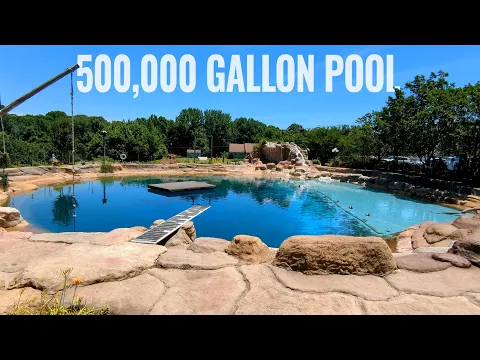

The absurd 500,000-gallon pool was not designed for an event, but it ended up becoming one.
Micky shares that his children grew up swimming there, his grandchildren make dives, and he has hosted friends, family, and even groups like sports teams and scout troops.
There’s also an element of “inheritance” that he discusses with dry humor. When asked what happens to the pool after he’s gone, he says the only certainty is that it won’t be his problem.
It’s an answer that aligns with the project: too big to be simple, too personal to be just property.
In the end, the project poses a practical question about the limits of DIY.
The absurd 500,000-gallon pool depends on a giant filtration system, weekly-scale chlorine, and infrastructure that requires vigilance.
The reward is a backyard that has become a landscape, with a waterfall and rope swing as its signature.
The story of the absurd 500,000-gallon pool is less about luxury and more about method: layering, measuring the space, accepting slow filling, and insisting until the filtration system becomes predictable.
On paper, it is 1.9 million liters; in practice, it is discipline, maintenance, and patience.
If you lived in a space with room, would you take on a project this size? What scares you the most: the ongoing cost of chlorine, the dependency on the filtration system, or the responsibility of keeping the waterfall and rope swing safe for children and guests?




-

-

-

-

-

-

154 people reacted to this.