






 Portuguese
  Spanish


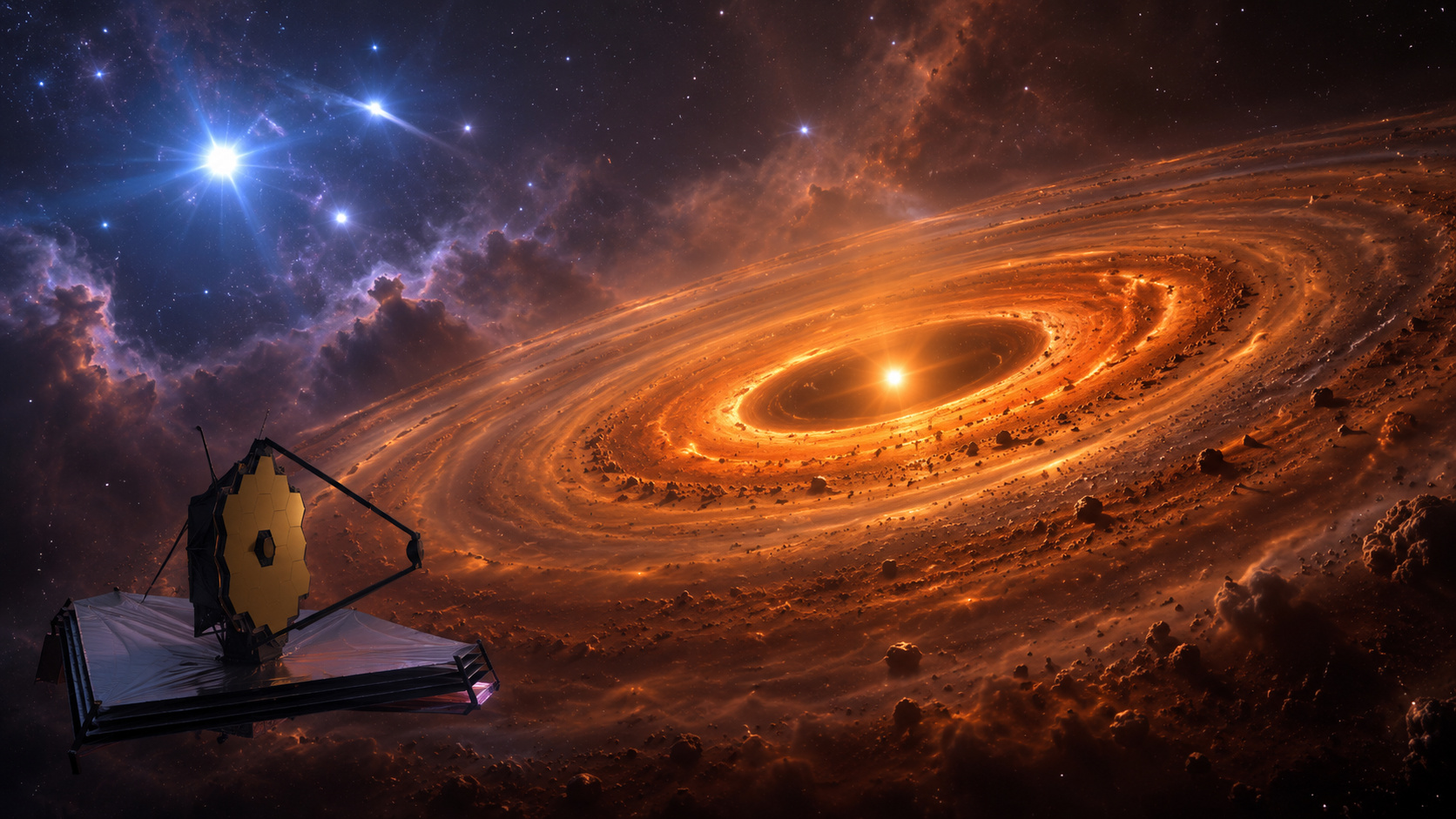
Study with James Webb reveals protoplanetary disk rich in CO₂ and almost without water around star XUE 10, challenging planetary formation models.
According to Stockholm University, a study led by Jenny Frediani, a PhD student from the Department of Astronomy at the institution, published on August 29, 2025 in the journal Astronomy & Astrophysics, revealed that the protoplanetary disk around the young star XUE 10 has a radically different chemical composition than predicted by planetary formation models. Using the MIRI instrument of the James Webb Telescope, the team detected four distinct forms of carbon dioxide in the inner region of the disk, precisely where rocky planets like Earth form.
The most surprising data is that water, which dominates this region in most other disks studied, is almost absent. The star XUE 10 is about 5,550 light-years from Earth, in the star-forming region NGC 6357, known as the Lobster Nebula, an environment marked by intense ultraviolet radiation emitted by neighboring massive stars. For the authors, the discovery is not just a chemical curiosity, but a direct challenge to the standard theory of how rocky planets form.
Protoplanetary disk of XUE 10 challenges what astronomy expected to find
To understand why the near absence of water in the disk of XUE 10 is so important, it is necessary to remember what astronomers expected to see. A protoplanetary disk is the cloud of gas and dust that forms around a young star and later gives rise to planets, asteroids, and other solid bodies.
-
In Somaliland’s Desert, Greenhouse Uses Sun and Seawater to Grow Lettuce, Cucumbers, and Tomatoes Without Rain: 1-Hectare Project Cools Crops, Desalinates Water, and Converts Brine into Commercial Salt

-
Trump Unveils $400 Million Boeing 747 Donated by Qatar as Temporary Air Force One Amid Boeing Delays, Sparking Debate on National Security, Costs, and Foreign Influence
-
Chinese Company Unveils Robotic Toilet That Comes to You, Featuring Lidar Sensors, Voice Command, Bidet, Hot Air Drying, UV Light, and Self-Cleaning Waste Disposal
-
Rotterdam Develops Floodable Square to Absorb Nearly 2 Million Liters of Rainwater, Doubling as Sports, Theater, and Leisure Space When Dry to Combat Urban Flooding





These disks usually have a chemical organization defined by temperature. Closer to the star are minerals and silicates that form rocks and metals. Further away, ices such as water, CO₂, and carbon monoxide accumulate.
In the inner region, hot enough for the ice to sublimate, the pattern observed in the disks studied before XUE 10 was clear: water vapor dominating the local chemistry.
It was precisely for this reason that the result from James Webb drew so much attention. When the chemical spectrum of the inner region of the disk was obtained, the opposite of what was expected emerged: strong CO₂ and almost absent water. The contrast was so great with previous models that the discovery required detailed analysis before being published.
James Webb detected four forms of CO₂ in the protoplanetary disk of XUE 10
The most technical result of the study is not just the abundance of carbon dioxide, but the fact that the JWST detected four distinct forms of CO₂ at the same time. Among them are common CO₂ and three rare isotopic variants, something that had never been observed before in protoplanetary disks.
The identified forms include CO₂ with carbon 12, as well as versions with carbon 13, oxygen 17, and oxygen 18. These variants are much less abundant than the common form, which means that the chemical signal in the XUE 10 disk is so strong that even the rare isotopes appeared clearly in the spectrum recorded by the telescope.
This matters because isotopic ratios work like a kind of chemical fingerprint.
They record the conditions in which the CO₂ was formed and altered over time. According to the team, these signatures may even help explain anomalous isotopic compositions found in meteorites and comets of the primitive Solar System.
Intense ultraviolet radiation may explain lack of water and excess CO₂
The main hypothesis raised by researchers to explain the observed pattern involves the intense ultraviolet radiation from the region where the star formed.
The NGC 6357 is not a calm stellar nursery. It is one of the most massive and violent star-forming regions in the galaxy, dominated by hot stars of types O and B, which emit large amounts of UV radiation.

This radiation can penetrate the protoplanetary disks and alter their chemistry from the outside in. In the case of XUE 10, the authors suggest that water and CO₂ respond differently to radiation. Water is more easily broken down by UV photons, while carbon dioxide can better resist and even form from the products of this breakdown.
The end result would be exactly what the disk shows: depletion of water and enrichment of CO₂ in the planetary formation zone. In other words, the environment around the star may be rewriting the chemistry of the material even before the planets exist.
Discovery of XUE 10 changes debate on rocky planet formation in the galaxy
The broader consequence of the study goes beyond XUE 10. Most previous studies of protoplanetary disks analyzed stars near the Sun, in relatively calm regions with low ultraviolet radiation.

These environments reinforced the idea that Earth’s chemistry, rich in water, might be relatively common in rocky planets.
The problem is that a large portion of stars are not born in calm regions. The study led by Jenny Frediani states that between 50% and 90% of all stars form in dense environments, close to massive stars and under strong UV radiation, much more similar to NGC 6357 than to the solar neighborhood.
If these environments systematically produce disks rich in CO₂ and poor in water, then many rocky planets in the universe may have formed under chemical conditions very different from those on Earth.
This changes the debate on habitability, atmospheric composition, and planetary diversity. The study suggests that Earth may not represent the dominant pattern of planetary chemistry in the cosmos, but perhaps a more particular case than astronomy imagined.
Upcoming studies with James Webb will show if XUE 10 is an exception or the norm
The discovery is part of a larger program by the XUE collaboration, which is using the JWST to systematically map various protoplanetary disks in NGC 6357.
The goal is to build a chemical catalog that allows for the comparison of stars of different masses under different levels of radiation.

The XUE 10 is a star of the Herbig type, more massive and luminous than the Sun, which may influence the chemistry of the disk. Therefore, the team still needs to verify if the pattern of high CO₂ and low water appears in other disks in the same region or if it is specifically linked to the stellar type of XUE 10.
The upcoming results will answer a central question. Is the disk of XUE 10 an isolated anomaly or the first evidence that many planetary nurseries in the universe do not have the chemistry that produced Earth? If the second hypothesis is confirmed, the discovery by James Webb may force astronomy to revise a fundamental part of the planetary formation theory.





Be the first to react!