





 Portuguese
  English
  Spanish
  5 min of reading
  0 comments


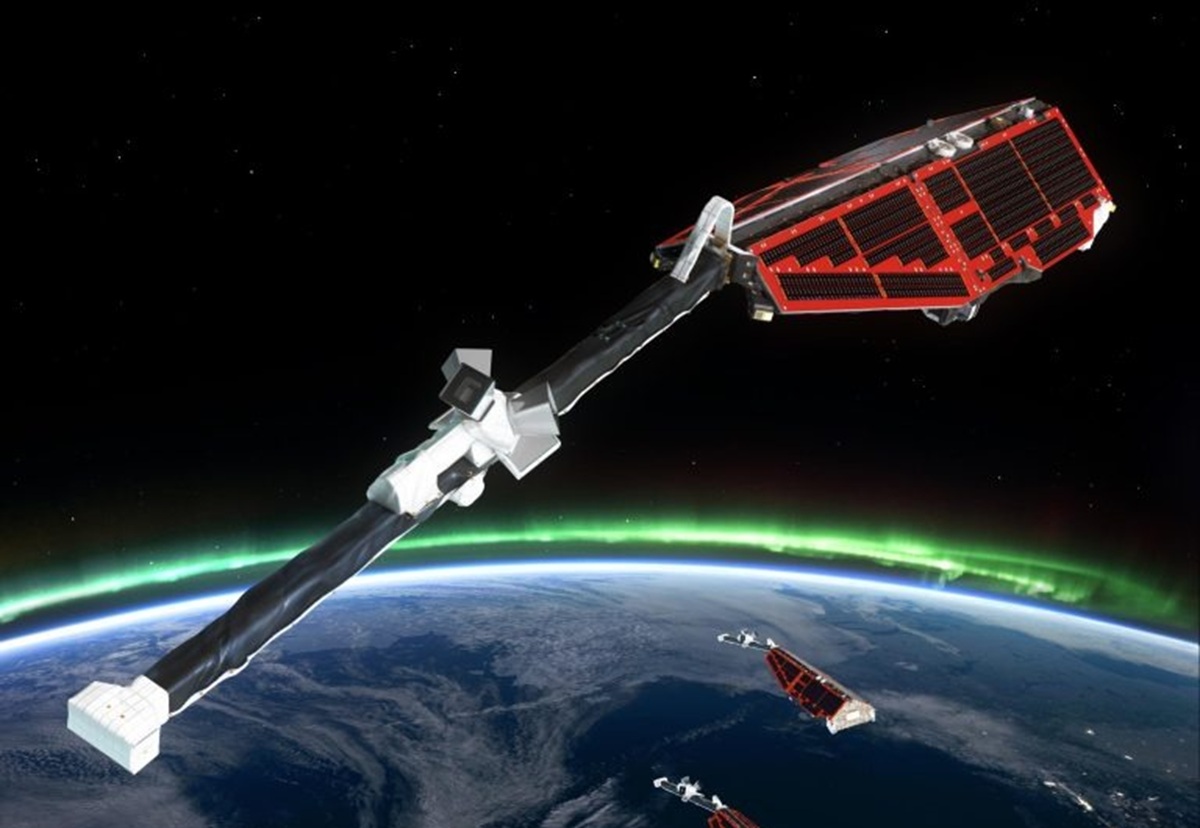
Based on 11 years of continuous measurements from the Swarm mission of the European Space Agency, scientists have identified that the South Atlantic Anomaly has expanded persistently since 2014, reaching an area approaching half of continental Europe and indicating rapid and irregular changes in the Earth’s magnetic field, with direct impacts on satellites, navigation, and space security.
Data from 11 years of the Swarm mission indicate that the South Atlantic Anomaly has expanded since 2014 to reach an area close to half of Europe, evidencing rapid and irregular changes in the Earth’s magnetic field with direct implications for satellites and navigation.
Rapid Changes in the Earth’s Magnetic Field Observed by Satellite
Long-term measurements reveal that the Earth’s magnetic field is changing faster and more irregularly than expected. The data indicate dynamic processes in depth, in the planet’s core, as the main drivers of these variations observed globally.
The South Atlantic Anomaly appears as an extensive zone of low magnetic intensity located over the South Atlantic. This region stands out for showing persistent weakening of the field, now documented with greater precision by continuous observations from space.
-
China surrounds the country’s largest desert with a gigantic green belt of 3,046 km, transforming the “sea of death” into an “ecological scarf” and uses vegetation, straw, and solar energy to hold back the sand, protect oases, save cities, and create billion-dollar income for families in the desert.

-
The “freshwater lid” that worries scientists: Greenland melts, could weaken Atlantic currents and is already being monitored by robots, satellites, and artificial intelligence before altering the climate in the coming decades.
-
Scientists in Saudi Arabia create an “electricity-free refrigerator” that uses a chemical reaction to lower the temperature from 25°C to 3.6°C in 20 minutes and then uses the sun itself to restart the system without a compressor, outlet, or generator.
-
MIT study creates method to search for dark matter in gravitational waves and finds possible evidence in black hole signal




The Earth’s magnetic field is essential for sustaining life by protecting the planet from cosmic radiation and charged particles emitted by the Sun. Changes in its intensity and distribution have direct effects on technological systems and space operations.
Deep Origin of the Earth’s Electromagnetic Field
The Earth’s electromagnetic field is generated in the outer core, a layer of molten iron in motion located about 3000 km below the surface. The circulation of this liquid metal produces electric currents that give rise to the global magnetic field.
Although often compared to a simple magnet, the magnetic field results from much more complex processes. Interactions between the core, the mantle, the crust, the oceans, and the upper layers of the atmosphere contribute to its variable structure in time and space.
These internal dynamics explain why certain regions show weakening of the field, while others register intensification. Current observations allow for better distinction of these different sources of magnetism and their regional effects.
The South Atlantic Anomaly and Its Continuous Expansion
First recognized in the 19th century southeast of South America, the South Atlantic Anomaly is an area where the Earth’s magnetic field is exceptionally weak. Since then, its evolution has been monitored with increasingly detailed measurements.
Data from the Swarm mission show that this anomaly has expanded consistently between 2014 and 2025. Currently, its area corresponds to almost half of continental Europe, evidencing a significant change in just over a decade.
Since 2020, the weakening of the magnetic field has become even faster in a region of the Atlantic Ocean southwest of Africa. This asymmetric behavior indicates that the anomaly does not evolve uniformly across its extent.
According to lead researcher Chris Finlay, professor of Geomagnetism at the Technical University of Denmark, the anomaly shows distinct dynamics towards Africa and South America, suggesting specific processes acting in that region of the planet.
Direct Impacts on Space Security
The South Atlantic Anomaly is considered especially critical for space security. Satellites crossing this area are exposed to higher levels of radiation, increasing the risk of malfunction and damage to sensitive components.
This exposure can cause temporary failures, data loss, and even momentary shutdowns of onboard systems. For this reason, the region is closely monitored by space agencies and low Earth orbit satellite operators.
The latest results were published in the journal Physics of the Earth and Planetary Interiors and reinforce the need to understand the evolution of this anomaly to mitigate risks associated with space weather and the operation of orbital infrastructure.
Reverse Flow Spots at the Core Boundary
The observed behavior is associated with unusual patterns in the magnetic field at the boundary between the liquid outer core and the Earth’s rocky mantle. These patterns are known as reverse flow spots.
In these areas, the lines of the magnetic field, instead of emerging from the core in the southern hemisphere, return to its interior.
One of these spots has been observed moving westward over Africa, contributing to the regional weakening of the anomaly.
Thanks to Swarm data, scientists can track the movement of these deep structures and relate them directly to changes observed at the surface and in the space near the Earth.
The 11 Years of Continuous Observations from the Swarm Mission
The latest model of the magnetic field generated by the core marks a new milestone for the Swarm satellites, which now provide the longest continuous record of magnetic measurements from space.
The mission was launched on November 22, 2013, as the fourth Earth Explorer of the European Space Agency’s FutureEO program.
It consists of three identical satellites operating together for high-precision measurements.
Originally conceived as a demonstrator of innovative technologies, the mission has exceeded its planned lifespan. The satellites have become an essential part of long-term records used in operational services and scientific research.
Intensification of the Magnetic Field Over Siberia
Swarm data also reveal that the Earth’s magnetic field is not weakening uniformly. In the Southern Hemisphere, there is a particularly strong field point, while in the Northern Hemisphere, there are two, near Canada and Siberia.
Since the Swarm entered orbit, the magnetic field has intensified over Siberia and weakened over Canada.
The Canadian area has decreased by 0.65% of the Earth’s surface, nearly the size of India.
In contrast, the Siberian region has grown by 0.42% of the Earth’s surface, a value comparable to the size of Greenland.
These changes reflect complex processes in the turbulent core of the planet.
Movement of the Magnetic Pole and Effects on Navigation
The observed changes are associated with the movement of the north magnetic pole towards Siberia in recent years. This movement influences navigation systems that rely on updated global magnetic models.
The interaction between strong field areas in Canada and Siberia directly affects the accuracy of compasses and orientation systems, making continuous monitoring essential for civil and scientific applications.
According to Finlay, only with satellites like Swarm is it possible to fully map this complex structure and track its changes over time, going beyond the simplified view of a magnetic dipole.
Future Prospects of the Swarm Mission
The Swarm mission manager at ESA, Anja Stromme, highlighted the importance of the extensive time series of data to understand the dynamics of the Earth as an integrated system, from the core to the outer layers of the atmosphere.
The satellites remain in perfect operational condition and continue to provide high-quality data. The expectation is to extend the record beyond 2030, taking advantage of the solar minimum period.
This extension will allow for unprecedented information about the Earth’s magnetic field, its regional variations, and its technological impacts, reinforcing the central role of the Anom








Be the first to react!