






 Portuguese
  Spanish
  4 min of reading
  3 comments


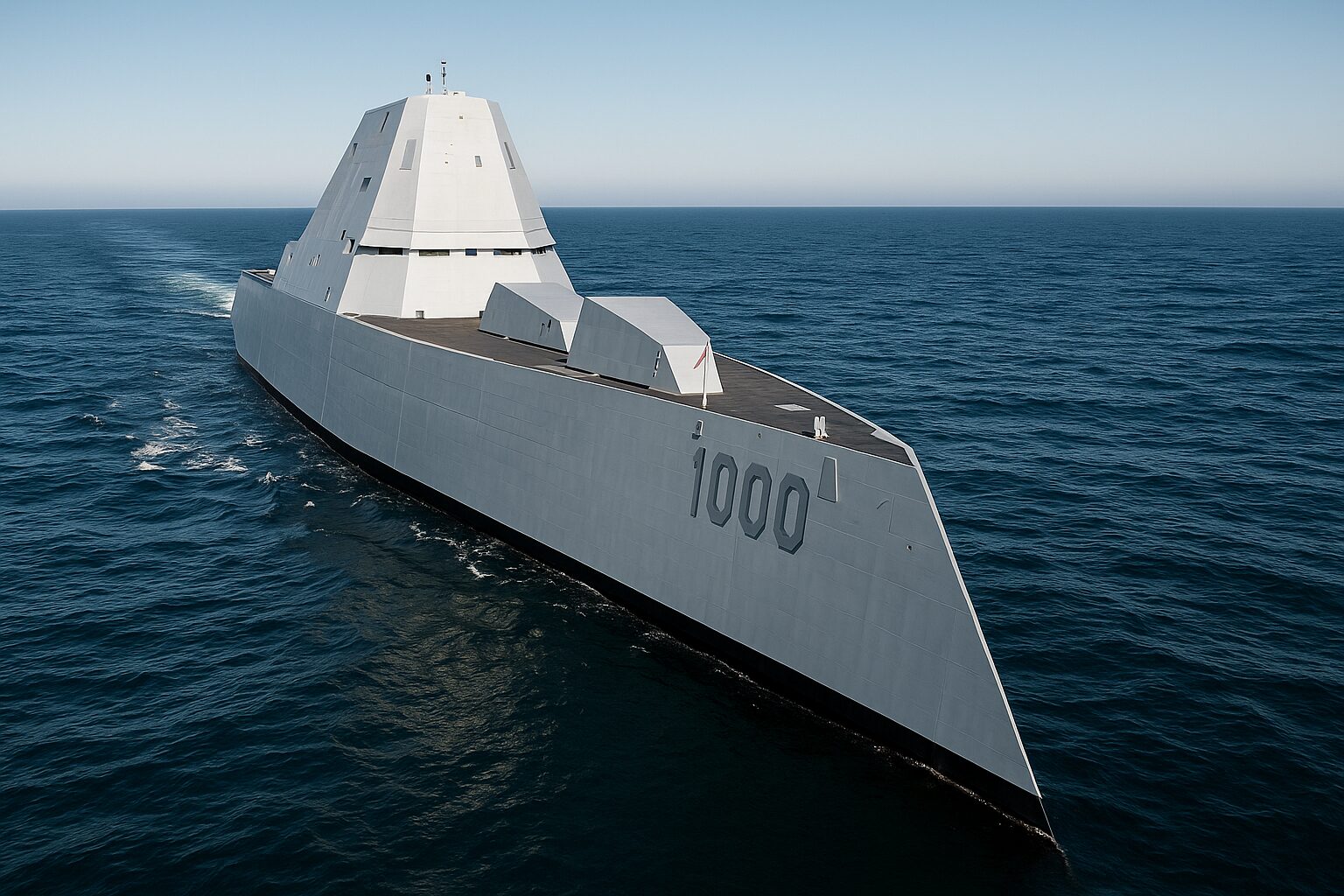


The USS Zumwalt (DDG-1000) Impresses with Stealth Technology, Angular Design, and Advanced Armaments, Being Considered the Most Futuristic and Invisible Warship Ever Built by the U.S. Navy.
The USS Zumwalt (DDG-1000) is the most futuristic destroyer ever launched by the United States Navy. With its angular design and state-of-the-art stealth technology, the ship gained fame as the “invisible ship” for being nearly undetectable by radar. Despite being 190 meters long and displacing about 15,000 tons, it may appear, on enemy radars, as small as a fishing boat.
Designed to operate discreetly in hostile environments, the Zumwalt is considered the most technologically advanced warship ever built, combining firepower, automation, and one of the most unique structures in modern naval engineering.
The “Invisible Ship” of the U.S.: A Project That Changed Navy Standards
The USS Zumwalt program was initiated in the late 1990s, with the proposal to create a new class of multifunctional destroyers. The idea was for them to be capable of operating close to shore (littoral operations) with a low radar signature, executing land attack missions and supporting naval and ground forces.
-
North Korean Fiasco: Launch of the Largest Warship Ends in Sinking

-
While giant ships still burn heavy fuel and the maritime sector races against climate targets, Maersk and Vale are starting to bet on ethanol as a new route to reduce emissions at sea.

-
China begins construction of the world’s largest LNG ship, a 344-meter giant capable of supplying 4.7 million homes for a month, carrying 271,000 m³ of gas, and placing QatarEnergy in the largest naval order ever recorded in world history.
-
China is designing a container ship with a thorium nuclear reactor that will operate for 40 years without refueling, and the 25,000-container giant from Jiangnan Shipyard will cross oceans without emitting carbon in an industry that burns 300 million tons of fuel per year.



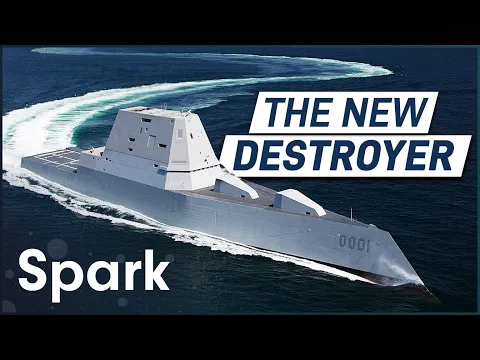

Commissioned in 2016, the Zumwalt is the first of three ships of the DDG-1000 class, with construction costing approximately US$ 4.4 billion per unit. The investment raised the standard of onboard technology and drove new ways of conceiving warships.
Stealth Design: The Ship That Nearly Doesn’t Appear
The most remarkable feature of the USS Zumwalt is its design. The ship adopts a structure known as “tumblehome hull,” with sloped sides that significantly reduce its radar signature. Flat and angled surfaces scatter radar waves in unpredictable directions, making detection difficult.
This approach ensures that the invisible ship has the smallest radar profile ever recorded for vessels of its size. In practice, this allows the Zumwalt to approach sensitive areas without being identified by conventional sensors, increasing effectiveness in stealth missions.
Integrated Electric Propulsion and Automation
Another significant advancement is in propulsion. The Zumwalt uses an integrated electric propulsion (IEP) system, powered by Rolls-Royce turbines that generate energy for the entire ship — including motors, sensors, and weapon systems. This allows for efficient energy distribution and prepares the ship for next-generation armaments like electromagnetic guns and lasers.
Automation is also a highlight: while traditional destroyers in the U.S. Navy require crews of around 300 people, the Zumwalt operates with only 130 crew members, thanks to automated navigation, damage control, and equipment monitoring systems.
Armaments and Strategic Reconfiguration of the “Invisible Ship”
Originally, the USS Zumwalt was equipped with two Advanced Gun Systems (AGS), designed to launch long-range projectiles. However, the cancellation of the development of these munitions led to a reassessment of the project. The Navy decided to redirect the ship’s use for surface warfare missions.
Currently, the Zumwalt is undergoing an upgrade that will make it the first ship in the U.S. fleet to receive hypersonic missiles, weaponry capable of reaching speeds exceeding Mach 5, making it even more lethal and difficult to intercept.
Additionally, the destroyer is equipped with over 80 vertical launch system (VLS) cells, capable of firing Tomahawk land attack missiles, anti-aircraft missiles, and anti-submarine torpedoes.
Comparison with Other Stealth Ships
The Zumwalt is not the only ship with stealth characteristics. On a smaller scale, vessels such as the Visby Class corvettes (Sweden), La Fayette Class frigates (France), and Type 055 Class destroyers (China) also utilize shapes and materials that reduce their detectability.
However, no other warship combines as much stealth technology, electric propulsion, and integration capability with advanced weapons as the Zumwalt. It is an operational prototype of the future of naval warfare.
Challenges and Criticism of the Project
Despite its innovations, the Zumwalt has faced criticism throughout its development. The high cost and cancellation of part of the original armament led to a reduction in the number of units ordered — from 32 ships initially planned to just 3.
Experts also point out that the ship still needs to prove its effectiveness in real combat scenarios. The current adaptations, such as the installation of hypersonic missiles, aim to expand its strategic utility and justify the billion-dollar investment.
The Future of Stealth at Sea
The USS Zumwalt represents the starting point for a new generation of war vessels, where the U.S. Navy bets on invisibility, automation, and weapons of extreme range and precision.
As technologies such as artificial intelligence, alternative propulsion, and directed energy weapons advance, the Zumwalt remains the most advanced floating laboratory of the Navy — and a symbol of how warships of the future will be built.








Na atual guerra dos drones, é apenas mais um alvo.
Acho interresante a guerra de narrativas os EUA dizem serem quase invisível a China diz desenvolver radares que vão detctar. mais ela própria gasta construindo equipamentos que se diz tambem quase invisiveis. Durmam com um barulho deste kkkkkkkkk
A dita furtividade é um mito que só se sustenta na ideia de que inimigo não vai evoluir na tecnologia de detecção, o que é virtualmente um erro crasso.
Uma vez detectado é só mais um navio.