






 Portuguese
  Spanish


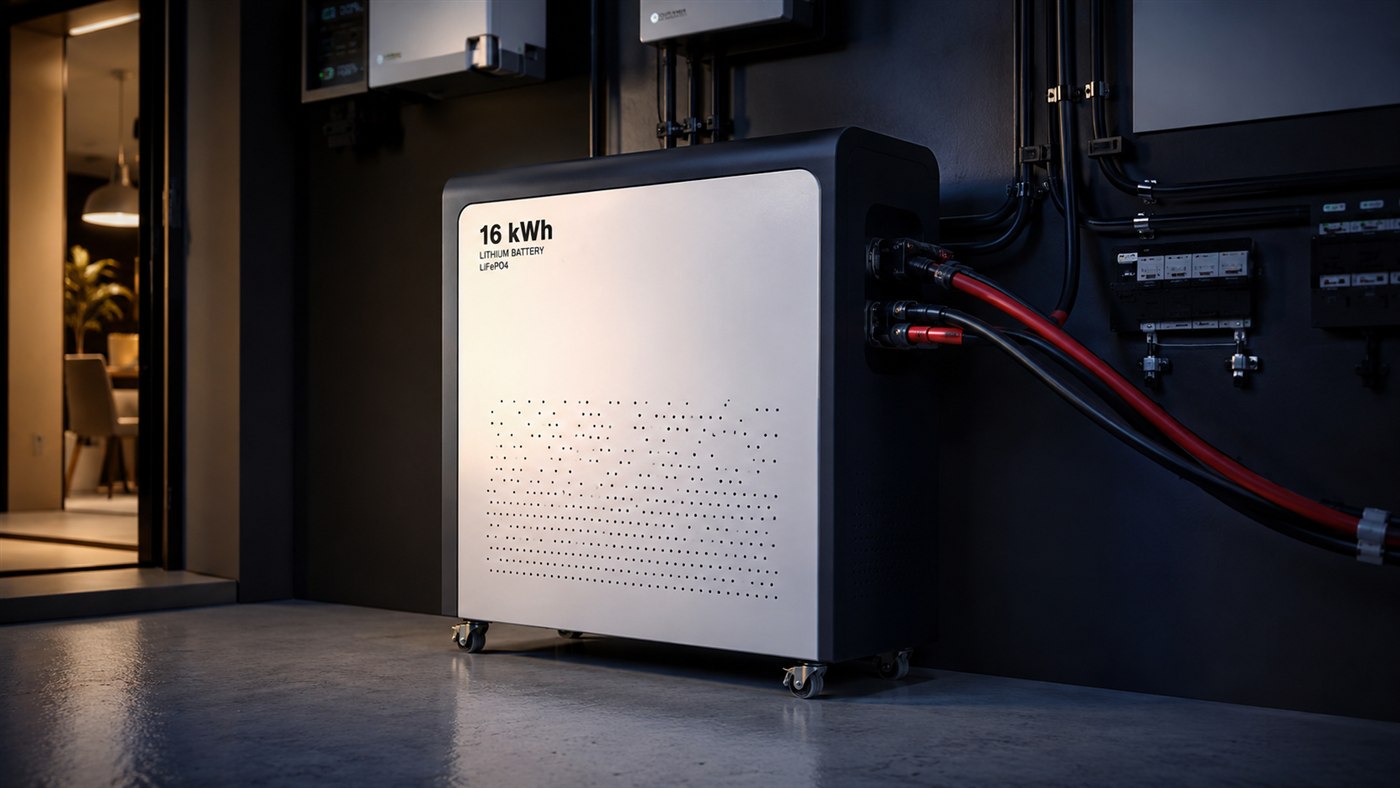

Powering the entire house without relying on the utility company has become the promise of a single 150-kilogram steel box. According to the channel Luciano Batista, in a review published in June 2026, the Kingbo solar battery model MB48314, with LiFePO4 technology, delivers 16 kWh of storage in an off-grid system, enough to power an entire home disconnected from the electrical grid.
The product’s numbers explain the ambition. The solar battery has a voltage of 51.2 volts and a capacity of 314 ampere-hours, resulting in 16 kWh, and the BMS supports a discharge of up to 200 A, which means drawing about 10,000 watts almost instantaneously, as detailed by Luciano Batista. With this reserve, the house can maintain air conditioning, microwave, and even an electric shower, which usually requires a maximum of 5,500 watts.
What is the LiFePO4 solar battery and why it lasts so long
The acronym on the label is the secret to longevity. According to Luciano Batista, the Kingbo MB48314 uses LiFePO4 chemistry (lithium iron phosphate), the standard that dominates residential storage systems by combining energy density and long lifespan, in a package presented in the video as a set of 16-cell batteries in series, the 16s configuration.
-
Drones Can Now Detect Underwater Mines Hidden by Sand and Algae Using Aerial Images, Special Light, and AI

-
Helicopters Drop “Green Rain” of Seeds Over Remote U.S. Forests to Reforest 19 Hard-to-Reach Areas in Minnesota, Reviving Pine Trees Where Ground Teams Struggle to Access

-
Brazilian Man Builds Homemade Welding Machine Using Parts from Old Microwaves, Achieving Over 100 Amperes

-
Canada Sinks Six Giant Balloons in Lake Ontario to Test Underwater Battery That Stores Compressed Air 60 Meters Deep



The impressive data is the durability. The battery is specified for 8,000 cycles or more at 25 degrees, equivalent to 22 years of use or more in a home, as recorded by the Luciano Batista channel on YouTube. It’s a time scale that changes the investment calculation: instead of replacing battery banks every few years, as was the case with the old lead-acid technology, the user plans the equipment to last longer than the mortgage on the house itself.
314 Ah and 16 kWh: the standard that powers the whole house
The capacity is the heart of the off-grid system. According to Luciano Batista, the 314 Ah capacity translates to 16,076.8 Wh, that is, the 16 kWh that the review repeats as a key number, with a nominal voltage of 51.2 volts and an operating range of 43.2 to 56 volts.
Peak power is what allows heavy appliances. The recommended standard charge and discharge is 94.2 A, but the maximum reaches 200 A, and it is this margin that delivers about 10,000 watts capable of supporting a shower and air conditioning at the same time, as Luciano Batista explains. The front screen, described as large and easy to read, shows in real-time the state of charge, voltage, current, and protections, as well as the individual voltage of each of the 16 cells.
Up to 15 batteries in parallel: 241 kWh on a wall
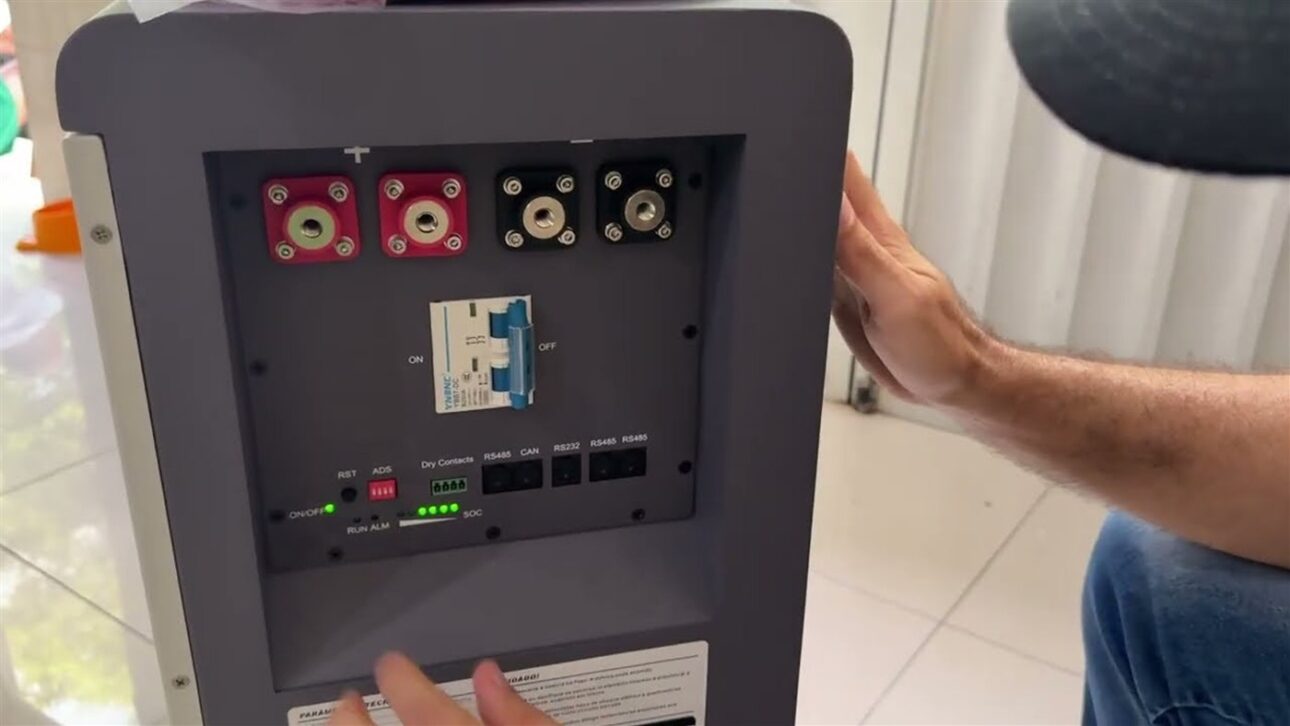
The architecture thinks big from the factory. According to Luciano Batista, the MB48314 accepts connection of up to 15 units in parallel, using the two positive and two negative connectors of each battery, a setup that multiplies autonomy without changing equipment.
The final count leaves the kilowatt range and enters the small megawatts. Fifteen 314 Ah batteries add up to 4,710 Ah, equivalent to 241.2 kWh of storage, as Luciano Batista calculates in the review. It’s more than enough reserve for a rural property, a small business, or a large house that wants to get through cloudy days without activating a generator, a scenario increasingly common in the interior of Brazil.
150 kg and wheels: the logistics of the energy box
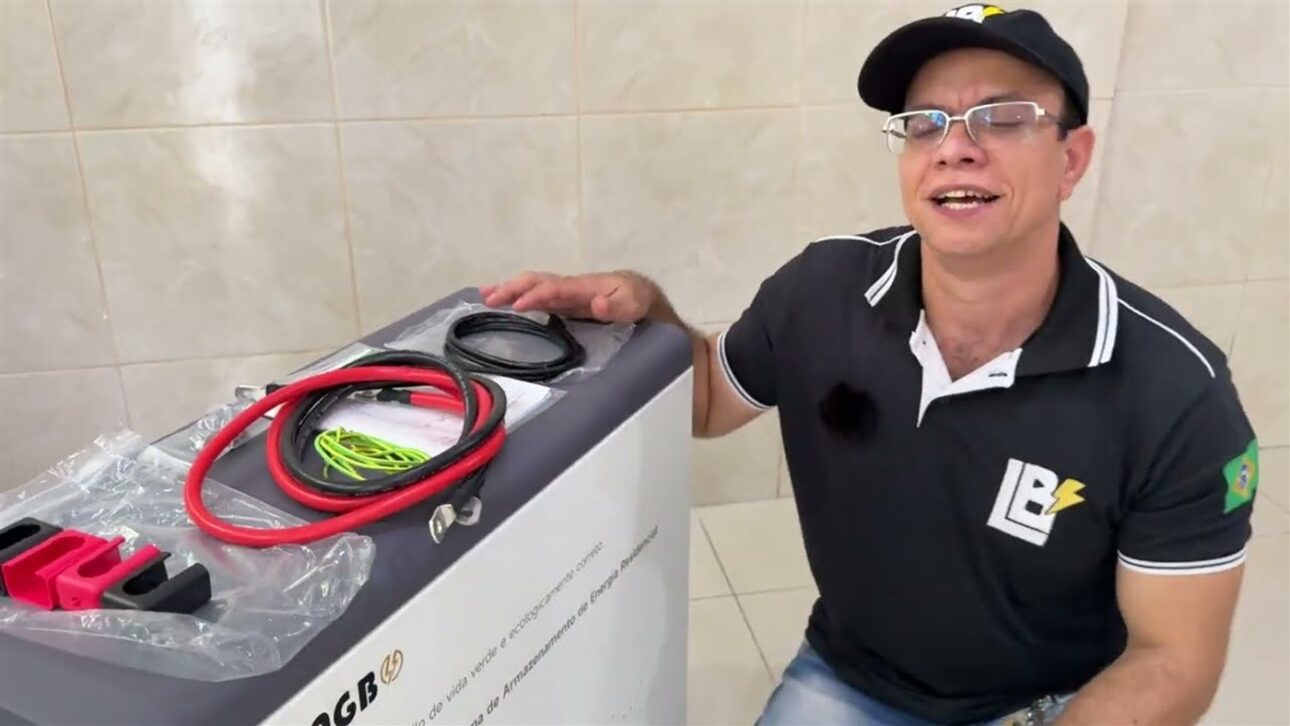
Power of this order comes with heavyweight. According to Luciano Batista, the battery weighs 150 kilograms, requires four to five people for initial handling, and therefore, already comes with wheels at the base for transport after positioning.
The installation details appear at the back. The unit features a 250 A direct current circuit breaker, on-off button, reset, dry contacts for automation, and a set of RS485, CAN, and RS232 communication ports, as Luciano Batista shows. Accompanying the box are the manual, grounding cable, communication cable, and 4 AWG cables to connect to the inverter, a kit that reduces the rush for accessories when energizing the system.
Compatible with the inverters that Brazilians already use
The battery is useless without communicating with the inverter. According to Luciano Batista, the RS485 communication protocol of the MB48314 includes an embedded list of compatible inverters, which the review goes through on the equipment’s own screen.
The names are familiar to those who have already set up solar energy in the country. The battery lists compatibility with brands like Growatt, Luxpower, and Goodwe, among others, as Luciano Batista points out. It’s a decisive practical point: the Brazilian buyer who already has an inverter from one of these manufacturers tends to integrate the storage bank without changing the rest of the system, which lowers the total cost of migrating to off-grid.
Why off-grid is growing in Brazil
The topic speaks directly to the Brazilian consumer’s wallet. With electricity bills pressured by tariff flags and adjustments, and with the price of lithium batteries falling in recent years, residential storage has ceased to be a luxury for isolated farms and has become an option for savings and security for those who already have solar panels.
The historical bottleneck of solar has always been the night. Photovoltaic panels only generate with the sun, and without a battery, the excess energy from the day would go to the grid, but a 16 kWh bank stores what’s left from noon to light up the house at night, the reasoning that supports the race for storage. For rural properties at the end of the distribution line, where power outages are routine, the solar battery also becomes insurance against blackouts, not just a savings tool.
Regulatory changes push the same trend. With the revision of the rules for compensating energy injected into the grid, storing one’s own generation at home has become more economically sensible than exporting the cheap excess to reimport it expensively at night. In this scenario, a long-life solar battery, designed to last two decades, ceases to be an expense and becomes an asset: it pays the difference between the full utility tariff and the practically zero cost of reusing what the roof has already produced. For small businesses that cannot stop due to lack of power, from butcheries with cold storage to offices full of equipment, the same 16 kWh bank functions as an industrial-sized UPS.
What to check before buying a solar battery


The review serves as a buying lesson for beginners. Before the price, it’s worth checking the chemistry (LiFePO4 is the safest and most durable for residential use), the promised number of cycles, the maximum current of the BMS, and compatibility with the inverter already at home.
Weight and installation also factor in. A 150-kilogram battery requires a ventilated location, a firm base, and transport planning, and high-current wiring demands the correct gauge, like the 4 AWG cables that come with the MB48314, a precaution that separates safe installation from improvised. Buying the box is only half the project: the other half is sizing consumption, panels, and inverter so that the 16 kWh deliver as promised.
It is still worth thinking about the future of the bank. As the solar battery accepts parallel expansion, the buyer can start with one unit and add others as consumption grows, without discarding what they already have. It is the modular logic that established LiFePO4 in residential storage: the same box that today holds the essentials of a house can, tomorrow, become part of a bank that spans several cloudy days without any sun.
The video shows the battery screen, technical parameters, communication ports, accompanying cables, and the list of compatible inverters.
The Kingbo MB48314 summarizes where residential energy is heading: more storage, more years of life, and less dependency on the utility company. Tell us in the comments: would you install 16 kWh of battery to disconnect the house from the grid?


