Portuguese
  Spanish


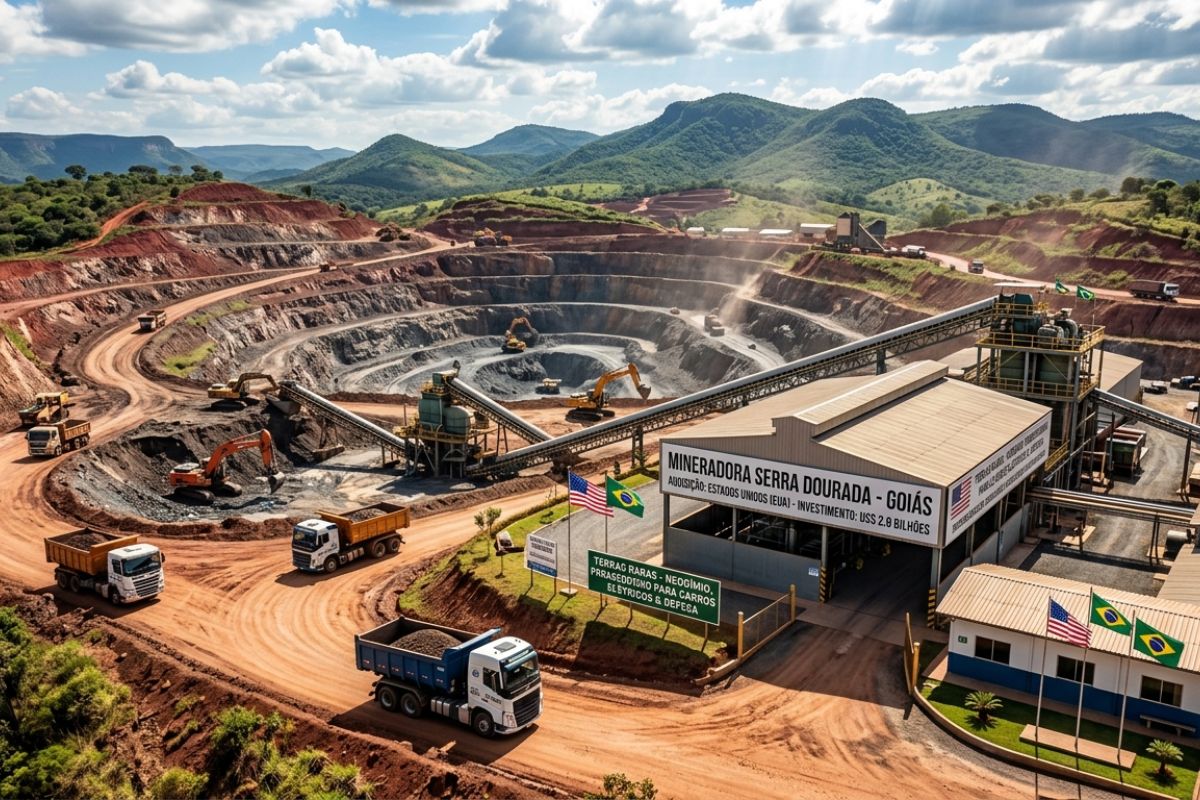

The acquisition of Serra Verde by USA Rare Earth consolidates the state of Goiás as a strategic point for the production of critical minerals focused on the technology and defense industry.
The American mining company USA Rare Earth officially announced on Monday, April 20, 2026, the purchase of the Brazilian Serra Verde for an approximate amount of US$ 2.8 billion. The operation involves the acquisition of 100% of the company based in Goiás, which owns the mine and the Pela Ema processing plant, positioning the United States competitively in the global supply chain.
This transaction occurs at a decisive moment of geopolitical competition, aiming to reduce Western dependence on Chinese processing of essential minerals. The established timeline anticipates that the deal will be finalized in the third quarter of 2026, ensuring Americans control of key assets for the manufacturing of electric vehicles and advanced defense systems.
Financial structure and strategic assets in Goian territory
The financial design of the transaction involves the payment of US$ 300 million in cash, in addition to the issuance of 126,849 million new shares of USA Rare Earth to the former controllers.
-
Company Offering “Stones to Diamonds” Scheme Sells Ruined Italian Homes to Brazilians for 1 Euro, Disappears with Promised Renovations, Leaving Buyers in Debt to Italian Tax Authorities Until 2028 Without Property

-
Plastic Packaging Drives Santa Catarina Industry to 230% Growth, Aiming for R$ 500 Million by 2030 Amid Sector Crisis, with New Gearless Line Expanding in Southern Brazil to Compete in South America

-
Flamengo Star Invests in Brazilian Coastal Luxury Real Estate as Itapema Surpasses Balneário Camboriú in High-End Market Growth
-
Brazil to Issue “Panda Bonds” in China, Aiming to Raise Up to 5 Billion Yuan at Lower Interest Rates Than Dollar Debt


The Brazilian mining company was managed by heavyweight funds such as Denham Capital and Vision Blue Resources, which now hand over control of a unique asset: the Pela Ema mine is the only large-scale producer outside Asia capable of supplying the four main magnetic rare earth elements.
The relevance of the unit located in Goiás is evidenced by the market projections of the new controller. The expectation is that Serra Verde will account for over 50% of the supply of heavy rare earths outside China by 2027, a milestone for the technological sovereignty of U.S. allies.
The plant has already received over US$ 1.1 billion in prior investments and is expected to reach its full operational capacity in the coming months.
Institutional support and long-term supply guarantee
The move by the American mining company is widely supported by Washington, which sees Brazil as an essential partner for the security of its industrial base.
USA Rare Earth has already signed a letter of intent with the U.S. Department of Commerce to access up to US$ 1.6 billion in financial support, divided between direct federal resources and guaranteed loans, signaling the importance of the project for sensitive sectors such as semiconductors.
In addition to financial support, the agreement is reinforced by a 15-year contract for the sale of the initial production of elements such as neodymium, praseodymium, dysprosium, and terbium.
This contract includes fixed price floors to mitigate market risks and protect the investment against external fluctuations. These minerals are the basis for the production of permanent magnets, used in everything from wind turbines to high-precision military equipment.
Economic Outlook and Value Aggregation in Brazil
The combined company’s projection is ambitious, estimating an annual EBITDA of up to $1.8 billion by 2030, depending on the execution conditions of the projects and global demand.
For the Brazilian economy, the consolidation of this mining company as a prominent global player reinforces the importance of the country’s mineral reserves, although it raises a necessary reflection on the final destination of these natural riches.
Although the investment brings capital and technology, the market observes that the higher value-added industrial stages tend to be concentrated abroad, where the final production of magnets and electronic components will take place.
The Goian unit began its commercial production in 2024 and continues to expand, consolidating Brazil as one of the few countries capable of offering such specific inputs on an industrial scale.
With the sale of this important mining company to foreign capital, do you believe that Brazil should require the establishment of final component factories on national soil to avoid exporting only raw materials?