Portuguese
  Spanish


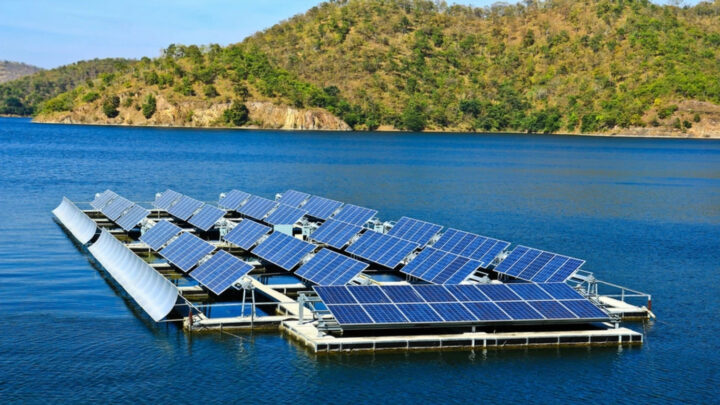

Itaipu Binacional Authorized, on March 13, 2025, the Implementation of a Floating Solar Power Plant in the Reservoir of the Hydroelectric Plant. The project provides for the installation of approximately two thousand photovoltaic modules in an area between 7 and 10 thousand square meters, located in the Paraguayan sector of the plant.
In addition, the timeframe for the execution of the work will be 150 days, followed by 180 days for technical support, training, and final system approval. Thus, the results obtained will help define future strategies for large-scale floating solar energy generation.
International Partnership and Project Characteristics
The agreement for the project took place with the presence of the general directors of Itaipu, Enio Verri (Brazil) and Justo Zacarias Irún (Paraguay), as well as representatives of the binational consortium Sunlution-Luxacril, Ediléu Cardoso Jr. and Sebastian Rojas.
The experimental solar unit will have a capacity of 1 MWp (megawatt peak), enough energy to supply around 650 homes. Thus, this technology represents an advancement in diversifying Itaipu’s energy matrix, leveraging the vast potential of its reservoirs.
-
Axia Energia Invests $280 Million in Q1, Increases Investments by 36%, and Turns Loss into $740 Million Profit

-
Brazil’s Vitória Airport to Launch Solar Plant Covering Area of 10 Soccer Fields, Boosting Clean Energy and Cutting Costs
-
Switzerland Converts Train Tracks into Solar Power Plants with Removable Panels to Generate Energy Without Using Additional Land
-
Surge in Solar-Powered Homes in Brazil Leads to Grid Strain and Connection Restrictions in Three States



Impact and Objectives of the Pilot Project
According to Enio Verri, the energy generated by the floating installation, estimated between 1,800 MWh and 2,000 MWh annually, will help meet part of the consumption of Itaipu’s own offices.
Additionally, the results obtained from this project will serve as a reference for future expansions both at Itaipu and in other dams in Brazil and Paraguay. Thus, it will be possible to expand floating solar energy technology based on concrete studies and detailed analyses.
The main objective of the project involves conducting in-depth research on the effectiveness of the technology, its advantages, and possible environmental impacts on the reservoir. Thus, the technical analysis will allow the development of solutions that maximize energy efficiency without compromising the environment.
Energy as a Tool for Social Inclusion
During the launch event, Enio Verri highlighted the importance of electricity for social inclusion. According to him, those who have access to electricity can improve their quality of life, ensuring the use of essential appliances and equipment.
Moreover, Brazil, being the world’s largest producer of hydroelectric energy, has a great opportunity to integrate floating solar generation in its plants. With this initiative, Itaipu can become a model for other renewable energy projects in Latin America.
Potential for Expansion of Floating Solar Generation
The CEO of the KWP Energia/Sunlution group, Ediléu Cardoso Jr., emphasized the potential of floating solar energy. According to him, if only 10% of the surface of the reservoir were utilized, it would be possible to install a plant with 14,000 MW, equivalent to a new Itaipu.
Additionally, this project, the first of its scale in a binational hydroelectric plant, represents a milestone for the adoption of floating solar energy on a large scale. Thus, it contributes to diversifying the energy matrix and reducing dependence on fossil fuels.
Environmental and Technological Benefits
During the technical presentation, Pedro Domaniczky, head of the Renewable Energy Advisory in Paraguay, and engineer Márcio Massakiti, representative from Brazil, highlighted the advantages of the system.
Floating solar energy prevents deforestation and does not occupy productive areas. In addition, it reduces water evaporation and minimizes algae proliferation, benefiting the aquatic ecosystem.
Another essential point involves the comparative analysis of data before and after installation. In this way, it will be possible to accurately assess the environmental impacts and the efficiency of the technology. Thus, Itaipu will have a technical foundation for future decisions on project expansion.
Investment and Cutting-Edge Technology
The Sunlution-Luxacril consortium won the public competition with a proposal of US$ 854,500, an amount 11.72% lower than predicted in the notice.
The contract encompasses the engineering project development, supply of electrical equipment, control and instrumentation systems, mechanical structure, civil works, assembly, and commissioning.
According to Ediléu Cardoso Jr., this initiative will bring to Itaipu the most modern technology in floating solar energy available in the world. Furthermore, the main objective is to ensure maximum efficiency, reducing costs and optimizing integration with the hydroelectric plant.