






 Portuguese
  Spanish
  4 min of reading
  0 comments


Study Reveals That Venus Has Ongoing Tectonic Activity, With Structures Called Corona Indicating Internal Processes Similar to Those That Shaped Primitive Earth.
A new study has brought a surprising revelation about Venus. The planet, known for its extreme and inhospitable conditions, may be undergoing geological processes similar to those occurring inside Earth.
The discovery was made based on an analysis of old data collected by a NASA probe in the 1990s.
Mysterious Structures Called Corona
Scientists analyzed giant circular structures known as corona, which are common on the surface of Venus.
-
Helicopter Drops 180 Tons of Sand and Gravel on Swedish River to Revive Ecosystem Damaged by Decades of Exploitation

-
Brazilian Company Launches Retro Smartphone with 48 MP Camera, T9 Keyboard, and Privacy Features for Social Media-Free Use

-
Self-Taught Chinese Farmer Builds 5-Ton Submarine from Scrap, Launches It in Anhui River
-
Invisible Induction Technology Enables Wireless Power for Blenders, Coffee Makers, and Air Fryers, Reducing Countertop Cables





These formations resemble craters but have a different origin.
They have a raised ring around a sunken center, with fractures radiating outward. They can reach hundreds of kilometers in diameter.
Initially, it was thought that these structures were impact craters. But new studies have shown that they have a volcanic origin.
It is believed that corona form when plumes of hot material rise from the planet’s interior.
This material pushes the surface upward, forming a dome that later collapses, creating the current shape.
Plumes and Deformations in the Crust of Venus
Even without tectonic plates like those on Earth, Venus shows signs of internal activity.
The hot plumes rising from the mantle interact with the crust, causing deformations. This activity may explain the formation of the corona.
To investigate this possibility, the researchers used data from the Magellan mission, which orbited Venus in the 1990s.
They cross-referenced topographic information with gravity data, seeking to understand what happens beneath the corona.
The team identified 75 corona and discovered that 52 of them show clear signs of active plumes.
These plumes are hotter and less dense than the surrounding material, indicating that they are in motion and may be shaping the planet’s surface.
Two Possible Processes Similar to Those on Earth
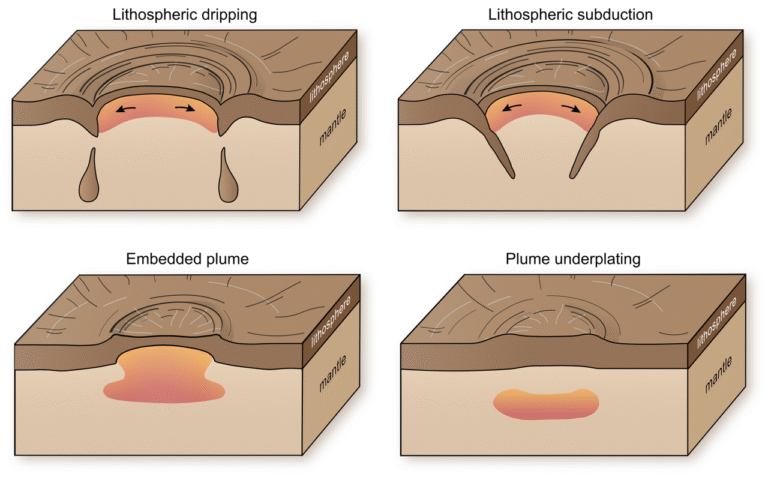
Based on the observations, scientists propose two processes that may be occurring on Venus. Both are already known here on Earth.
The first is subduction. On Earth, this occurs when one tectonic plate slides under another.
On Venus, the plume would force surface material to spread and collide with other areas, pushing some into the mantle.
The second possible process is lithospheric dripping. This phenomenon occurs when the lower part of the crust is heated and begins to detach. The colder, denser material drips and sinks into the planet’s interior.
These two processes are considered forms of tectonic activity. If they are indeed happening on Venus, it means that the planet remains geologically active.
Future Research May Focus on the Corona
For scientists, the corona are now one of the most important targets for future space missions. Although Venus has extremely high temperatures, intense atmospheric pressure, and acid rain, researchers believe that new missions could reveal more about its interior.
“Corona are not found on Earth today; however, they may have existed when our planet was young and before the establishment of tectonic plates“, explained Gael Cascioli from the University of Maryland and NASA’s Goddard Space Flight Center.
According to scientist Anna Gülcher from the University of Bern, the corona are large and very numerous.
Diverse theories have already been suggested to explain their origin, but new data indicate that there are active processes behind these formations.
“We can now state that there are likely various active processes underway driving their formation. We believe these same processes may have occurred in the early history of Earth“, says Gülcher.
Similarities with Primitive Earth
One of the most exciting ideas from the study is the possibility that the corona of Venus are comparable to processes that occurred on Earth billions of years ago. This could help scientists better understand how terrestrial geology evolved.
The discovery reinforces the idea that, even without tectonic plates, Venus still has a dynamic interior. This changes the previous view that the planet was practically geologically dormant.
The study was published in the scientific journal Science Advances. The team used models and real data to propose a new interpretation of Venus’s dynamics.
They emphasize that observations made based on data from the Magellan mission have paved the way for new investigations.





Be the first to react!