






 Portuguese
  Spanish
  8 min of reading
  0 comments


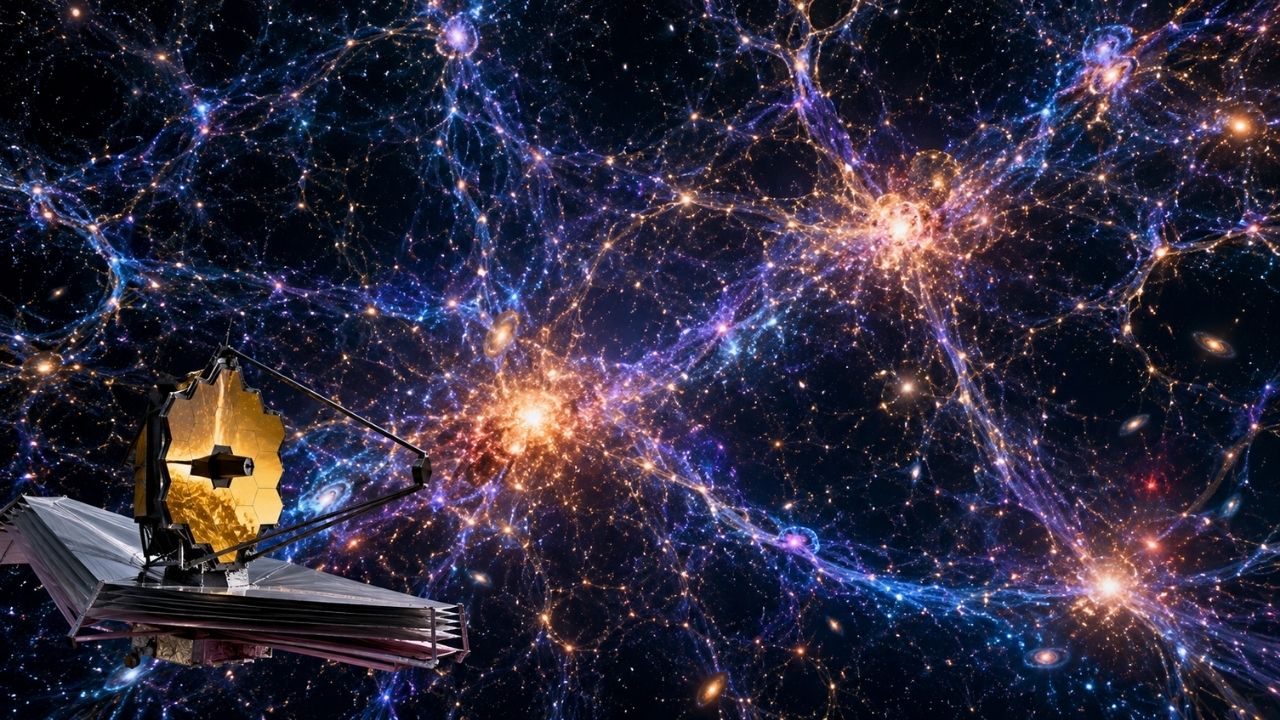
COSMOS-Web survey used James Webb data to map the cosmic web and connect 164 thousand galaxies throughout the history of the universe. Published in The Astrophysical Journal, the study relates dense environments to galactic growth and the subsequent reduction of star formation in different cosmic epochs already observed.
James Webb allowed astronomers to produce the most detailed map ever presented of the cosmic web, the gigantic structure formed by filaments, clusters, and voids that organizes galaxies in the universe. The study, led by researchers from the University of California, Riverside, was published in May 2026 in The Astrophysical Journal.
As explained in a video published by the channel SpaceToday, the team used the COSMOS-Web survey to analyze 164 thousand galaxies and reconstruct their distribution from the relatively nearby universe to epochs when the cosmos was about 1 billion years old. The result shows that the environment in which a galaxy forms and evolves can influence its size, mass, and its ability to continue producing stars.
James Webb transforms invisible structure into a map of the universe

The cosmic web is described by astronomers as the large-scale architecture of the universe. Instead of galaxies scattered randomly through space, matter organizes itself into filaments and dense regions, separated by huge voids where there are far fewer visible objects.
-
Oil Company Robots Discover 3,300-Year-Old Canaanite Shipwreck in the Mediterranean, Proving Ancient Mariners Navigated Open Seas Using Stars Long Before Historians Thought

-
Helicopter Drops 180 Tons of Sand and Gravel on Swedish River to Revive Ecosystem Damaged by Decades of Exploitation

-
Brazilian Company Launches Retro Smartphone with 48 MP Camera, T9 Keyboard, and Privacy Features for Social Media-Free Use

-
Self-Taught Chinese Farmer Builds 5-Ton Submarine from Scrap, Launches It in Anhui River




This network is formed by gas, dark matter, and galaxies connected in structures that can span gigantic distances. Dark matter does not emit light directly, while part of the gas between galaxies is extremely diffuse, which makes the complete drawing of the web difficult to observe.
The advancement of James Webb lies in seeing faint and distant galaxies with enough clarity to reveal the design of the network in which they are embedded. Instead of observing only isolated objects, researchers managed to reconstruct the environments where these galaxies grew throughout cosmic history.
COSMOS-Web gathered 164 thousand galaxies in a single reconstruction
The map was created with data from COSMOS-Web, the largest survey program conducted by James Webb so far. The research covers a continuous area of the sky equivalent, approximately, to the apparent size of three full moons and was designed to study how galaxies are distributed in different eras of the universe.
The team applied statistical methods to organize 164 thousand galaxies with reliable distance estimates. Since the light from very distant objects took billions of years to reach the telescopes, each observed galaxy also functions as a window into a different phase of cosmic history.
The reconstruction tracks structures from relatively recent periods to redshifts close to 7, an interval associated with the early phases of galaxy evolution. Thus, the map not only shows where the objects are but also how the cosmic web has changed over almost the entire age of the universe.
Infrared sensitivity allowed seeing further

James Webb primarily observes in the infrared, a range of light essential for detecting very ancient galaxies. As the universe expands, the light emitted by distant objects is shifted to longer wavelengths, making this type of observation crucial for investigating remote epochs.
Previous telescopes had already produced important maps of the COSMOS region, including the Hubble. However, according to researchers, the new survey offers enough depth and resolution to separate structures that previously appeared smoothed or confused in less defined sets.
This means that regions that seemed to form a single concentration of matter can now be examined as more complex networks, composed of different filaments, clusters, and voids. The James Webb not only extended the observable distance: it made the internal organization of the distant universe clearer.
Cosmic web functions as a network that connects galaxies
The idea of a web arises because the universe is not distributed uniformly. There are dense regions where galaxies and clusters concentrate, and very empty regions, separated by long filamentous structures that conduct matter over time.
These filaments can be understood as cosmic pathways where gas and dark matter contribute to forming and feeding galaxies. At points where several filaments meet, denser environments emerge, capable of gathering clusters formed by numerous galaxies.
The research with the James Webb precisely measured how the density of these environments relates to the characteristics of the galaxies. The cosmic address of a galaxy no longer appears just as a backdrop: it becomes an important factor in understanding its development.
Galaxies in dense regions accumulated more mass
One of the study’s conclusions is that the stellar mass of galaxies has a positive correlation with the density of the environment at different observed times. In simple terms, galaxies located in denser regions of the cosmic web tend to have greater mass formed by stars.
This association is especially relevant because it helps to understand how the first massive structures emerged. In the earliest periods investigated, extremely dense environments already appeared linked to the initial formation of groups that may have evolved into larger clusters.
The conclusion does not mean that every galaxy in a dense region will have the same fate. Mass, available gas, interactions, and black hole activity also exert influence. Even so, the map indicates that the cosmic web offered favorable environments for the early assembly of more massive galaxies.
Star formation changes as the universe ages

The study also analyzed the star formation rate, that is, the speed at which new stars emerge within galaxies. This process depends on the availability of cold gas, the necessary material for new formation regions to develop.
In the oldest periods observed, processes linked to the galaxies’ own mass played a dominant role in the cessation or reduction of star production. Among these mechanisms are internal phenomena capable of heating or expelling gas, making the birth of new stars less efficient.
In more recent times, the influence of the environment becomes more important, especially for lower-mass galaxies in dense regions. The cosmic web, which in the young universe was associated with accelerated growth, can also participate in the process that later hinders the continuity of star formation.
Dense environments can feed and then limit galaxies
The apparent contradiction between stimulating growth and contributing to the cessation of star formation is related to the evolution of the universe itself. In early phases, dense regions gathered enough matter and gas to favor the rapid construction of larger galaxies.
Over time, these same environments began to gather conditions capable of removing gas, heating available materials, or hindering their incorporation into new stars. Smaller galaxies may be especially vulnerable to these external influences when entering dense regions.
The map created with the James Webb allows tracking this transition in time scales that previously could not be examined with the same precision. The cosmic web thus appears as a network that first helps some galaxies grow and then can limit their ability to continue shining with new stars.
Research reaches a period close to the beginning of the first structures
By reaching times when the universe was approximately 1 billion years old, the survey approaches a decisive stage in cosmic history. During that period, the first galaxies were already forming and beginning to build larger structures under the influence of gravity.
Observing this past requires detecting very faint and distant objects. The expansion of the universe modifies the light that reaches the instruments, while the low luminosity of many galaxies makes the survey especially difficult for less sensitive observatories.
The James Webb was developed precisely to access this type of remote universe. By identifying faint galaxies in different layers of cosmic time, the telescope offers a view of how the first threads of the web grew to form the structure observed today.
Public data may expand studies on galactic evolution
In addition to publishing the findings, the team made available the catalog of 164,000 galaxies, information about their cosmic density, and materials associated with the map. This openness allows other researchers to use the data to investigate questions related to the formation and evolution of galaxies.
The set can support studies on clusters in formation, galaxies that have stopped producing stars, the influence of dark matter, and differences between dense and empty environments. It can also be compared to new surveys conducted by other telescopes in the coming years.
The publication of the map transforms a discovery into a research platform. The design revealed by James Webb does not conclude the study of the cosmic web; it offers a more detailed basis for scientists to test how the universe built its structures over billions of years.
Map does not photograph dark matter directly
Although the cosmic web is often called the “invisible skeleton” of the universe, the new work does not represent a direct photograph of all the dark matter present in the filaments. The reconstruction was carried out from the distribution of the observed galaxies and the density of the environments in which they appear.
The distinction is important because it avoids interpreting the map as a common image. Astronomers use the positions, distances, and properties of thousands of visible objects to reveal the larger structure in which these objects are organized.
Even so, the result allows us to see in an unprecedented way how galaxies follow the cosmic network. It’s like recognizing the design of an invisible structure by carefully observing the luminous points it has gathered and shaped over time.
James Webb reveals that galaxies do not evolve alone


For a long time, many explanations about galactic evolution focused attention on the internal processes of galaxies: star birth, mergers, black holes, and gas depletion. The new map strengthens the idea that the external environment also needs to be considered.
A galaxy can be connected to filaments, located in a dense cluster, or isolated in a less populated region. These differences influence the amount of available matter, the interactions experienced, and the chance of continuing to form stars over time.
By mapping 164,000 galaxies in different eras, James Webb shows that the history of the universe was not written only by individual stars or isolated systems. The growth and aging of galaxies also bear the mark of the immense cosmic network where each one was born and evolved.
Invisible skeleton of the universe is no longer just a distant theory
The most detailed map of the cosmic web enhances the ability to investigate a structure that, for decades, was reconstructed mainly through models, simulations, and more limited observations. Now, a broad sample of galaxies allows us to track this network over a range that covers almost the entire observable history of the cosmos.
The study does not resolve all questions about dark matter, galactic formation, or the cessation of star production. However, it reinforces that the cosmic web plays an active role in the evolution of galaxies, especially by favoring initial growth in dense regions and influencing the subsequent reduction of star formation.
Did you imagine that galaxies could have their growth and future conditioned by the place they occupy in this invisible network of the universe? Comment on what surprised you most about this discovery by James Webb.




Be the first to react!