Portuguese
  Spanish


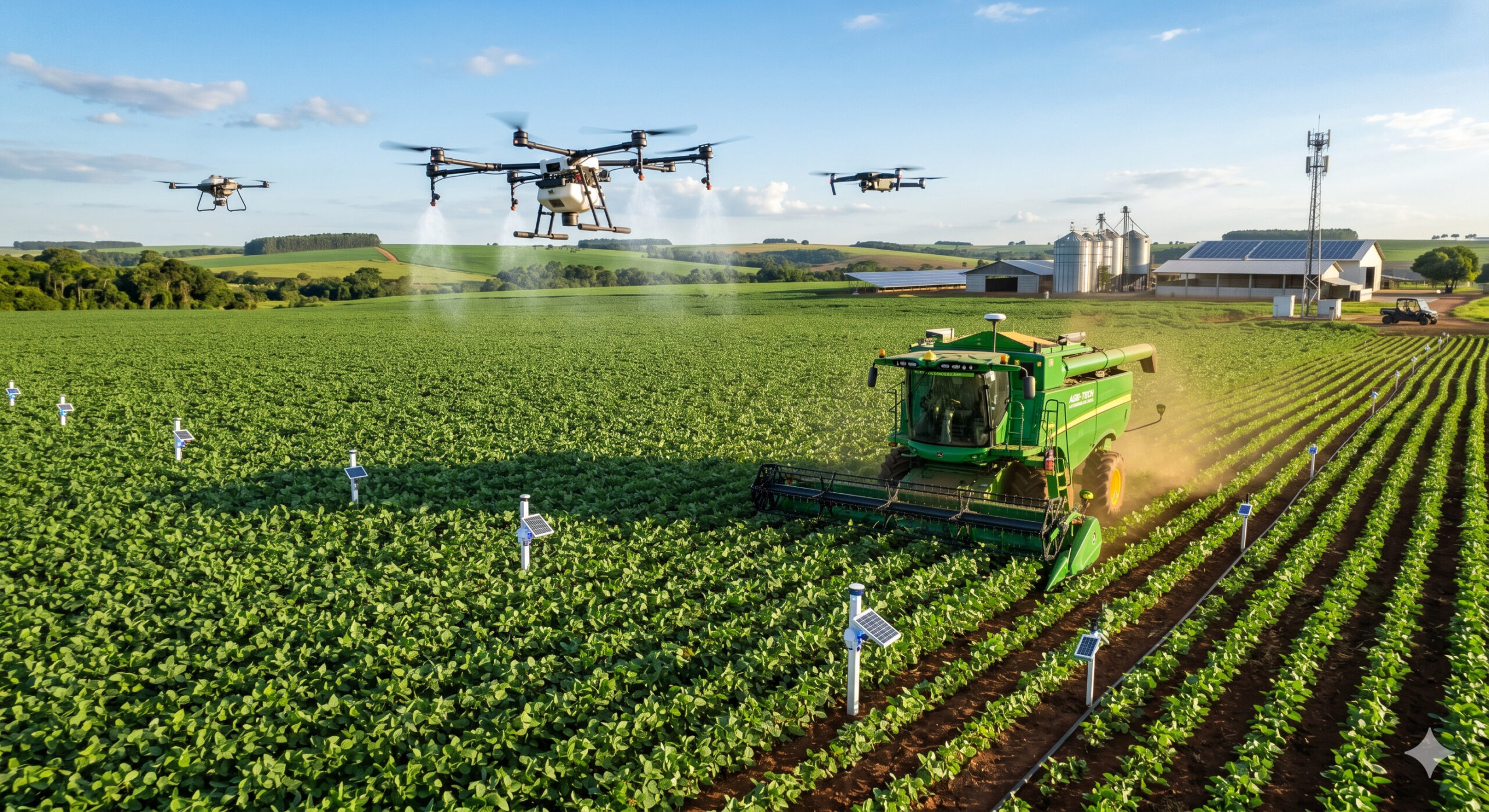

The advancement of technology in agriculture has been one of the main drivers of transformation in agribusiness in recent decades. At the same time, with the constant increase in the global population, the pressure for greater food production is growing at an accelerated pace. This information was released by data from the United Nations (UN), which indicates that by 2050, the planet is expected to reach 9.7 billion people, representing an increase of approximately 2 billion inhabitants in the next 30 years.
In this scenario, it becomes evident that technology in agriculture is not just an option but a strategic necessity. Furthermore, the pursuit of efficiency, productivity, and sustainability places the rural producer at the center of this transformation. Therefore, understanding how to implement technologies in the field is essential to ensure competitiveness and growth.
Evolution of technology in agriculture and impact on agribusiness
First of all, it is important to understand that agriculture has gone through several phases throughout history. Initially, the so-called Agriculture 1.0 emerged about 12,000 years ago, marked by manual processes and low productivity. During this period, subsistence and family farming predominated, with little or no technology involved.
-
Vertical Farming Company Backed by SoftBank and Jeff Bezos Files for Bankruptcy, Valuation Plummets from $1.9 Billion to Under $15 Million

-
Indian Inventor Develops Solar-Powered Machine Enabling Blind Farmers to Independently Manage Crops with Sensors and Audio Alerts

-
Brazilian Honey Supplying U.S. Supermarkets Faces Price Hike and Job Threats Amid New Tariff Round
-
Drought in France Threatens Beet Crops, Raising Fears of Sugar Price Surge Across Europe


However, with scientific advancement, Agriculture 2.0 emerged at the beginning of the 20th century. At this time, tractors and agricultural machinery began to be used, which consequently significantly increased productivity and gave rise to modern agribusiness.
Subsequently, from the 1990s onwards, Agriculture 3.0 emerged, characterized by the introduction of precision agriculture. With this, technologies such as GPS began to be used to monitor factors such as soil fertility and water availability. Thus, producers began to make more assertive decisions.
Next, Agriculture 4.0 brought the digitalization of the field from 2010. In this context, automation tools, connectivity, and technological integration became part of the agricultural routine. In this way, productivity increased, and property management became more efficient.
Furthermore, there is already talk of Agriculture 5.0, which promises to revolutionize the sector even more. In this new phase, technologies such as Artificial Intelligence, Internet of Things (IoT), robotics, and decision support systems are expected to make the production process even more intelligent and personalized.
Technology in Brazilian fields and production growth
While the world advances, Brazil stands out as one of the protagonists when it comes to technology in agriculture. According to data from Embrapa, between 1975 and 2015, the use of technologies was responsible for a 59% growth in the gross value of Brazilian agricultural production.
Furthermore, between 1977 and 2017, grain production increased fivefold, from 47 million tons to 237 million tons. And the most impressive thing is that this growth occurred with an expansion of only 60% of the planted area.
In other words, these numbers prove that technology allowed for increased productivity without the need for proportional expansion of agricultural areas. Therefore, the intelligent use of resources has become a competitive differential.
Moreover, research by Embrapa in partnership with Sebrae shows that 84% of Brazilian farmers already use some type of technology in the field. At the same time, more than 70% access agricultural content online, while 40% already conduct online purchases and sales of inputs.
Consequently, these data indicate that Brazilian producers are increasingly connected and open to innovation. According to specialist José Augusto Tomé, CEO and co-founder of AgTech Garage, technology impacts the entire production chain, from planning to commercialization.
How to implement technology in agriculture and increase productivity
Amid so many changes, many producers still wonder how to implement technology in agriculture efficiently. The good news is that it is not necessary to invest in everything at once. On the contrary, the ideal is to start strategically.
Among the main available technologies, the highlights are:
Smart sensors: allow monitoring of the soil, detecting pests, and tracking the health of the plantation in real time.
Agricultural drones: offer high-resolution images and precise data to optimize the use of inputs and improve planting.
Management software: help in production control, planning, and decision-making.
Agricultural automation: autonomous machines, such as tractors and spreaders, increase efficiency and reduce operational costs.
Moreover, these technologies provide various benefits, such as increased productivity, cost reduction, greater precision in management, and lower risk of losses caused by climatic factors or pests.
Therefore, by adopting these solutions, the producer can improve crop performance and increase profitability. At the same time, it contributes to a more sustainable use of natural resources.
Are you already using any technology in the field or are you still planning to take this next step?