Portuguese
  Spanish


A Monorail Crosses a 19-Story Building in Chongqing, China, Catching Attention With Its Innovative Engineering. The Liziba Station, Integrated Into the Building, is a Tourist Attraction and Example of Creative Urban Solutions.
The monorail that cuts through a 19-story building in Chongqing, China, draws the attention of tourists and curious people from all over the world.
In operation for almost two decades, the transportation system has become a symbol of modern engineering and a reference for innovative solutions in large cities.
The building, which houses the Liziba station of Line 2 of the Chongqing Rail Transit, has become a tourist attraction and a must-see for visitors interested in witnessing one of the most impressive scenes of global public transportation up close.
-
The Frenchman Who Brought the World Cup to Life: Overcoming Resistance and Crossing the Atlantic with the Trophy to Create Football’s Biggest Tournament

-
Archaeologists Reexamine 4,500-Year-Old Tombs in Ancient Mesopotamia, Suggesting Some Early Kings May Have Been Powerful Women
-
The North Face Co-Founder Donates Vast South American Lands to Create National Parks in Patagonia, Turning Private Wealth into Environmental Legacy

-
From Rural Brazil to Global Tech: Entrepreneur Builds a 800-Employee Company with Over $40 Million Annual Revenue in 19 Countries



Monorail Crosses Building and Becomes a Phenomenon on Social Media
Images of the train passing through the building have gone viral on social media platforms like X (formerly Twitter) and Instagram, causing surprise around the world.
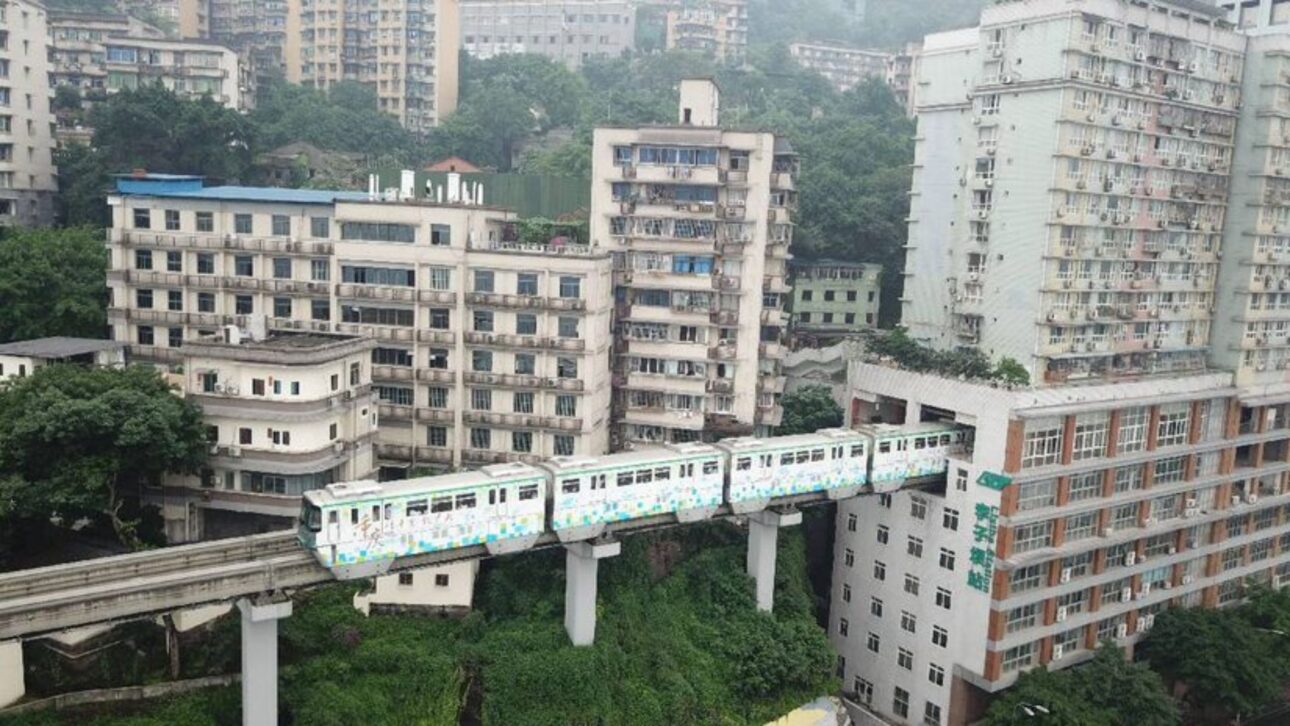
The unusual scenery, often mistaken for a digital montage or artificial intelligence effect, is completely real and remains fully operational.
Since 2006, the monorail has been cutting through the building amidst the urban landscape of Chongqing, a city located in southwestern China and known for its rugged topography, marked by mountains and deep valleys.
Construction of the Liziba Station Inside the Building
The idea of connecting a residential building to a monorail station was conceived in the 1990s, given the limitations imposed by the local terrain.
At that time, a construction company acquired the land planning to build a condominium.
However, urban planning studies and maps of the region indicated that the area would be more suitable for the installation of a transportation station, as a steep slope at the back of the lot made redirecting the tracks to another location difficult.
With the challenge presented, representatives of the construction company and the Chongqing Rail Transit Group began negotiations to arrive at a viable solution.
According to engineer Ye Tianyi, responsible for the project, the goal was to meet both housing demand and the need to integrate the transportation system into the city’s urban fabric.
The result was a unique project: a 19-story building, with the Liziba station occupying the sixth to eighth floors, crossed by the Line 2 monorail.
Innovative Engineering to Integrate Transportation and Building in Chongqing
To enable the passage of the monorail through the interior of the building, the engineering team developed specific solutions to minimize noise and vibration impact.
Reinforced walls with acoustic insulation, structural dampers, and adaptations in the design of the tracks allowed train traffic not to compromise the comfort of residents.
Furthermore, the integration between the building and the station was planned to ensure the safety and efficient flow of passengers, with separate entrances for residents and transportation users.
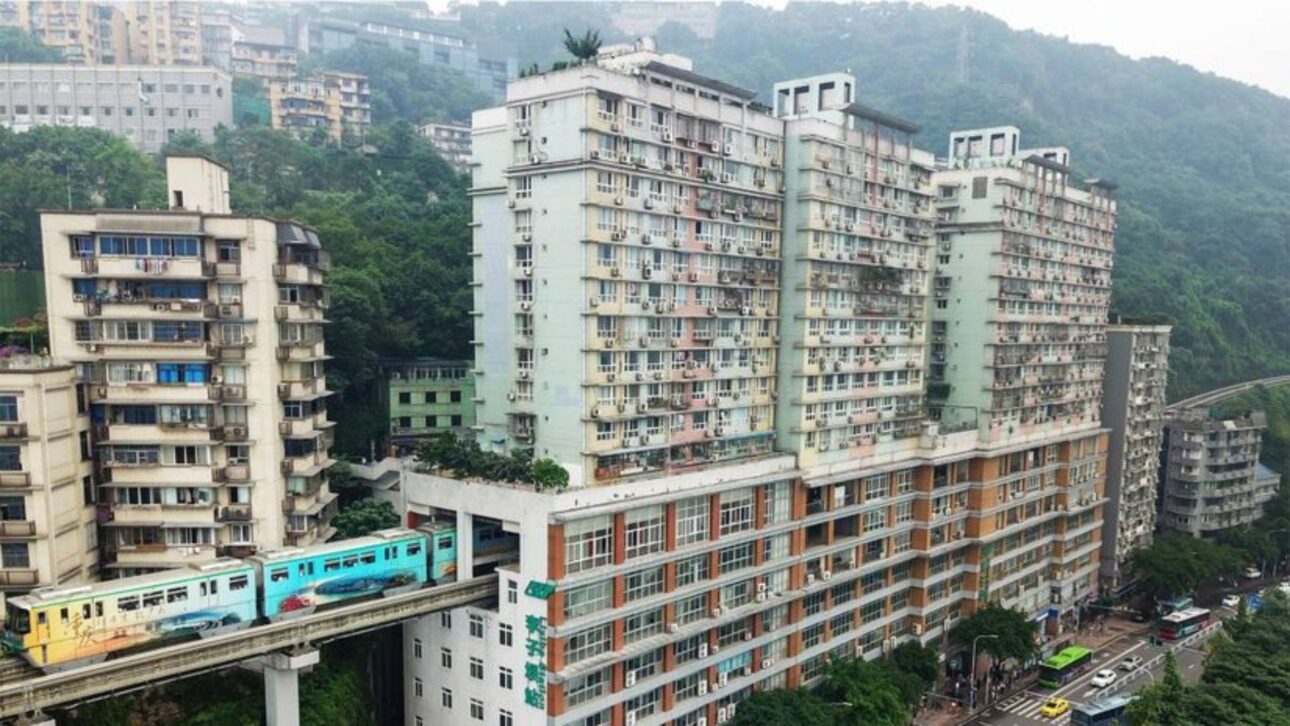
The construction process took about two years, concluding in 2004, and the commercial operation of the monorail began in 2006.
Since then, the Liziba station has been recognized as an example of advanced engineering, attracting students, industry professionals, and tourists from various nationalities.
In 2022, the project was cited by Chinese authorities as a historical heritage and a model of sustainable development in densely populated urban areas.
Tourism Growth and Exclusive Platform for Visitors
The tourism phenomenon surrounding the Liziba station gained strength in 2012, when images of the monorail went viral internationally.
According to data from the Chongqing Tourism Department, the flow of visitors has grown significantly over the years, boosting the local economy and fostering new businesses in the region.
In 2018, an exclusive observation platform was installed in front of the building, allowing tourists to capture the moment the train crosses the building — a scene that has already become a postcard of the city.
The Liziba station currently features automatic food vending machines, restrooms, computerized ticketing, and two boarding and disembarking platforms.
The site is widely advertised as a point of interest for those wishing to experience the innovative architecture of Chongqing and have a unique public transportation experience.
Urban Context of Chongqing and Innovation in Mobility
Chongqing, one of China’s largest cities, currently houses more than 32 million inhabitants in its metropolitan area.
The accelerated growth and challenging geography have propelled the adoption of bold solutions in urban mobility, such as the monorail that crosses buildings.
Line 2 of the Chongqing Rail Transit, to which the Liziba station belongs, operates on a route that runs alongside the Jialing River and connects important residential, commercial, and tourist areas of the city.
Cases similar to that of Chongqing are rare in the world.
Other metropolises face obstacles in incorporating subway or monorail stations into existing structures, especially in densely populated regions.
The success of the Liziba station has solidified the city’s name as a reference in projects of urban integration and engineering adapted to local reality, inspiring academic studies and reports in international media.
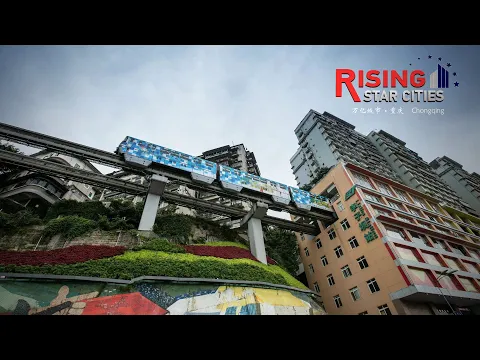

Curiosities and Cultural Impact of the Liziba Station
In addition to being recognized for its unique architecture, the Liziba station has appeared in audiovisual productions, reports, and institutional promotional materials from China.
The circulation of videos and photos on social media reinforces the station’s status as a cultural icon and symbol of creativity in public transport.
According to experts, the choice for solutions like the one adopted in Chongqing highlights the potential for innovation in cities with severe geographic restrictions.
The Liziba station, by uniting efficient mobility and the utilization of urban spaces, has also become an example of sustainability by reducing the need for long commutes and complex integrations.
The phenomenon of the monorail cutting through the building continues to attract tourists, curious onlookers, and scholars — raising an important question: are other cities around the world prepared to invest in solutions as bold and creative as Chongqing?