






 Portuguese
  Spanish
  4 min of reading


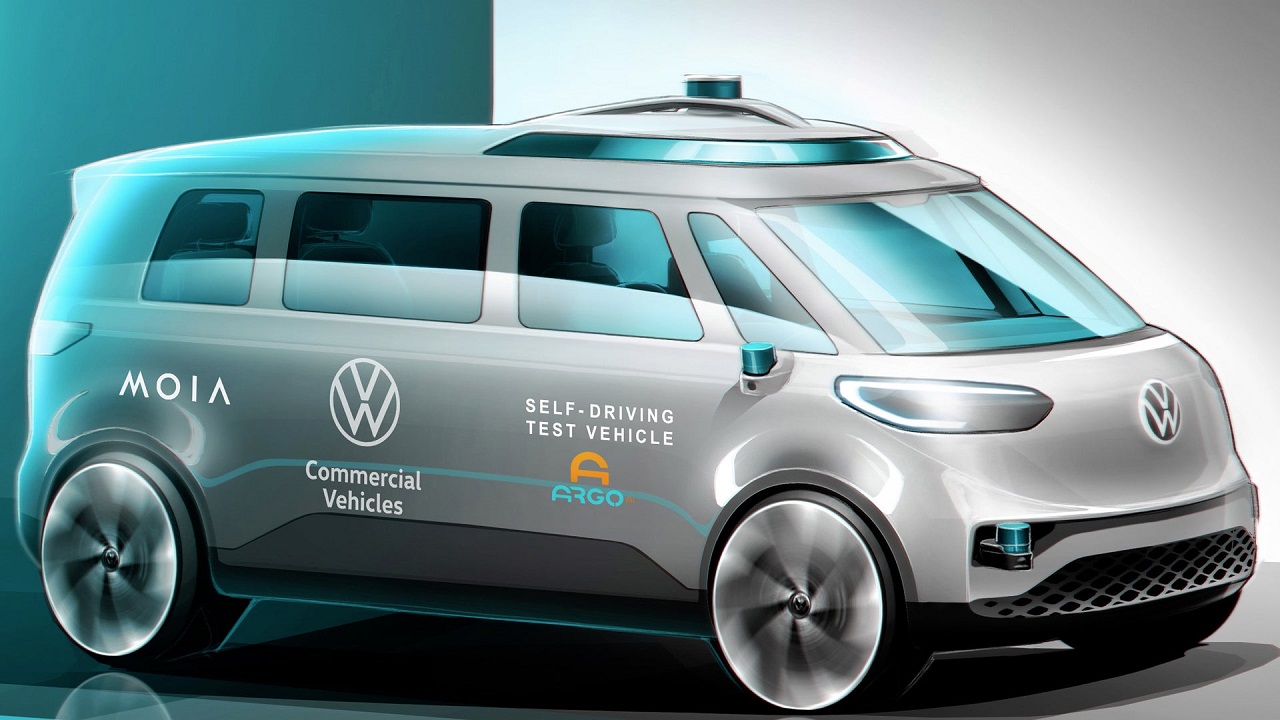
With the Aim of Innovating in the Autonomous Electric Car Market, Multinational Volkswagen Plans to Develop a Type of Microbus That Travels Alone on Streets and Dispenses the Need for a Driver
Multinational Volkswagen announced that the electric microbus ID Buzz, will be launched as a type of “robot-bus” to provide accessible vehicle-sharing solutions in cities thanks to Level 4 autonomous driving technology by 2025. Tests with the autonomous ride-sharing company MOIA will take place in Munich and Pennsylvania later this year, using prototypes of the ID Buzz.
Read Also
After Volkswagen Boss Announces Halt of Gasoline and Diesel Engine Production, Automaker Launches Autonomous Electric Microbus
The “digital driver,” as Volkswagen refers to the ID Buzz, is not yet complete. In fact, it is not the innovative car that many are imagining. Multinational Volkswagen will start building it next year, but what the automaker is announcing today is that it is working with the autonomous technology company Argo AI to build an ultra-ambitious autonomous system. It will be implemented in specific urban areas by MOIA as part of its ride-sharing program.
Level 4 is a type of autonomy that has been proven in a test by AutoX in Shenzhen, China, where the robotic axes are actually moving on their own. It is defined as the vehicle that has the capability for a human to take over, but is completely self-sufficient in a geographically restricted area.
-
Two new 300cc models from QJ Motor are expected to arrive in Brazil as SBM to target the CB 300F and shake up the low-displacement market, with more power and liquid cooling than Honda.

-
Camaro may reappear in 2027, but not as you remember: Chevrolet prepares the return of the icon with four doors, manual transmission, and an extreme performance version to face the new era of sports cars.

-
Is the BYD Song Pro worth it? The Anderson Sincero channel says it doesn’t exceed R$ 140,000, and the price dropped by R$ 47,000, reinforcing the depreciation of the plug-in hybrid in the Fipe table.
-
Caoa Changan CS75 arrives for R$ 199,990 with 4.77 m in length, a trunk of up to 1,620 liters, 8-speed Aisin transmission, 180 hp, 37.2 inches in screens, and Zero Gravity seat with massage.


Therefore, the idea is for you to tell the car that it can go anywhere it wants, say in Pittsburgh, and that it will be equipped with the knowledge and experience to handle anything thrown at it.
The Innovative Idea of Multinational Volkswagen for Autonomous and Driverless Vehicles
“Vehicles with digital drivers allow access to mobility for everyone; you democratize mobility, it is a service product,” said the head of Mobility as a Service at multinational Volkswagen, Christian Senger. “The digital driver will be even safer than the human driver.”
And as our commitment to electric vehicle mobility in cities can also be very clean, cities become more attractive to live in.” If only there were a widely available form of accessible road transport around defined routes in cities. Oh wait, there it is: public transport. The humble bus has been doing this job for decades without anyone thinking, “the real problem with this is that it has a driver,” instead of, “the real problem with this is that some weird guy is talking to me again, man.”
Volkswagen Microbus Promises to Be a Success

Buses already have suspension ready to be lowered to make passage through a ramp easily accessible; they are also large so that you can accommodate many people on board and are widely available in urban environments.
Multinational Volkswagen states that 50% of the ride-sharing market lives in 10 cities in the United States and Europe: Los Angeles, New York, Chicago, Atlanta, Dallas, Houston, Miami, Boston, and Washington DC in the United States and Hamburg, Barcelona, Rome, Madrid, Paris, Naples, Milan, Berlin, Athens, and Vienna in Europe.
The AI from Argo used in Volkswagen’s new electric car uses cameras, long-range lidar, short-range lidar, microphones, and radar to try to replicate the awareness around the vehicle that is needed.
It tests its AIs by putting them in “challenging” scenarios, like complex interchanges, and although they are not there yet, Argo is confident it will be able to launch Level 4 autonomous drivers by 2025 and that the ID Buzz is the right platform to achieve this.
MOIA is so confident in Argo’s AI that it is already the first client of VW’s project, which is expected to meet the 2025 timeline with a launch in Hamburg, although Uber just sold its disastrous attempt at an autonomous car.


Be the first to react!