Portuguese
  Spanish


The universe has billions of stars and trillions of planets, but that doesn’t mean intelligent civilizations are common
For decades, movies, series, and science fiction books have fueled an apparently logical idea: if there are billions of stars in the Milky Way and trillions of planets scattered throughout the universe, then intelligent life must be everywhere.
At first glance, the argument seems irresistible. After all, how could Earth be special in such a vast cosmos?
However, when the issue is analyzed through physics, evolutionary biology, statistics, and modern astronomy, a surprising conclusion emerges. The existence of intelligent civilizations may be much more unlikely than we imagine.
-
Scientists Develop Needle-Free Insulin That Penetrates Skin, Reduces Glucose in Animals Within an Hour, Paving the Way for Diabetes Patches and Creams for Humans

-
After 40 Years of Research, Powdered Coconut Water to Be Produced in Brazilian Biorefinery, Aiming to Revolutionize Health for Children, Elderly, and Hospital Patients
-
Queen Guitarist Brian May Collaborates with ESA Scientists to Study Asteroids Bennu and Ryugu Using 3D Simulations
-
Largest Known Single-Piece Meteorite, Weighing 60 Tons, Puzzles Scientists with Its Intact Fall and Lack of Visible Crater



The discussion does not involve beliefs or philosophical speculations. It involves concepts studied by scientists like Richard Feynman, Charles Darwin, Enrico Fermi, Brandon Carter, Frank Drake, and various researchers who have dedicated decades to the search for answers about life beyond Earth.
Perhaps the correct question is not why we haven’t found aliens yet.
Perhaps we should ask why we believe they should exist in large numbers.
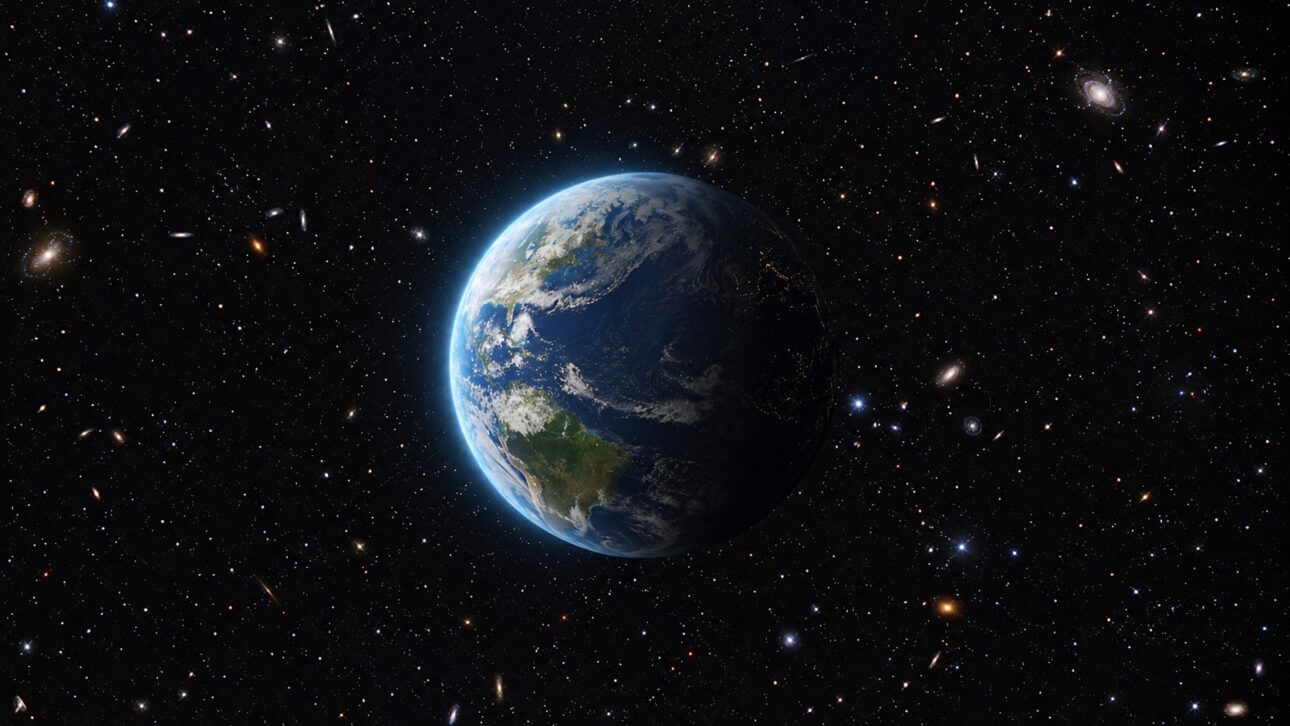
The universe is gigantic, but size doesn’t guarantee life
Currently, astronomers estimate that there are more than 100 billion stars just in the Milky Way.
Observations made by space telescopes indicate that a good portion of these stars have planetary systems.
When these numbers are multiplied by the number of observable galaxies, we reach practically incomprehensible values.
However, Richard Feynman often warned his students about a common mistake.
Large numbers do not automatically mean high probabilities.
The existence of many planets does not imply that all have suitable conditions for life.
Much less for complex life.
And even less for intelligent life.
The difference between these stages is enormous.

The Earth may be rarer than it seems
For a long time, it was believed that Earth was just another common planet.
However, recent discoveries have shown that our planet has an extraordinary combination of factors.
The Earth has:
- stable liquid water;
- protective magnetic field;
- suitable atmosphere;
- active tectonic plates;
- relatively stable orbit;
- large stabilizing moon;
- long-lasting star with low variability.
Each of these factors plays an important role in maintaining life.
If any of them were significantly different, Earth’s biological history could have taken another path.
Some researchers call this hypothesis the Rare Earth Hypothesis.
According to this view, habitable planets may be much less common than we imagine.
Charles Darwin and the billions of accidents of evolution
Even assuming that life arises on another planet, there is another problem.
Evolution has no goals.
This was one of the great conclusions of Charles Darwin when formulating the theory of evolution by natural selection.
Nature does not work to produce intelligence.
It simply favors organisms capable of surviving and reproducing.
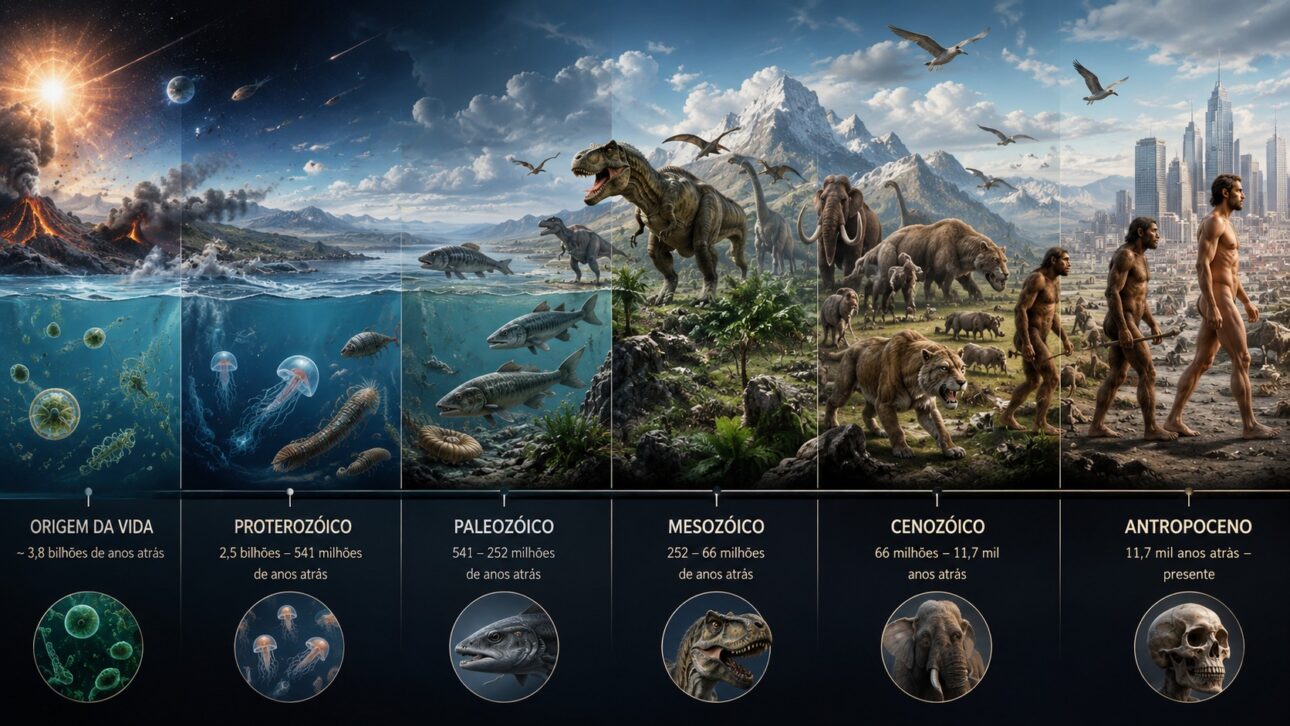
For about 3 billion years, Earth was dominated only by microscopic organisms.
Multicellular life appeared relatively late.
Complex animals emerged much later.
Mammals came even later.
And Homo sapiens appeared only in the last moments of the planet’s geological history.
This means that technological intelligence does not seem to be an inevitable result of evolution.
It may have been an extremely unlikely accident.
The Fermi Paradox remains unanswered
In 1950, the Italian physicist Enrico Fermi asked a simple question during a conversation with colleagues.
If the universe is full of advanced civilizations, where are they?
The question became known as the Fermi Paradox.
Mathematics suggests that a sufficiently advanced civilization could colonize large regions of the galaxy in relatively short time scales compared to the age of the Milky Way.
Our galaxy is about 13 billion years old.
Even slow travel could allow gradual expansion over millions of years.
So why don’t we observe clear signs of this presence?
To this day, no definitive answer has been found.
The absence of evidence does not prove that we are alone.
But it also does not confirm that we are accompanied.
The Drake Equation may be overestimating civilizations
In 1961, the astronomer Frank Drake created a famous equation intended to estimate the number of technological civilizations existing in the galaxy.
The formula considers factors such as:
- rate of star formation;
- number of planets;
- probability of life;
- probability of intelligence;
- duration of civilizations.
The problem is that several of these factors remain unknown.
Small changes in some variables can turn millions of civilizations into just a few.
Or even none.
The equation remains a useful tool for organizing scientific thought.
But it still does not provide a definitive answer.
The Great Filter might be hidden somewhere
One of the most discussed hypotheses currently is the so-called Great Filter Theory.
It suggests that there is an extremely difficult barrier along the evolution of life.
This barrier might be:
- before the emergence of life;
- before complex life;
- before intelligence;
- after technological development.
If the filter is in the past, then humanity has already overcome extremely rare obstacles.
If it is in the future, technological civilizations may have a natural tendency towards extinction.
This possibility concerns many researchers because it could explain the cosmic silence observed to date.

Intelligence might not be a permanent evolutionary advantage
There is another possibility often overlooked.
Technological intelligence may not be a stable evolutionary strategy.
Building civilizations requires increasing consumption of energy and resources.
This increases environmental risks, conflicts, and vulnerabilities.
An extremely intelligent species might also create means to destroy itself.
Nuclear weapons, climate change, artificial pandemics, and uncontrolled artificial intelligence are examples frequently cited by researchers.
The very technological capability that drives a civilization may end up becoming its greatest threat.
Brandon Carter and the Anthropic Principle
The Australian physicist Brandon Carter proposed an important reflection.
We observe a universe compatible with our existence because only in a compatible universe could we be here making observations.
This idea became known as the Anthropic Principle.
Although it seems simple, it has profound implications.
Perhaps we are overestimating the probability of intelligent life because our only point of reference is precisely a planet where intelligent life arose.
In statistical terms, a single sample is insufficient to determine the real frequency of a phenomenon.
Earth remains the only confirmed example of life in the entire known universe.
The silence of the universe may be the greatest evidence
Over decades, scientific projects have monitored the sky in search of artificial signals.
Radio telescopes have examined thousands of stars.
Researchers have looked for transmissions, megastructures, and other possible technological signatures.
So far, the result remains the same.
Silence.
This does not mean that aliens do not exist.
But it means that technologically advanced civilizations do not seem to be abundant in the observed regions.
Richard Feynman argued that science must follow the available data, not human desires.
And the current data shows that we have not yet found any unequivocal evidence of extraterrestrial intelligence.

Physics does not favor galactic empires
Popular culture often portrays civilizations spread across hundreds of star systems.
However, physics imposes severe limitations.
The enormous interstellar distances.
The limits of the speed of light described by Albert Einstein.
The energy costs involved.
The effects of entropy studied by Ludwig Boltzmann.
All these factors make galactic expansion much more difficult than we usually imagine.
Even extremely advanced civilizations would need to obey the same fundamental laws of nature.
The universe makes no exceptions.
What Richard Feynman would probably say about all this
Richard Feynman never claimed that we are alone in the universe.
But he would certainly insist on a fundamental question.
We must not confuse hope with evidence.
Science does not exist to confirm what we wish to believe.
It exists to discover what is true.
Today we know there are billions of stars.
We know there are billions of planets.
We know that the chemistry necessary for life is spread throughout the cosmos.
But we still do not know if technological intelligence is common or extraordinarily rare.
Perhaps we are more special than we imagine
The idea that humanity occupies a common place in the universe may seem intuitive.
However, the combination of factors necessary to produce a technological civilization may be much rarer than most people imagine.
If this is true, Earth ceases to be just another planet.
It comes to represent something exceptional.
Perhaps there are thousands of civilizations spread across the galaxy.
Perhaps there are only a few.
Or perhaps we are the only technological species existing in a vast region of the cosmos.
The answer remains unknown.
But one thing is certain.
The more science advances, the more we realize that the existence of intelligent life may be one of the most improbable events in the entire universe.