Portuguese
  Spanish


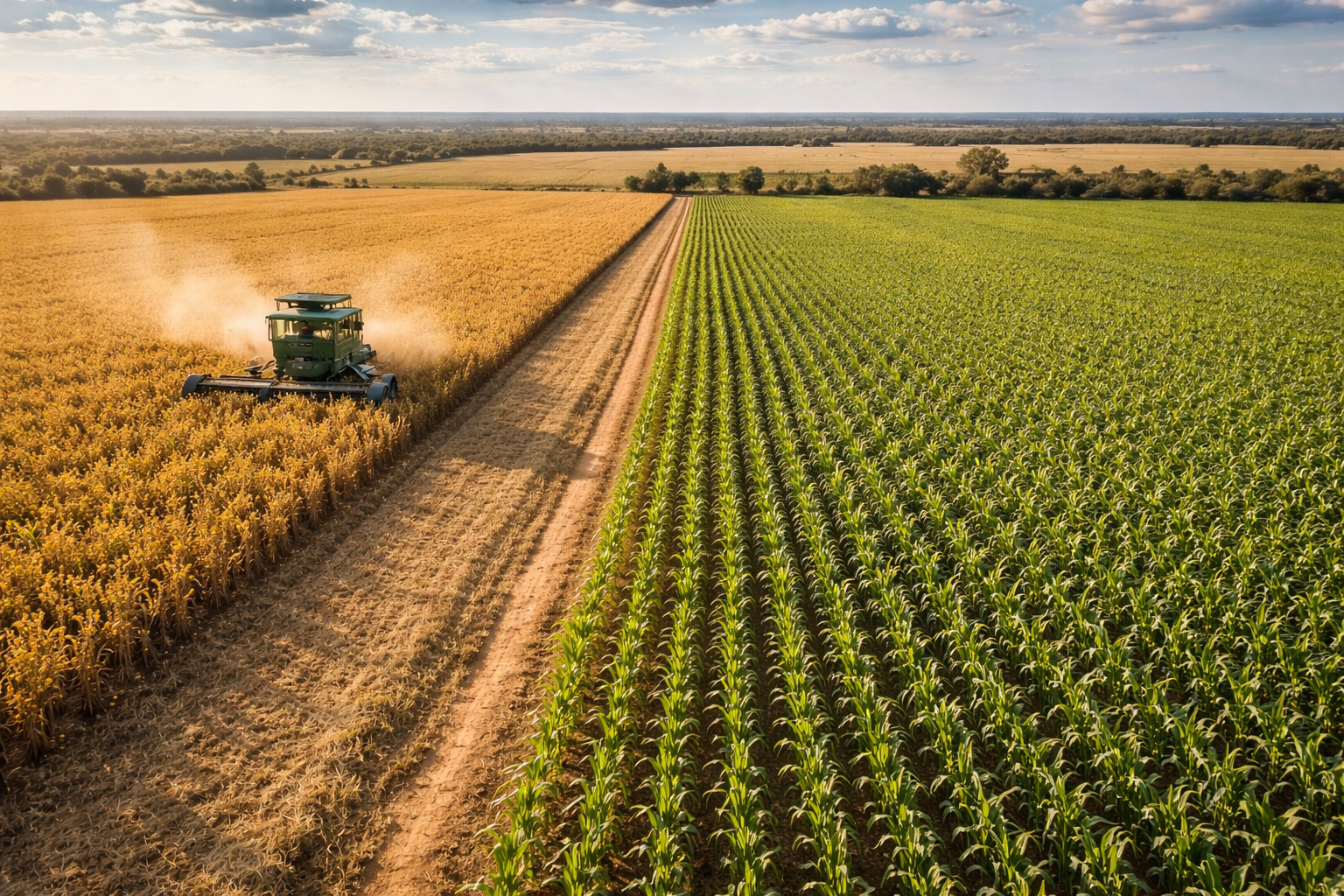

Brazilian Cerrado became an agricultural power with soybean and corn in the same year, thanks to safrinha, soil correction, and Embrapa technology.
Until the 1970s, the Brazilian Cerrado was largely seen as a territory of low agricultural value. The acidic soil, with low natural fertility and high aluminum saturation, combined with twisted vegetation, reinforced the perception that it was an area unsuitable for commercial crops. The popular expression “Cerrado, neither given nor inherited” synthesized this prevailing view. The first attempts to cultivate soybean brought from the South of Brazil resulted in failure. The available varieties did not adapt to the tropical light regime, and the chemical limitations of the soil hindered the proper development of the plants. Production did not advance, and the Cerrado remained on the margins of national agriculture.
According to Harvard Review, Iowa State University, Farmdoc Daily from the University of Illinois, and Wikipedia, the transformation that followed — led by Embrapa and dubbed by The Economist magazine as “The Cerrado Miracle” — is one of the greatest agricultural revolutions in history. And at the center of it is a trick that changed everything: safrinha.
Cerrado soil is highly acidic, phosphorus-poor, and required decades of chemical correction and intensive management
The predominant soil in the Cerrado is classified as Latossolo, characterized by high depth, good drainage, and reddish color, but with very high acidity and low availability of essential nutrients, especially phosphorus.
-
India’s Sugar Export Cuts and Ethanol Shift Amid El Niño Threat Could Impact Global Prices and Stocks

-
Quarantine Pest Threatening Palm Trees Puts Brazilian Authorities on Alert, Prompts Monitoring at University of Taubaté and Potential Control Measures Across São Paulo
-
Global Alert: Report Finds 159 Pesticides in Coffee Beans Sold in Europe, Posing Serious Risks to Millions of Farm Workers
-
Low-Demand Brazilian Beef Offal Gains Popularity Abroad: Indonesia Purchases $19.5 Million, Boosting Revenue and Reducing Waste



This environment imposes severe restrictions on plant growth. Acidity limits nutrient absorption by the roots, while low organic matter reduces the soil’s capacity to retain water and mineral elements.
The transformation began with the intensive application of lime for pH correction, a process known as liming. At the same time, high doses of phosphate and potash fertilizers were incorporated. Research conducted by Embrapa, in partnership with institutions such as the Federal University of Viçosa and the Agronomic Institute of Campinas, established technical protocols capable of converting a soil considered unproductive into a highly efficient agricultural base.
Adaptation of soybean to the tropical photoperiod was decisive for enabling large-scale production
Soybean is originally a temperate climate crop, with development strongly influenced by the photoperiod. In tropical regions, where the variation in day length is limited, traditional varieties flowered early, resulting in short plants and reduced productivity.
The breakthrough came with the development of cultivars adapted to the tropical photoperiod. These varieties began to present an appropriate cycle even under short day conditions, allowing for greater vegetative growth and better grain formation.
This genetic improvement process, conducted by Brazilian researchers, was complemented by the use of biological nitrogen fixation, reducing dependence on nitrogen fertilizers and significantly lowering production costs.
Soybean production in Brazil jumped from 1 million to over 150 million tons in a few decades
In 1969, Brazil produced about 1 million tons of soybeans, with an average yield of just over 1,000 kg per hectare. Over the following decades, the combination of technology, management, and territorial expansion led to exponential growth.
By 2024, production surpassed 150 million tons, with yields exceeding 3,300 kg per hectare. This advancement represents an increase of over 200% in average yield and an expansion of over 15,000% in total production.
The country has become a leader in global soybean production, surpassing the United States, with a large portion of this volume concentrated in the Cerrado.
Safrinha consolidated the double crop system and transformed the productive logic in the Cerrado
The main innovation responsible for multiplying agricultural productivity in Brazil was not an isolated technology, but rather a change in the production calendar.
Traditionally, soybean cultivation was followed by a fallow period. In the Cerrado, where the rainy season lasts for several months, producers began to use the climatic window to plant corn immediately after the soybean harvest.


This system, known as safrinha, allows for two productive cycles in the same agricultural year. Soybeans are planted at the beginning of the rainy season and harvested between January and February. Immediately after harvesting, corn is sown, taking advantage of the residual soil moisture.
The result is the doubling of land use, with a significant increase in productivity per hectare throughout the year.
Safrinha already accounts for more than half of the maize production in Brazil
The model has rapidly expanded and today represents one of the foundations of Brazilian agricultural production. More than half of the corn produced in the country comes from the second crop.
This volume has allowed Brazil to stop being an importer and become one of the largest global exporters of corn. In certain harvests, the production of safrinha far exceeds that of the main crop.

In addition, the surplus generated boosted the growth of the corn ethanol industry in the Midwest, creating new production chains and expanding the diversification of the agricultural sector.
Agricultural zoning reduced risks and transformed the second harvest into a predictable system
The practice of double cropping involves climatic risks, especially related to rainfall variability. To mitigate these risks, the Agricultural Zoning of Climatic Risk was developed.
This system uses historical data on climate, soil, and precipitation to define ideal planting windows in each region. The adoption of these recommendations has become a requirement for access to rural credit and agricultural insurance.
As a result, the second harvest has ceased to be an experimental practice and has begun to operate on a national scale with greater predictability and security.
Biological nitrogen fixation reduces costs and increases environmental efficiency of Brazilian soybean
One of the most relevant factors for the competitiveness of Brazilian soybean is biological nitrogen fixation. Microorganisms present in the soil establish a symbiotic relationship with the plant’s roots, converting atmospheric nitrogen into assimilable forms. This process eliminates the need for nitrogen fertilizers, reducing costs and environmental impacts.
The savings generated by this technique represent billions of reais per year and contribute to a more energy-efficient agriculture.
No-till farming increased soil conservation and enabled the two harvests per year system
No-till farming was another essential element for the success of the agricultural model in the Cerrado. In this system, the soil is not tilled between harvests. The residue from the previous crop remains on the surface, protecting against erosion, reducing moisture loss, and improving the physical structure of the soil over time.
In addition to the environmental benefits, no-till farming allows corn to be sown immediately after soybean harvest, without the need for additional soil preparation, a decisive factor for the success of the second harvest.
The expansion of the agricultural frontier in the Cerrado occurred on a large scale and brought significant environmental consequences.
More than half of the native vegetation has already been converted into production areas. This process affects biodiversity and alters the hydrological regime of important watersheds.
Regions such as Matopiba concentrate part of this recent expansion, encroaching on still preserved areas and impacting local communities and regional climatic dynamics.
Conversion of degraded pastures can expand production without the need for deforestation
Studies indicate that Brazil has tens of millions of hectares of degraded pastures that can be converted into agricultural areas.
This strategy allows for increased production without the need to open new areas, reducing environmental impacts and increasing land use efficiency.
Productive intensification, combined with the use of technology, is seen as a path for the sustainable growth of the sector.
Tropical wheat emerges as a new agricultural frontier in the Brazilian Cerrado
The development of wheat varieties adapted to the Cerrado climate opens new possibilities for Brazilian agriculture.
This system follows the logic of the second crop, with cultivation after soybeans, taking advantage of the available climatic window. The expansion of tropical wheat can reduce dependence on imports and increase the country’s self-sufficiency.
The Cerrado has transformed into one of the main food-producing regions in the world in just a few decades. At the same time, questions arise about the limits of this growth and the associated environmental impacts.
In your view, is it possible to balance large-scale production and conservation of the biome, or does the current model require structural changes to remain viable in the long term?