






 Portuguese
  Spanish


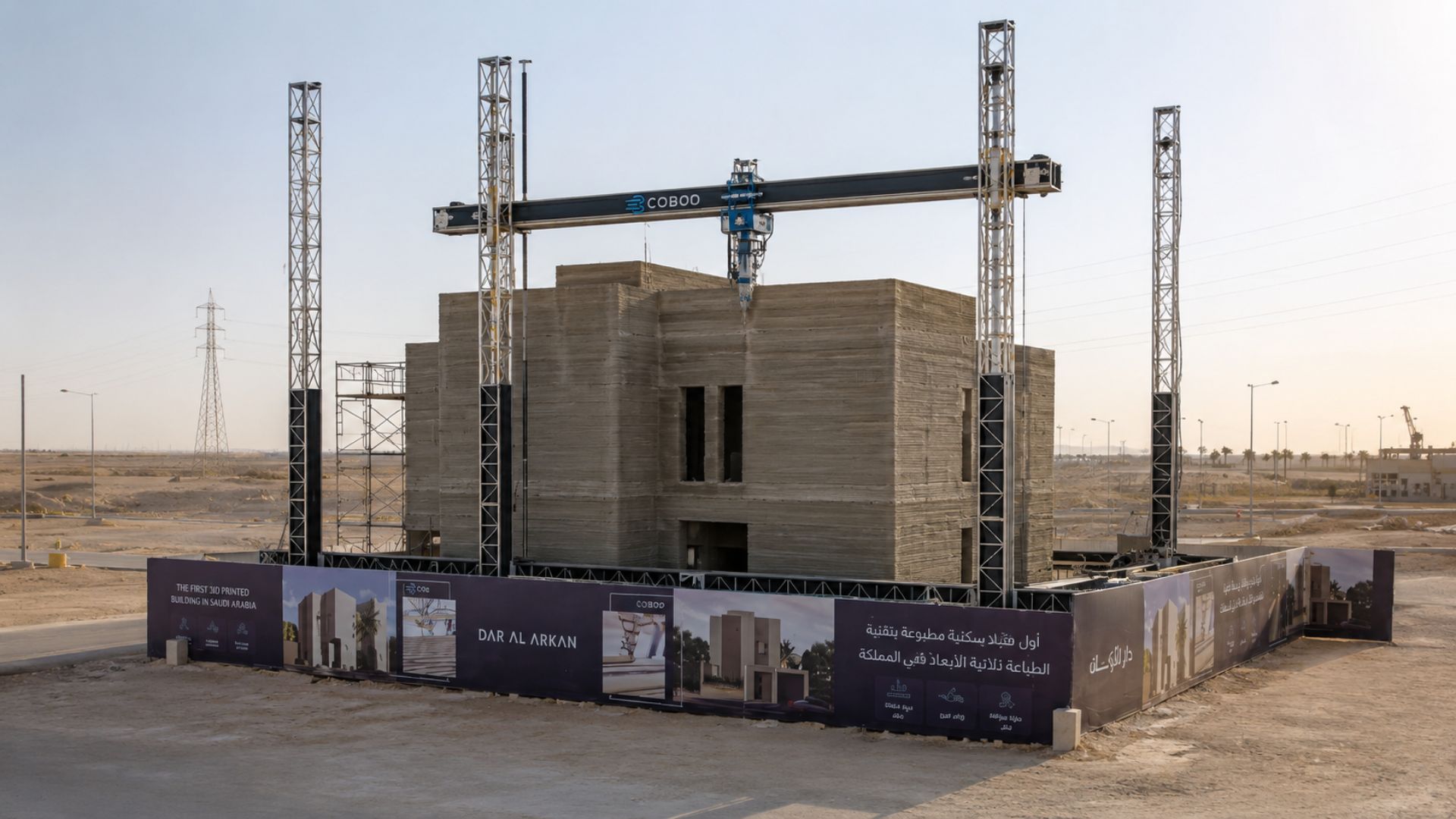

3D printing technology transforms civil construction in Saudi Arabia with a three-story villa built by robots in less than a month, using special concrete, home automation, and solutions aimed at the extreme desert climate.
A three-story residential villa built in Riyadh, the capital of Saudi Arabia, has shown that 3D printing in civil construction has already surpassed the phase of small experimental prototypes and is beginning to gain ground in large-scale housing projects, with practical application in real works.
Developed by the developer Dar Al Arkan with technology from COBOD, the property has 345 square meters, reaches 9.9 meters in height, and had its walls executed in just 26 days, using concrete specially formulated for automated application in successive layers.
Robots already execute central stages of civil construction
Unlike the popular idea associated with home printers, the residence did not come out ready from a machine in a single operation, as the process uses a large-scale equipment responsible only for the automated execution of the structural walls planned in the digital project.
-
Brazilian Mother and Homemaker Becomes Bioconstructor, Builds 24-Ton Earth Dome and Teaches Technique Across Argentina

-
Manchester Builds 40 Furnished Homes for the Homeless Under Railway Arches, Complete with Community Hall, Laundry, Garden, and Sports Court
-
New Highway Section in Brazil’s Serra das Araras Opens: $300 Million Investment, 24 Viaducts, and Promised Travel Time Cuts of Up to 50% to Rio de Janeiro and 25% to São Paulo
-
Major Infrastructure Project in Northeast Brazil Advances with New Overpass Construction to Ease Traffic for Over 13,000 Daily Drivers


While the printer deposits the cementitious mixture layer by layer, other phases still depend on conventional methods, including electrical installations, air conditioning, roofing, frames, internal finishing, and all the systems necessary to transform the structure into a functional residence.
The aspect that most attracts attention in the Saudi project is precisely its scale, because the construction left aside the compact models frequently used in technical demonstrations and advanced to a vertical three-story villa compatible with high-standard properties.
How 3D concrete printing works
Based on the BOD2 printer, developed by the Danish company COBOD, the technology used in the project employs automated axes to position the concrete exactly at the points previously defined by the digital file created for the residential work.
By replacing part of the repetitive tasks manually executed in conventional construction sites, the system reduces some operational stages and allows the creation of more complex architectural forms, including curves and designs that would require more laborious molds in traditional masonry.
To ensure stability during printing, the concrete needed to be specifically adapted to the construction method, as the mixture must be fluid enough to pass through the equipment without losing strength or deforming before the complete curing process.
Extreme heat and dust increased the challenges of the work
In addition to the structural requirements of 3D printing itself, the project also had to deal with the severe conditions of the Saudi desert climate, characterized by high temperatures, constant dust, and factors that increase the complexity of technical control throughout the execution.
According to information released by COBOD, the walls were printed in an open environment without protective structures around the equipment, a situation that demands even greater precision in controlling the cementitious mixture applied during each stage of automated construction.
Another point highlighted by the companies involved was the use of local materials in the production of printable concrete, a strategy considered important to reduce dependency on imported inputs and adapt the technology to the real conditions of the Saudi real estate market.
Villa received home automation and solar energy
In addition to the structure produced by 3D printing, the residence was presented with home automation features aimed at controlling doors, locks, lighting, and climate systems integrated into the daily functioning of the house built in Riyadh.
On the roof of the property, solar panels were also installed to power part of the villa’s electrical functions, while the facade received a heat-reflective nanotechnology paint to improve thermal performance amid the high desert temperatures.
Combining 3D printing, automation, and solutions aimed at energy efficiency, the project sought to present a complete and functional residence, far from the experimental laboratory idea often associated with early experiences with automated construction.
3D printing still depends on conventional methods
Although automation reduces part of the manual work related to wall execution, 3D printed construction still does not eliminate various traditional stages that remain indispensable to ensure functionality, safety, and compliance with local technical standards.
Foundations, plumbing, electrical systems, roofing, interior finishing, and structural inspections are still carried out by conventional methods, showing that the technology mainly acts in the partial automation of the most visible structural phase of the site.
Even so, industry experts observe that 3D printing can help reduce waste, improve standardization, and shorten execution times, especially in markets facing a shortage of skilled labor and high operational costs.
Saudi Arabia bets on technology to modernize construction
The international repercussion of the villa is also linked to the urban transformation scenario experienced by Saudi Arabia, a country that has been increasing investments in planned cities, industrialized methods, and real estate projects associated with the modernization of its infrastructure.
In this context, Dar Al Arkan presented the 3D printed residence as a concrete demonstration of the practical application of technology in large-scale residential constructions, reinforcing Saudi interest in automated solutions for the real estate sector.
Besides the visual impact caused by the image of a giant printer erecting walls in the desert, the project also rekindles discussions about productivity, industrialization, and possible future changes in the way houses can be built in different parts of the world.
Even without completely replacing conventional methods, the experience carried out in Riyadh indicates that robots can already execute a significant part of the structure of a vertical residence using concrete applied in layers and commands controlled by software.
As new works of this type begin to emerge in different markets, 3D printing in civil construction is starting to move beyond just being a technological showcase and is beginning to occupy space in residential projects developed for real and permanent use.


