Portuguese
  Spanish



With a lightweight and high-revving rotary engine, the Chinese truck promised efficiency but revealed high consumption and mechanical failures.
China, now a global reference in the automotive sector, especially in electric vehicles, has previously undertaken a bold and little-known attempt: to apply a rotary engine in trucks and buses. This initiative took place around 1970, when local manufacturers sought simpler and lighter solutions for cargo transport.
The project involved the First Automobile Works (FAW) and later the Tianjin Machine Factory, which developed a functional prototype. Despite rigorous testing, including a journey of 10,000 kilometers on one of the country’s most challenging routes, the proposal failed due to technical limitations that made practical use unfeasible.
Origin of the rotary engine and why China bet on the technology
Before reaching China, the concept of the rotary engine had existed for centuries. An early version was patented by James Watt in 1781, still in the context of steam engines. However, the modern model only emerged in 1929, created by German engineer Felix Wankel.
-
Sales of Brazil’s Cheapest Electric Car Halted Before First Deliveries: E-Motors Suspends Emova Easy Due to Import Tax Increase and Rising Freight Costs

-
Nissan Discontinues Qashqai SUV Amid Cost-Cutting, Chinese Competition, and Product Line Review

-
BYD Patents Revolutionary System Using Computer Vision to Detect Animals Under Cars Before Starting, Preventing Tragedies

-
Study Reveals Why Cars Are More Expensive to Produce and Buy in Brazil Compared to Mexico, Highlighting Taxes, Logistics, and Industrial Costs as Key Factors.




Decades later, in 1964, the first passenger car with this technology was launched: the NSU Spider. While other countries focused on sports applications, taking advantage of the engine’s high revs, Chinese engineers decided to explore a different application: cargo transport.
The bet made sense on paper. The rotary engine was compact, lightweight, and had fewer moving parts, indicating simpler maintenance. Additionally, its ability to reach high rotations seemed promising for performance.
How the rotary engine used in the truck works
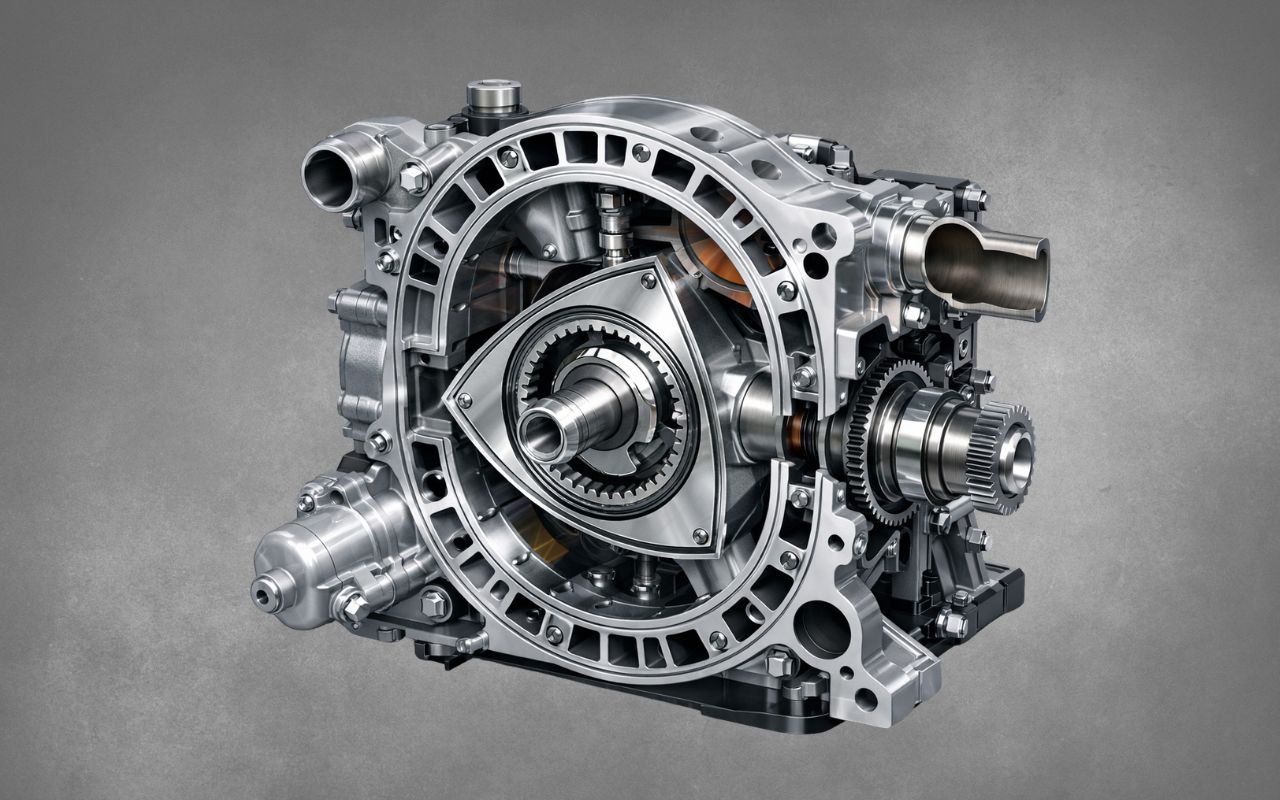
The operation of the rotary engine is different from traditional engines. Instead of pistons moving up and down, it uses a triangular rotor that spins within a chamber.


During this continuous movement, the engine performs the four fundamental stages:
- Intake of mixture (admission)
- Compression
- Combustion
- Release of gases
Everything happens in a single rotation cycle, which reduces vibrations and mechanical complexity. This feature was one of the main factors that motivated China to test the technology in larger vehicles.
Truck TJ140: China’s experiment on the roads
The main example of this attempt was the TJ140 truck, developed by Tianjin Machine Factory. The vehicle had the capacity to transport up to 4 tons and was equipped with a two-rotor rotary engine.

To validate its durability, the truck was subjected to an extreme test: the Sichuan-Tibet highway, known for its severe conditions and mountainous terrain. The route, about 10,000 kilometers long, usually challenges even modern diesel engines.
Surprisingly, the TJ140 completed the entire route, which was initially seen as a positive sign for China’s project.
Low torque revealed a central problem in the truck
Despite the success in the test, practical use revealed a decisive problem. The engine delivered only 29 kgfm of torque — and this occurred at a very high rotation, of approximately 8,500 RPM.
For a truck, this characteristic is inadequate. Cargo vehicles need strength at low rotations to get moving and transport weight efficiently. In the case of the TJ140, it was necessary to keep the engine constantly at high rotation, which compromised performance and durability.
High consumption and accelerated wear made the project unfeasible
With continuous use, the problems became evident. The truck showed extremely high fuel consumption, making its operation expensive. Additionally, essential internal components, such as the rotor seals (known as apex seals), suffered premature wear.

This wear compromised the engine’s compression, reducing its efficiency and further increasing oil consumption. Thus, what seemed like an innovative solution turned out to be unsustainable for heavy transport.
Other attempts in China confirmed rotary engine failures
Even after the initial problems, other initiatives emerged in China. One example was the Qiantangjiang truck, developed by the Jinhua Repair Factory.
The proposal promised that the vehicle would run up to 50,000 kilometers without the need for heavy maintenance. However, in practice, at 30,000 kilometers, the engine was already showing serious failures, including loss of compression and excessive oil consumption.
These results reinforced that the problem was not just in the execution, but in the very limitation of the rotary engine for this type of application.
China turned attempts into learning in engineering
The experience of China with trucks equipped with rotary engines showed that not all technology efficient in one context can be applied in another. Although the system works well in vehicles that require high rotation, such as sports cars, it does not meet the demands of a truck, which needs constant power and prolonged durability.
In the end, the attempt was marked as a bold experiment, but one that stumbled upon fundamental limitations of physics. Still, the episode reveals how the automotive industry evolves through tests, errors, and adaptations — even when the results are not as expected.
Source: AutoPapo