






 Portuguese
  Spanish
  5 min of reading
  0 comments


The circle on the seat of the plastic chair is not decorative. Understand how it helps in manufacturing, water drainage, and stacking of monobloc chairs.
Plastic chairs are among the most common objects in Brazilian daily life, but one detail often goes unnoticed: the circle in the center of the seat. Although many people treat this element as a mere aesthetic choice, it has practical functions related to the engineering of the piece, industrial manufacturing, and daily use.
According to the Design Museum, the monobloc chair was born from the idea of producing a chair in a single piece of material, something that became feasible with advances in plastic molding technologies from the second half of the 20th century. Meanwhile, Ankurwares highlights that the cutout or hole present in modern models is not random: it was retained because it helps solve several problems at once, from production to storage.
Monobloc plastic chair is produced in a single piece
According to the Design Museum, the logic of the monobloc chair is to manufacture the entire structure in a single production step, without subsequent assembly of separate parts. This feature made the model extremely cheap, lightweight, durable for everyday use, and easy to reproduce on a large scale.
-
Germany and Japan expand defense amid tensions with China, Russia, and doubts about the US

-
Instead of retiring, two gentlemen defy logic and handcraft a 1,200 hp V12 engine, installed in a machine made to tear through the California desert at nearly 430 km/h in pursuit of a brutal speed record.

-
Plug the charger into the outlet first or connect it to the phone? Experts warn that a simple sequence can reduce electrical fluctuations, minimize voltage spikes, and influence the battery’s lifespan after years of continuous use.
-
Neymar focuses on Dubai and buys a penthouse worth R$ 314 million in a Bugatti building, with an elevator that takes the car inside the house, an artificial beach inspired by the French Riviera, and only 11 residential units of this type in the building.




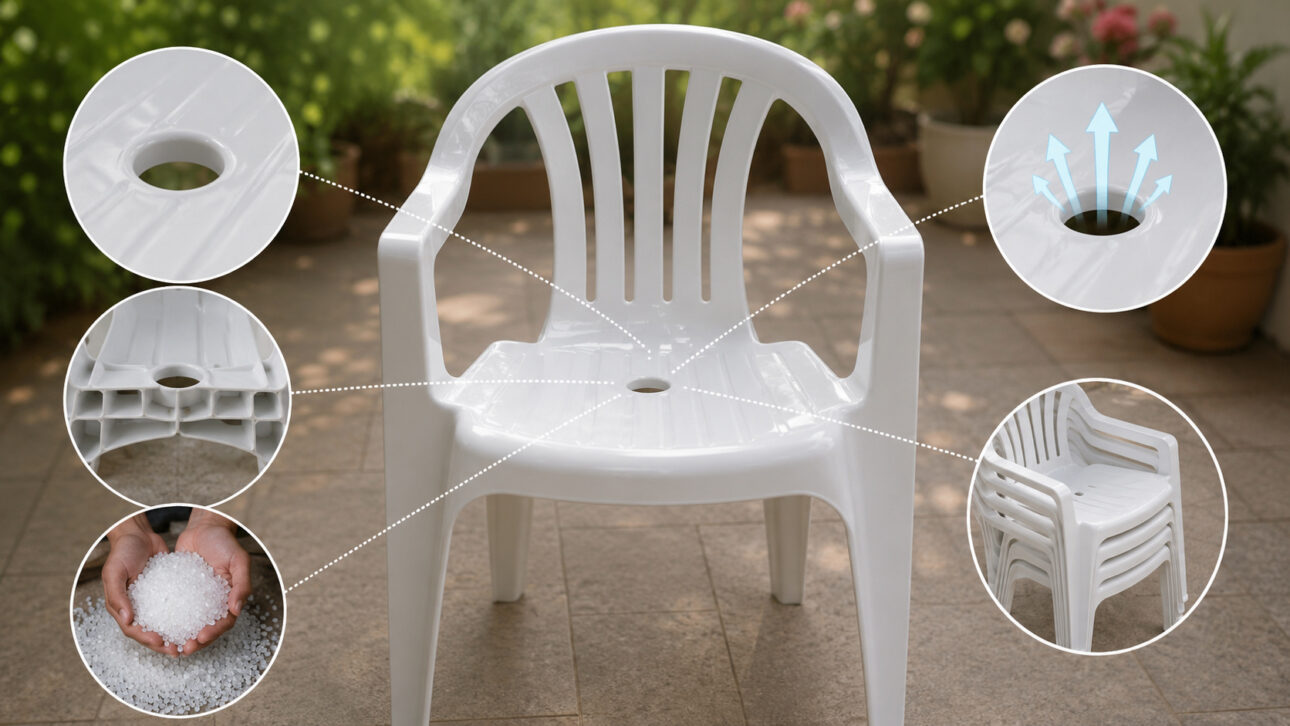
It is precisely in this context that the central circle gains importance. Since the chair comes from a single molding process, any detail of the design needs to help the piece maintain shape, stability, and practicality. In products made by the millions, small geometric adjustments can have a direct impact on performance, cost, and durability.
The result is that the small circle should not be seen as decoration, but as part of the industrial reasoning that made the monobloc chair one of the most popular items in the world.
The circle in the middle of the chairs helps during manufacturing
According to Ankurwares, during the molding of the chair, the central cutout helps to relieve internal material stresses during cooling, reducing the risk of deformations, warping, and cracking. In large plastic pieces produced in a single block, this control is important for the chair to come out of the mold more regularly and maintain structural integrity.
This makes sense because, in the manufacturing of molded plastic pieces, the behavior of the material during cooling directly influences the final shape. When shrinkage occurs unevenly, the piece can twist, deform, or lose stability. The central detail helps make this process more controlled.
In practice, the circle functions as an industrial design feature that improves production repeatability and helps keep the chair with more uniform geometry as it comes off the production line.
The circle in the middle of plastic chairs also prevents water from accumulating on the seat
The most easily noticeable function in daily life is the drainage of water. According to Ankurwares, the cutout in the seat allows rain or any accumulated liquid to pass through quickly, preventing puddles on the surface.
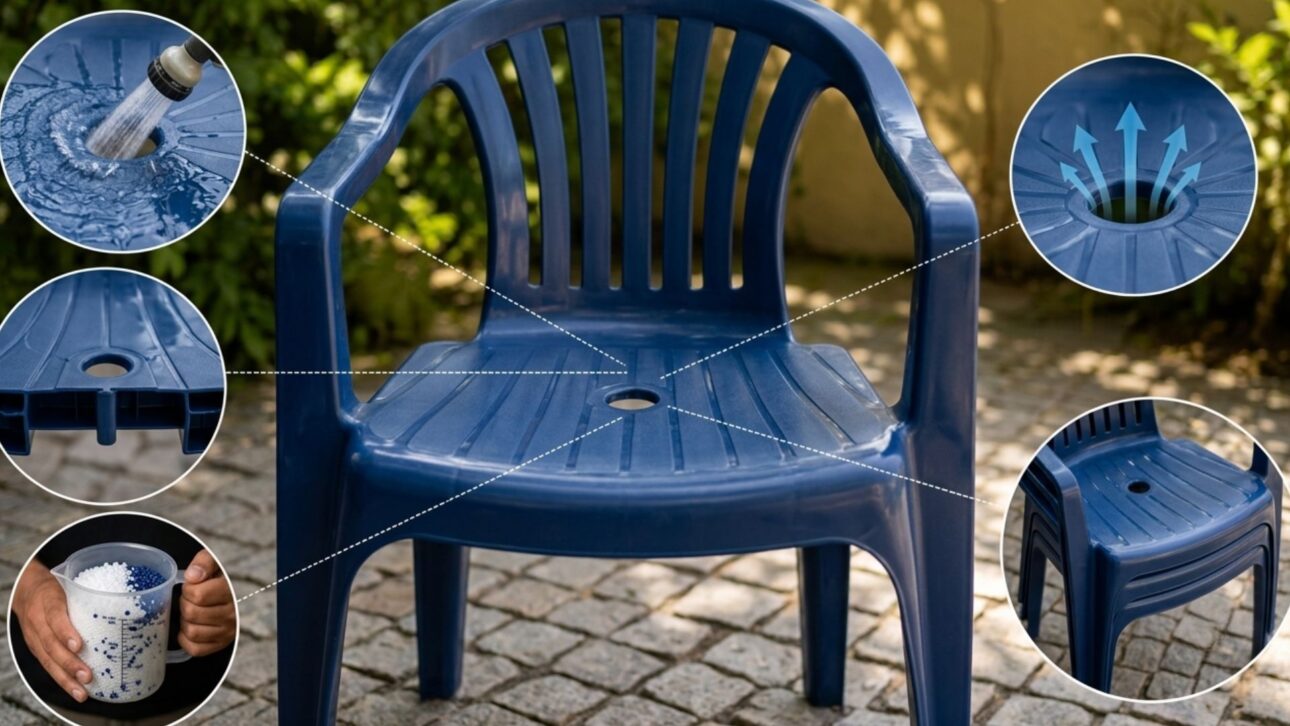
This detail is especially important in outdoor areas, where plastic chairs are exposed in yards, balconies, bars, churches, schools, and events. Without this drainage, standing water would prolong drying time and increase dirt accumulation.
Therefore, even in more modern models, the feature continues to appear frequently. It improves the practicality of everyday use without requiring any extra parts or significant production costs.
Stacking the chairs becomes easier and safer
Another often overlooked benefit is in stacking. According to Ankurwares, the circle in the middle of the chairs helps reduce the effect of vacuum or suction when several chairs are placed on top of each other. Without this air passage, the pieces can stick more firmly and become harder to separate.
This function is especially useful in restaurants, furniture rentals, schools, events, and churches, where storing large quantities of chairs depends on the ability to quickly stack and unstack the set.
Thus, the central circle improves not only the comfort of use but also the logistics of transport, organization, and storage, which is one of the reasons for the commercial success of the monoblock chair.
The circle reduces material without compromising the function of the piece
According to Ankurwares, removing a small part of material from the central region also helps to reduce the amount of plastic used in each chair. On an industrial scale, even small reductions per unit can generate significant savings in raw materials throughout production.
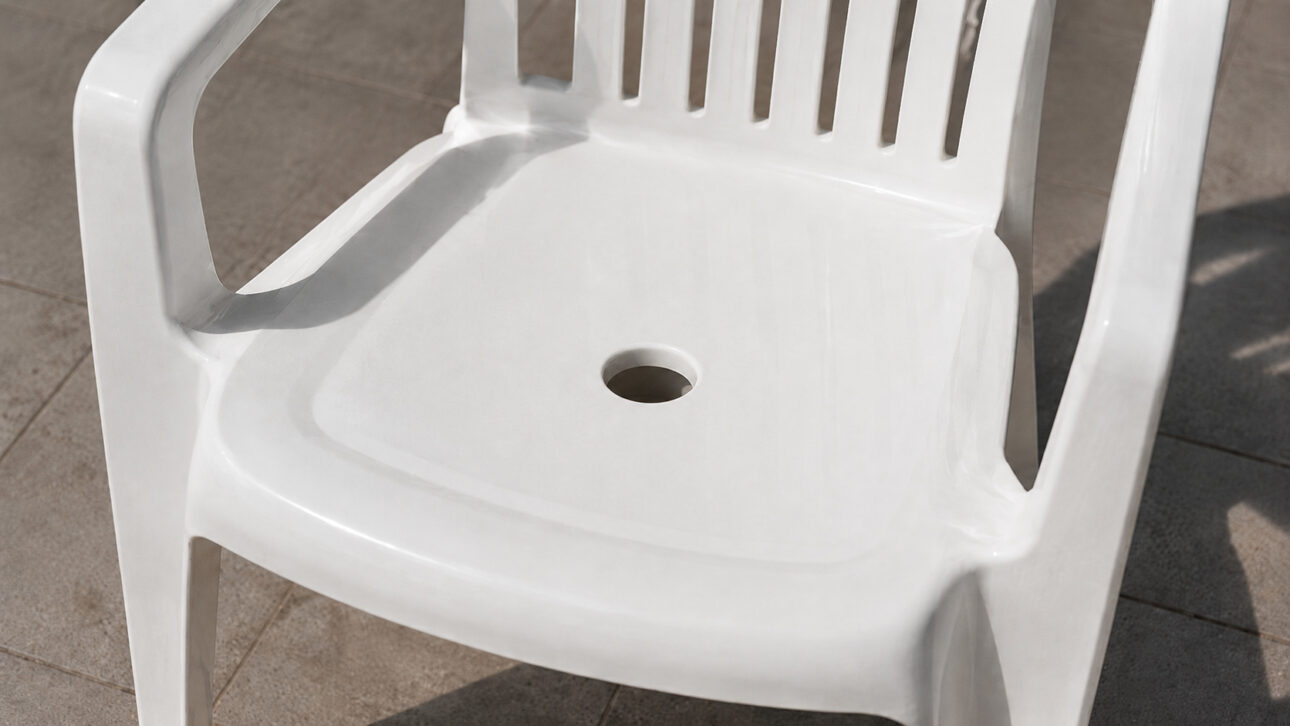
This type of solution is typical of the industrial design of mass-produced objects. The idea is not only to make the chair cheaper but to do so without compromising the necessary strength for daily use. The circle in the middle of the chairs works because the structure of the piece distributes the effort more broadly than it seems at first glance.
Therefore, the central circle does not automatically weaken the chair. In many cases, it is part of a strategy to balance weight, cost, practicality, and stability in a product that needs to be simple and cheap, yet still functional.
Comfort and ventilation exist, but are secondary effects
Many people believe that the circle was created primarily to ventilate the body during use. According to Ankurwares, this air circulation can indeed occur to some extent, but it is not the main technical reason for the presence of the cutout.
The original motivation is much more related to the manufacturing of the chair, the behavior of the plastic in the mold, the drainage of water, and the ease of stacking. The additional comfort may exist but appears as a secondary consequence of a design primarily intended to solve industrial and practical problems.
This is precisely the type of solution that marks well-designed objects: a simple detail that seems trivial but fulfills several functions at the same time.
A small detail helps explain why the monoblock chair dominates the world
According to the Design Museum, the monobloc chair has become a global symbol because it combines qualities that are difficult to unite in the same product: fast production, low cost, simple use, and single-piece manufacturing.
The circle in the center of the seat sums up this logic well. It is small, almost invisible in everyday life, but it helps the chair come out of the mold better, drain water, stack more easily, and use less material. Instead of a decorative detail, it is a synthesis of the engineering behind one of the most popular industrial objects on the planet.
The next time one of these chairs appears at a party, in a bar, or in the backyard, it’s worth remembering that the circle is not there by chance. It is the direct result of decades of industrial refinement in an object that seems simple but has been refined precisely to solve a lot with very little.


Be the first to react!