






 4 min of reading
  0 comments


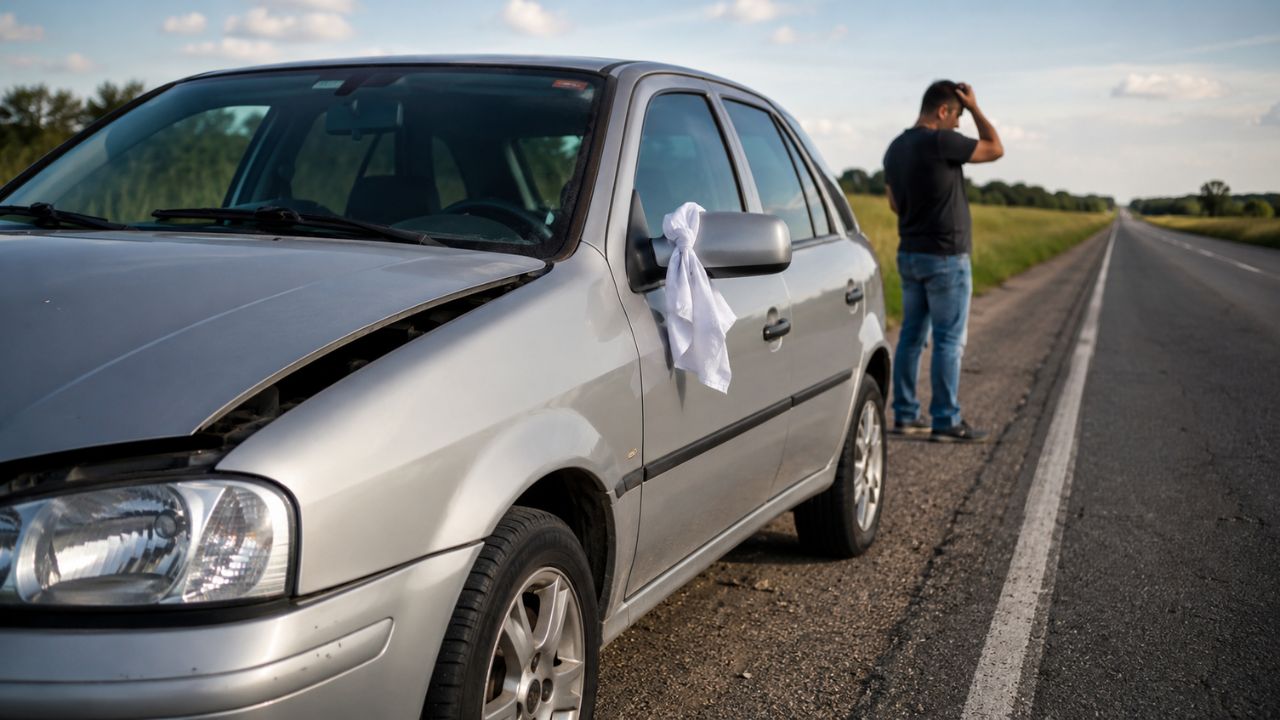
The white cloth on the car can indicate mechanical failure, lack of fuel, a call for help, or even participation in a funeral procession. Understand the meaning.
Seeing a white cloth tied to the mirror, door handle, or another part of a stopped vehicle can spark curiosity among many drivers. Although technology has made communication easier in recent years, this signal is still used on highways and roads to indicate that the driver is facing a problem and needs help. The practice has been known for decades and still serves as an important visual alert for other road users.
White cloth indicates breakdown, emergency, or request for help
According to Auto+, the main meaning of the white cloth on a vehicle is to signal an emergency situation. In most cases, the driver has suffered a mechanical breakdown, run out of fuel, or needs some type of assistance.
Before the popularization of cell phones, this resource was one of the few ways to communicate to other drivers that someone needed help. Even today, the method remains useful when the cell phone is out of battery or there is no phone signal in the area.
-
While the world looks at forests, the UN warns that the Earth is also threatened by the silent degradation of natural grasslands and savannas, ecosystems that cover half of the planet, support billions of people, and can exacerbate water, food, and climate crises.

-
Small pygmy hippopotamus is born in Germany, surprises veterinarians with healthy growth and steals the show at the Berlin Zoo

-
Brazilian mechanic invented a lamp made from a PET bottle during the 2001 blackout, the idea turned into an NGO present in 30 countries and has already illuminated 40,000 people in 200 communities without electricity in Brazil.
-
Centuries-old mystery gains new chapters in Greece after excavations reveal a possible lost temple of Poseidon, hidden among ancient lagoons, monumental remains, ritual objects, and an architectural plan that surprised even the experts.




Furthermore, the white cloth helps to show that the vehicle has not been abandoned. In this way, traffic agents, rescue teams, and highway concessionaires can more quickly identify that there is an ongoing incident.

The use of the white cloth as a form of signaling has been recommended in educational materials related to road safety. The guidance was to use a cloth or visible object to alert other drivers about the existence of a breakdown or accident until help arrives.
Thus, the signal functions as a kind of visual call for help, easily recognized by those traveling on the road.
Guidance has already been recommended in traffic safety materials
The use of the white cloth did not just emerge as a popular custom. The former National Traffic Department (Denatran), currently called Senatran, has already included similar guidelines in educational materials produced in partnership with the Brazilian Association of Traffic Medicine (Abramet).
The recommendations indicated the use of a cloth or visible object to signal breakdown or accident situations until help arrives, contributing to the safety of the occupants and other road users.
The white cloth does not always mean an emergency
Although it is best known for indicating mechanical problems, the white cloth can also appear in another very specific situation: funeral processions.
Traditionally, vehicles accompanying the hearse follow in a line, with headlights on and, in many cases, using hazard lights. In some regions, it was common to tie cloths or ribbons on the mirrors to identify which cars were part of the procession.
This identification helped other drivers recognize the procession and avoid interruptions in the group’s movement.
Many drivers are unaware that interfering in a funeral procession is not only considered disrespectful in many cultures. Brazilian legislation also provides for punishment for those who interrupt the passage of the procession.
Article 205 of the Brazilian Traffic Code (CTB) classifies this conduct as a minor infraction. The penalty includes a fine of R$ 88.38 and the registration of three points on the National Driver’s License (CNH).
How to identify the difference?
The interpretation depends on the context. If the vehicle is stopped on the shoulder or in an emergency area, the white cloth generally indicates mechanical breakdown, lack of fuel, or the need for help.
On the other hand, when the vehicle is in motion, accompanied by other cars with headlights and hazard lights on, forming an organized line, the cloth may indicate participation in a funeral procession.
In both cases, it is a signal that seeks to communicate a specific situation to other road users and promote more safety in traffic.






Be the first to react!