Portuguese
  Spanish


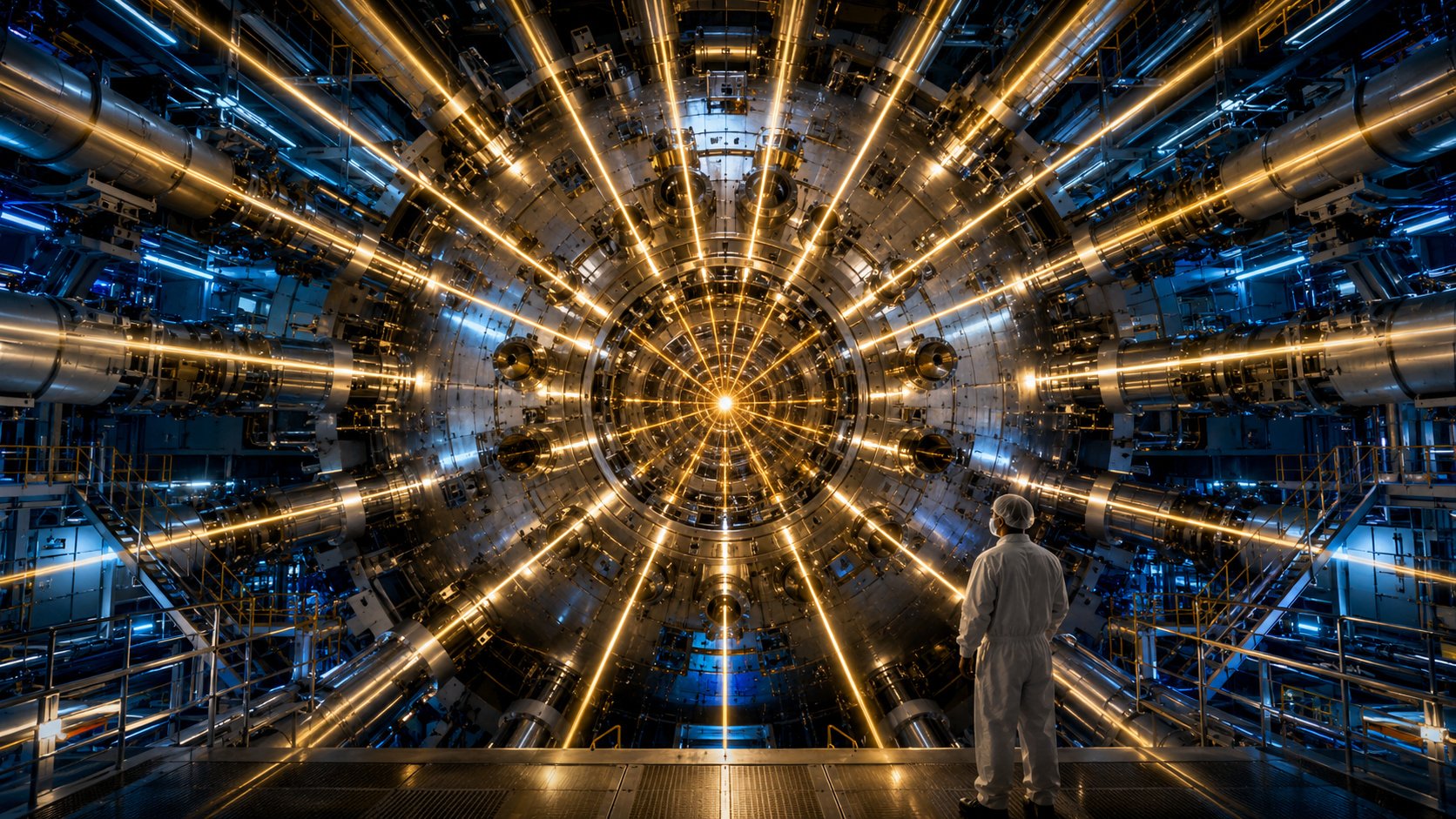


NIF uses 192 lasers to concentrate extreme energy on a microscopic target and study nuclear fusion under star-like conditions.
The world’s largest energy laser is located at the Lawrence Livermore National Laboratory in California and looks more like a science fiction structure than a common laboratory. Called the National Ignition Facility, or NIF, the system gathers 192 laser beams capable of concentrating extreme energy on a target approximately the size of a pencil eraser. According to the laboratory itself, the NIF delivers more than 2 million joules of ultraviolet energy and can reach about 500 trillion watts of peak power in just a few billionths of a second. The machine was created to study nuclear fusion, high energy density physics, and conditions similar to those found inside stars.
The National Ignition Facility uses 192 lasers to concentrate extreme energy on a single microscopic target
The NIF does not function like a common laser scaled up. It is a gigantic machine designed to guide, amplify, reflect, and focus 192 independent beams until they all arrive almost simultaneously at a small fuel capsule.
This capsule usually contains hydrogen isotopes used in fusion experiments. When the beams hit the target, the compressed energy generates extreme temperatures and pressures, creating the necessary conditions for atomic nuclei to come together and release energy.
-
China to Drill 15 Kilometers into the Earth, Set to Break Russia’s Record for Deepest Man-Made Hole

-
Researchers Use Algae to Enhance 3D-Printed Walls, Boosting Strength by 25% and Speeding Construction by 33%

-
Drill Uncovers Freshwater Rivers Hidden Beneath the Ocean Floor
-
3,000-Ton, 81-Meter Attack Submarine Begins Sea Trials, Equipped with Heavy Torpedoes and Anti-Ship Missiles


The technical challenge is brutal: the beams need to be synchronized with extreme precision, because any deviation can compromise the symmetry of the compression. In other words, the machine needs to “crush” the target from all sides with almost perfect regularity.
The power of 500 trillion watts lasts briefly but creates one of the most extreme environments on Earth
The figure of 500 trillion watts is daunting because it is greater than the instantaneous electrical power consumed by entire countries. But this energy is not sustained for minutes or hours: it appears in very short pulses, lasting only a few billionths of a second.
It is precisely this concentration in time that makes the NIF so powerful. The total energy, exceeding 2 million joules, is released in an extremely small window, creating a gigantic peak power within the target chamber.
The result is one of the most extreme physical environments ever produced in a laboratory, with temperature, pressure, and density capable of helping scientists study matter under conditions impossible to reproduce by conventional methods.
The target is smaller than an eraser, but it needs to receive energy from a gigantic installation
One of the most impressive contrasts of the NIF is the difference between the size of the machine and the size of the target. The installation occupies a huge area, with laser lines, mirrors, amplifiers, optical systems, shielding, and a spherical experiment chamber.

At the center of it all, however, is a tiny target. It is there that the beams converge after traversing long optical paths within the installation. The goal is to deposit enough energy to compress the fuel extremely.
This contrast helps explain why the NIF is so complex: a gigantic structure was built to control, with microscopic precision, an event that lasts less than a blink of an eye.
The machine was created to study nuclear fusion, the same process that powers the stars
Nuclear fusion occurs when light nuclei, such as hydrogen, unite to form heavier nuclei, releasing energy. This is the process that powers the Sun and other stars.
On Earth, however, reproducing this phenomenon in a controlled manner is extremely difficult. Atomic nuclei need to overcome electrical repulsions and reach extremely high temperature and pressure conditions.
The NIF attempts to do this by inertial confinement. Instead of keeping plasma trapped by magnetic fields, as in tokamaks, it uses lasers to quickly compress a small fuel capsule until fusion conditions are reached.
The laboratory achieved fusion ignition and entered the history of experimental physics
In December 2022, the NIF reached a historic milestone by achieving fusion ignition in an experiment announced by the United States Department of Energy. In practice, the energy released by the fusion reactions exceeded the energy delivered by the lasers to the target.

This result does not mean that commercial fusion plants are ready. The energy used to power the entire facility is still much greater than the energy delivered to the target, and turning this process into a viable electrical source requires many advances.
Even so, the milestone was decisive for experimental physics. For the first time, a laboratory fusion experiment demonstrated energy gain at the target, something researchers have pursued for decades.
The NIF also helps study safety, astrophysics, and matter in impossible conditions
Although nuclear fusion is the most well-known aspect, the NIF is not only used for energy research. The facility is also used in studies of national security, material behavior, laboratory astrophysics, and plasma physics.

By generating extreme pressures and temperatures, researchers can investigate how matter behaves in situations similar to planetary interiors, stellar explosions, and high-energy environments in the Universe.
This makes the NIF a kind of bridge between terrestrial engineering and cosmic phenomena. The machine allows scientists to test, on a controlled scale, processes that would normally only occur within stars, giant planets, or violent astronomical events.
The world’s largest energy laser shows that modern physics depends on almost unimaginable machines
The NIF represents a phase of science where some questions can only be answered with gigantic machines, extreme precision, and decades of investment. It is not enough to observe the Universe: in certain cases, it is necessary to recreate small parts of it within a laboratory.
With its 192 beams, over 2 million joules, 500 trillion watts peak, and microscopic target, the National Ignition Facility shows the current limit of engineering focused on fusion and extreme physics.
The strongest image is precisely this: a colossal facility concentrating energy in a tiny capsule to reproduce, for fractions of a second, conditions reminiscent of the interior of stars. Sources: Lawrence Livermore National Laboratory and National Ignition Facility.