






 Portuguese
  Spanish


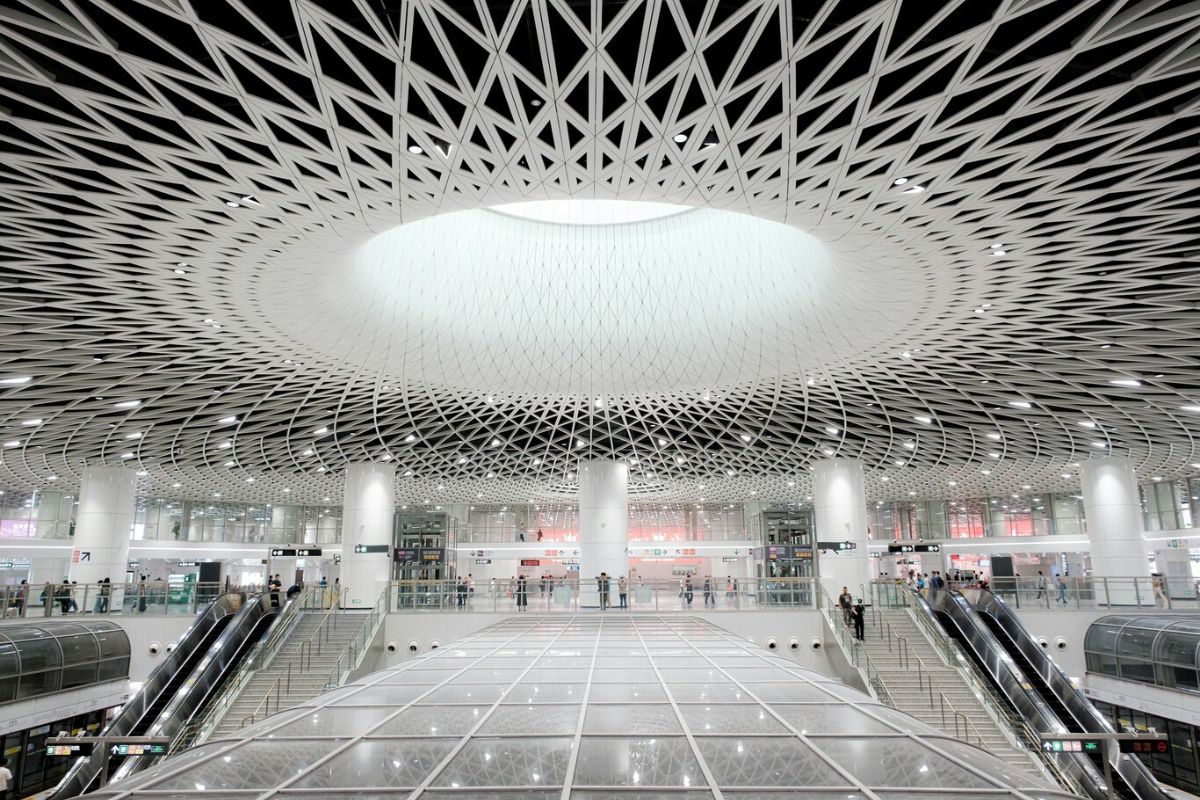


The Shenzhen metro combines accelerated expansion, ambitious station design, and automation, with a cost per kilometer lower than western cities and goals to reach 831 km by 2028
The Shenzhen metro has become one of the most visible symbols of the city’s transformation into a technological megacity, with 635 kilometers in length, 441 stations, and 17 lines in operation, including fully automated and driverless sections, such as Line 20.
The Shenzhen metro expanded at a rate of about 30 kilometers per year and has served as an urban and strategic showcase, delivering execution speed, user experience, and station designs that look like they came out of a science fiction movie, while maintaining a construction cost lower than that seen in the West.
A huge network that grew with the city
Shenzhen took about 20 years to have a metro system and another 20 years to transform this network into a reference, keeping pace with the population explosion and the consolidation of the city as a technological hub.
-
U.S. City Builds Tiny Home Village on Water Company Land to House 136 Homeless People: Inside the Social Housing Units

-
Woman Turns Shipping Container into Home, Embraces Rural Life to Cut Monthly Expenses to Just Over $330
-
France Revamps 530 Social Housing Units with Large Balconies and Glass Facades Without Demolishing Existing Buildings

-
Facing high rent, couple transforms parents’ garage into a fully functional apartment, creating a complete home at a fraction of the market cost.




Today, more than 17 million people live in the municipality, which has seen the birth of companies like Huawei, Tencent, DJI, and BYD, and this scale required territorial reorganization and aggressive transportation expansion.
The history of the Shenzhen metro is linked to the very history of Shenzhen, because the network grew to accommodate a metropolis that changed levels in just a few decades.
What makes the Shenzhen metro different from the West

The difference lies not only in size but in the rare combination of accelerated expansion and aesthetic ambition.
While many western projects prioritize functional solutions with controlled budgets, Shenzhen has built entire lines in just a few years and invested in striking stations, with architecture and interiors designed to impress.
This design choice is not a detail, it is a strategy, because the metro has become a showcase of the type of city that Shenzhen wants to project to the world.
Automated lines, high speed, and two operators

Within the railway labyrinth, the Shenzhen metro mixes semi-automated lines, fully automated and driverless lines, and high-speed lines like Line 11, which reaches 120 km/h.
The system also has an unusual feature: two operators share the network, with the Shenzhen Metro Group managing most of the lines and the MTR Corporation from Hong Kong operating Line 4 and Line 13.
This division adds complexity to the issue of interoperability and standardization, especially in a rapidly growing network.
Why the cost draws so much attention

The Shenzhen metro has become an example of how speed and quality can go hand in hand, and the third surprising factor is the cost.
China builds for about $250 million per kilometer in purchasing power parity, a cost between two and eight times lower than that of Western cities cited for comparison, such as Paris and New York.
The network stands out because it delivers large scale at a relatively lower cost, reinforcing the contrast with traditional infrastructure models in developed countries.
The metro as an urban catalyst and the TOD model
The Shenzhen metro not only transports but also organizes the city. The stations were planned under the TOD model, Transit-Oriented Development, encouraging urban growth around mobility axes.
This makes the system function as a catalyst for development, reorganizing neighborhoods, attracting investments, and consolidating centralities.
On a global scale, the network is becoming a methodological reference for uniting engineering, user experience, design, and territorial strategy.
Technical challenges and how they managed to build so fast
The underground did not make it easy. Weathered granite, high groundwater levels, and proximity to the Pearl River Delta required specialized machines, cement slurry injection, and even soil freezing. The climate also weighed in, with heat, high humidity, and recurring typhoons, requiring robust drainage and watertight gates.
The pace of 30 km per year has been made possible by large-scale prefabrication and meticulous planning, allowing for the manufacturing of station parts in factories and assembling them on-site like giant pieces.
And there is a deliberate visual component, with examples such as the Eye of Shenzhen at the Gangxia North Station, a ceiling inspired by origami, and maritime-themed integration at the Sea World station.
Railway More Properties and the Expansion Plan Until 2028
A central point of financing is the Railway More Properties model, imported from Hong Kong. The operator builds the subway and receives the right to develop land around the stations with apartments, offices, and shopping centers, using real estate revenue to support railway investment.
The future is also mapped out. By 2028, the goal is to reach 831 kilometers with nine new lines in Phase V. Between 2030 and 2035, the aim is to exceed 1,000 kilometers and expand the leap from metropolitan to regional, with direct connections between Shenzhen and cities in the Greater Bay Area.
The big test will be to see how a network that grows so quickly handles maintenance, aging, and system heterogeneity, a challenge that the city still needs to face.
If you could bring one element of the Shenzhen subway to Brazil, would you choose the construction speed, the driverless lines, or the Railway More Properties model?








