Led by geophysicist Sunyoung Park from the University of Chicago, scientists measured a displacement of 5 to 6 millimeters that moved the entire Japan, from Hokkaido to Kyushu, to the east. The energy released was equivalent to a magnitude 7.5 earthquake, in an unprecedented seismic event.
When a magnitude 9.0 earthquake shook Japan on March 11, 2011, at 2:46 PM local time, practically the entire country shifted east about 15 minutes later, and now scientists have discovered that this movement was an extraordinary and previously undocumented seismic phenomenon. The conclusion is from a new study led by geophysicist Sunyoung Park from the University of Chicago.
According to the study, after years of analyzing GPS data and seismic records, the team discovered that the waves generated by the earthquake reached the Earth’s core and then bounced back to the crust, displacing four major tectonic plates. The displacement was small, 5 to 6 millimeters, but permanent, covering about 3,000 kilometers from Hokkaido to Kyushu and released energy equivalent to a magnitude 7.5 earthquake, according to CNN Brasil.
The day the entire Japan moved east
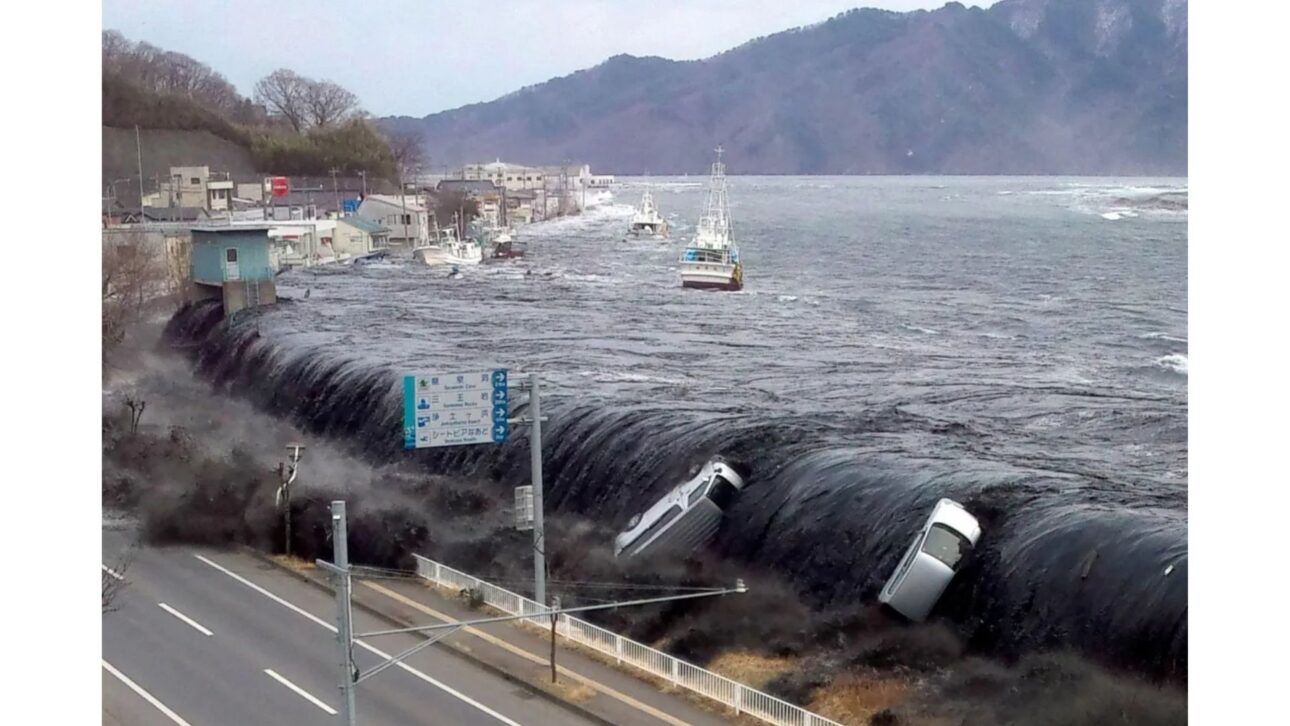
When the magnitude 9.0 earthquake shook Japan on March 11, 2011, the ground experienced a more lasting displacement, and about 15 minutes after the event began, practically the entire country moved east, according to GPS station measurements.
-
NASA captures heart-shaped pink lagoon in Argentina’s salt flats

-
To Aid Mars Missions, 12 Volunteers to Spend 60 Days in Bed Without Getting Up, Earning €18,000 in Study Starting 2026
-
Extreme Heat of 41.3°C Warps Roads in Germany, Causes Autobahn Asphalt to Crack, Injures People, and Forces Snowplows to Cool Down Highways

-
AI Security System in Brazil Aims to Cut False Alarms by Differentiating Pets from Intruders, Enhancing 24/7 Monitoring for Homes and Businesses



The displacement was small, 5 to 6 millimeters, but permanent, a signal that scientists would only decipher years later.
At the time, the movement went unnoticed by most or was attributed to a data error, but geophysicist Sunyoung Park believed that the recorded signals pointed to something concrete.
After investigating, scientists concluded that the ground movement reflected an extraordinary and previously undocumented seismic phenomenon.
“Basically, all of Japan shifted in an almost uniform and simultaneous manner,” stated Park, who led the research.
The waves that went to the Earth’s core and returned
After years of analyzing GPS data and seismic records, Park and his colleagues discovered that the waves generated by the earthquake propagated to the Earth’s core and then bounced back to the crust, displacing four major tectonic plates.
The movement affected Japan’s main territory, from Hokkaido to Kyushu, over about 3,000 kilometers, and did not coincide with the timing of the initial earthquake, according to the scientists.
Although seismologists already knew that waves from large earthquakes could travel through the planet’s interior and reflect off the outer core, composed of liquid metal, it was believed that the energy dissipated before returning to the crust.
For scientists, the novelty lies precisely in a wave that penetrates deep and triggers an event of such vast scope, something not seen before.
A national displacement, different from common earthquakes
Although earthquakes can cause drastic ground movements, with ruptures and the displacement of large areas by several centimeters, these movements tend to be more localized than the nationwide event detected by scientists.
Geophysicist Goran Ekstrom, from Columbia University, who did not participate in the study, noted that in the 2011 earthquake, the two plates sliding over each other under Japan moved about 10 meters.
According to Ekstrom, this rapid movement was what generated the ground shaking and the tsunami, as well as causing Honshu, Japan’s largest island, to shift about 20 centimeters to the east.
The displacement discovered by scientists, although smaller, is notable for occurring over such a vast area, being the most extensive ever recorded, and for releasing energy equivalent to a magnitude 7.5 earthquake, according to a press release.
A new seismic risk that can be predicted
The March 2011 earthquake, which struck a region 372 kilometers northeast of Tokyo, was the worst ever to occur in Japan, as it triggered a gigantic tsunami and a nuclear crisis, as well as causing the death of about 20,000 people.
Based on the new findings, scientists warn that authorities should be aware of this previously unknown source of seismic risk.
Unlike aftershocks, which cannot be predicted with precision, the round trip to the Earth’s core, a distance of about 5,800 kilometers, takes approximately 15 minutes, making it a seismic event that can be predicted and prepared for.
However, as the energy was distributed over an extremely wide area, the tremor was felt with less intensity and caused less damage than a typical magnitude 7.5 earthquake, which would concentrate the energy in a smaller area, according to scientists.
The discovery and the questions it raises
Japan has a high-level network of seismic and satellite monitoring stations that makes it possible to record such an event, said Vedran Lekić, a professor at the University of Maryland, who did not participate in the study but praised the scientists’ work.
According to him, however, it is possible that this type of phenomenon occurs in other regions with little instrumentation, where it cannot be definitively documented.
“This type of phenomenon occurs in other parts, in regions with little instrumentation,” said Lekić, by email.
The scientists said they considered other explanations for Japan’s eastward shift, including an underwater landslide, but argued that the impact of such an event would be much more localized.
For geophysicist Amanda Thomas, from the University of California, Davis, who also did not participate in the study, the research is very significant if the data interpretation is correct.
“Large earthquakes can continue to influence fault systems in unexpected ways,” said Thomas, who added that science still does not fully understand how faults work.
More than a decade after the magnitude 9.0 earthquake that shook Japan in 2011, scientists discovered that its waves traveled to the Earth’s core and back in about 15 minutes, shifting the entire country eastward by 5 to 6 millimeters at the same time, from Hokkaido to Kyushu, the most extensive movement of its kind ever recorded, with energy equivalent to a magnitude 7.5 earthquake.
Led by Sunyoung Park, from the University of Chicago, the study reveals a previously unknown seismic risk that, unlike aftershocks, could be anticipated, although scientists emphasize that the interpretation still needs confirmation and that science does not fully understand how fault systems behave.
The discovery, the team notes, adds another piece to the puzzle of how major earthquakes continue to act long after the main rupture.
And you, what did you think of the discovery that the 2011 earthquake in Japan moved the entire country through waves that reached the Earth’s core and returned? Do you believe this hidden seismic risk can be detected in other regions of the world? Share your opinion and exchange ideas with other readers about science and the planet.