Portuguese
  Spanish


Pakistan’s reforestation program gained international prominence by combining environmental recovery, climate adaptation, and rural job creation, but the official numbers require careful reading regarding goals, results, and monitoring.
Pakistan has been mentioned in environmental reports and international forums because of a reforestation program created to respond to effects associated with the climate crisis, such as extreme heat, floods, soil erosion, and loss of green areas.
The number of 10 billion trees, however, requires precision: official sources treat this volume as the national goal of the Ten Billion Tree Tsunami Programme, not as a quantity proven to have been planted in just three years.
The first phase of the program, planned for the period from 2019 to 2023, aimed to plant or regenerate 3.29 billion plants in different regions of the country.
-
Cape Verde’s World Cup Surprise: Betting on Electric Cars, a 5 MW Solar Plant, and an Ambitious Plan to Transform Energy for 600,000 Residents

-
Man Finds 1,469 Ancient Roman Silver Coins While Metal Detecting in Romania
-
Young Brazilian Siblings Go Viral for Catching Giant Fish, Launch Sport Fishing Project
-
72-Year-Old Retired Professor from Rural Brazil Recites 247 Digits of Pi in One Minute, Setting National Memory Record


The focus on large-scale planting is related to Pakistan’s vulnerability to extreme climate events and the low forest cover of the territory.
In rural communities, these effects appear in outdoor work during heatwaves, the loss of agricultural areas due to erosion, and the damage caused by heavy rains.
Reforestation, in this context, has been incorporated into public policies as a measure of climate adaptation, income generation, and environmental recovery.
Reforestation in Pakistan and climate vulnerability
The urgency of the issue is linked to the country’s limited forest cover.
Data cited by the United Nations Environment Programme indicate that about 5% of Pakistan’s territory is covered by forests, a percentage considered low for a country with arid regions, mountainous areas, extensive rivers, and a strong dependence on agriculture.
The lack of vegetation increases the exposure of slopes, riverbanks, and agricultural areas to erosion and degradation processes.
In places where the soil is unprotected, heavy rains can carry sediments, compromise crops, and increase risks in communities near unstable areas.
The floods of 2022 reinforced this debate.
According to the World Bank, the floods affected 33 million people and left more than 1,730 dead in Pakistan.
The disaster also caused displacements, infrastructure damage, and economic losses, which expanded the discussion on prevention and adaptation measures in the country.
In this scenario, trees began to be used on more than one front.
Vegetation can help reduce erosion, promote water infiltration into the soil, protect riverbanks, and restore degraded areas.
In rural communities, reforestation programs can also create jobs in nurseries, planting activities, maintenance of recovered areas, and monitoring against illegal logging.
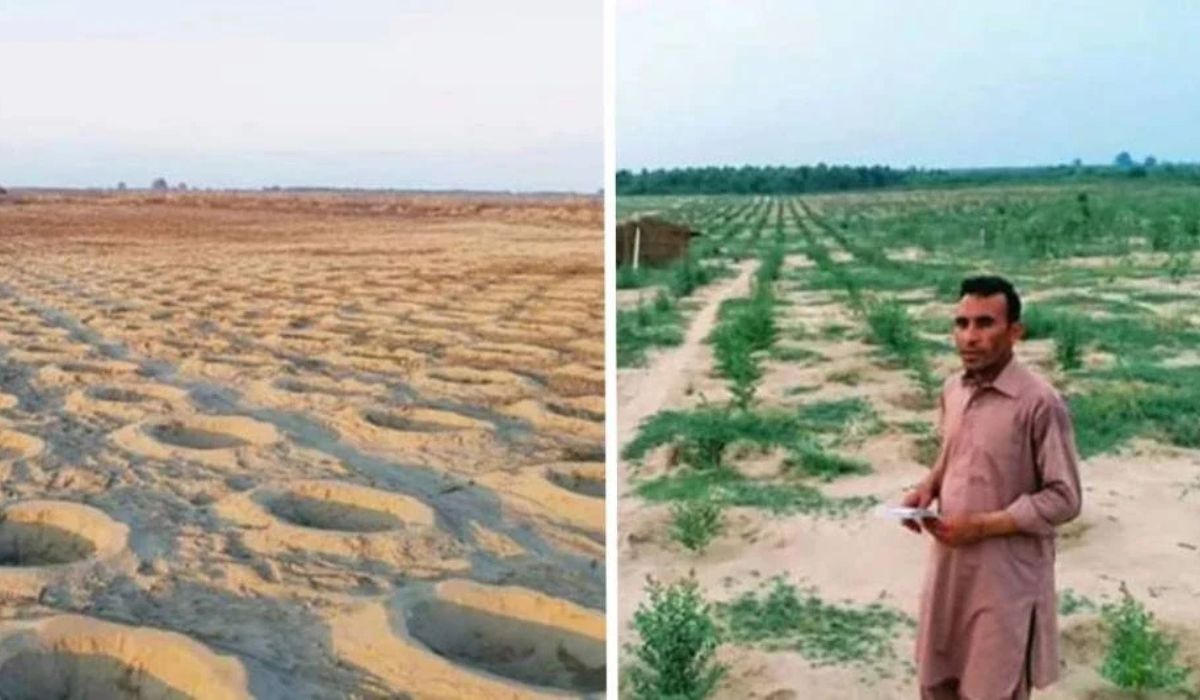
Billion Tree Tsunami served as a basis for the national program
The national 10 billion tree project was based on a previous initiative, the Billion Tree Tsunami, carried out in the Khyber Pakhtunkhwa province in northwest Pakistan.
This first phase combined direct planting with assisted natural regeneration, a method that protects degraded areas to allow the recovery of existing vegetation.
According to the World Economic Forum, Pakistan reached the mark of one billion trees in August 2017, ahead of the initially planned deadline.
The initiative also restored about 350,000 hectares of forests and degraded lands, according to the same source.
The experience in Khyber Pakhtunkhwa helped guide the expansion of the model to other regions.
The logic was not limited to seedling distribution.
The project included nurseries, area protection, local community participation, and monitoring of recovering lands.
The Ten Billion Tree Tsunami Programme was launched on September 2, 2018, during Plant for Pakistan Day.
The implementation began to involve the Ministry of Climate Change of Pakistan and provincial and territorial departments of forests and wildlife.
Among the official objectives were to recover forest and wildlife resources, strengthen protected areas, encourage ecotourism, engage communities, and create jobs related to conservation.
How large-scale tree planting works
The reforestation adopted by Pakistan brought together different strategies, according to the type of terrain and the level of degradation.
In areas without sufficient vegetation cover, the approach was direct seedling planting.
Where there were still seeds, roots, or sprouts, the priority could be to protect the area, control grazing, and prevent cutting to favor natural regeneration.
This difference is relevant because the outcome of a program of this magnitude does not depend solely on the number of seedlings placed in the soil.
The survival of the trees requires adequate conditions of climate, soil, water, maintenance, and protection against animals or illegal wood removal.
The program also mobilized nurseries and local workers to produce seedlings, prepare land, and monitor areas in recovery.
In a study on the previous phase in Khyber Pakhtunkhwa, the Pakistan Institute of Development Economics cited a survival rate of 88% for the plants and the creation of more than 500,000 green jobs.
Another central point was the choice of species.
In mountainous areas, the selection tends to consider trees adapted to slopes and cold climates.
In drier regions, resistant species with deep roots can contribute to soil protection and moisture retention.
Suitability to the environment avoids problems associated with planting species incompatible with water availability, local biodiversity, or agricultural use of the territory.
Reforestation results in Khyber Pakhtunkhwa
Remote sensing research indicates recovery of vegetation cover in analyzed areas of Khyber Pakhtunkhwa.
A study published in the journal Environment, Development and Sustainability pointed out that, in the researched area, healthy forest cover fell from 20% in 1990 to 2% in 2010, but rose to 35% in 2021 after reforestation and protection actions.
The same study recorded an increase of 1,951 km² of healthy forest cover in the analyzed area by 2021.
These data show progress in specific regions, but do not prove, by themselves, that the national goal of 10 billion trees has been achieved in three years.
In reforestation programs, experts and environmental institutions usually consider not only the total number of seedlings planted but also the survival rate, species diversity, continuity of protection, and effects on soil, water, and biodiversity.
The program also received critical analyses.
A study by the International Institute for Environment and Development pointed out that large planting initiatives can produce unequal benefits when landless communities, shepherds, and more vulnerable groups are left out of decisions or receive little participation in the gains.
The assessment indicates that large-scale restoration projects need to combine environmental goals with social inclusion, transparency, and monitoring.


Ten Billion Tree Tsunami and the impact on rural communities
The case of Pakistan draws attention because it linked tree planting to climate adaptation policies, rural employment, and the recovery of degraded areas.
Instead of treating the tree merely as vegetation cover, the program began to associate it with environmental services and local economic activities.
In practice, seedlings can come from community nurseries, workers can be hired for planting and maintenance, and recovering areas can receive surveillance against illegal logging or excessive grazing.
In rural regions, this structure brings environmental protection closer to immediate demands, such as income, soil stability, and water availability.
The difference between planting and restoring also helps to understand the program’s scope.
Planting means placing a seedling in the soil.
Restoring involves creating conditions for the area to function again as an ecosystem, with suitable species, protected soil, presence of fauna, water, and participation of nearby communities.
Therefore, the Pakistani model combined direct planting, natural regeneration, nurseries, area fencing, and monitoring.
The goal of 10 billion trees synthesizes the program’s ambition, but the evaluation of results depends on broader indicators, such as seedling survival, effective vegetation recovery, social impact, and maintenance of areas over the years.

Experience shows how an environmental policy can engage with agriculture, water security, employment, and climate risk prevention.
In a country affected by floods, droughts, and erosion, reforestation has become part of an agenda that goes beyond the landscape and involves how communities adapt to environmental changes.