Portuguese
  Spanish




Chinese automaker accelerates strategy in the country with new electrified model, production in Camaçari, and proposal focused on energy efficiency, versatility, and competitiveness in the segment
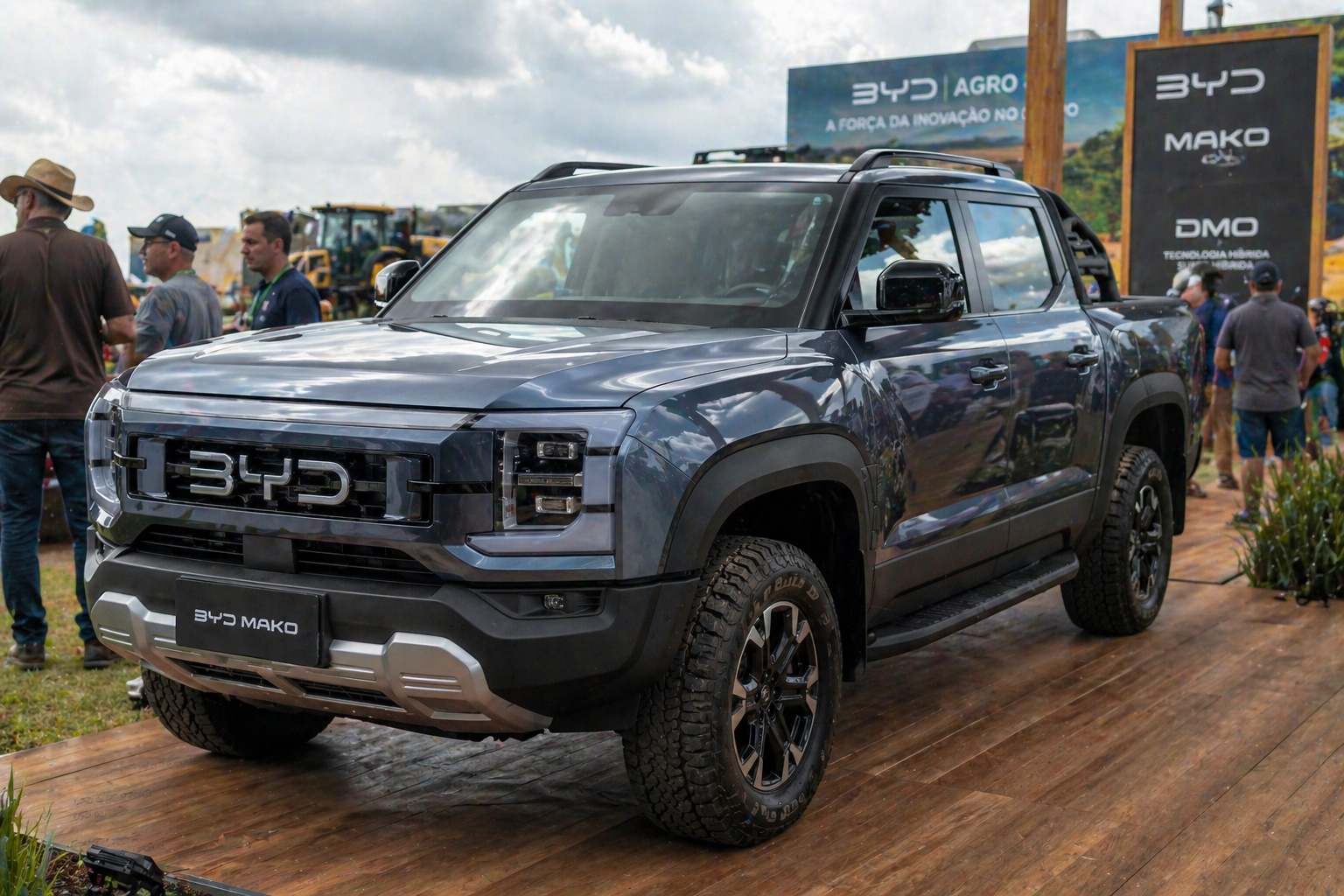
BYD is ready to take an important step in the Brazilian automotive market. The information was released by “CNN Auto”, based on an investigation by journalist Jorge Moraes, and reveals that the brand is preparing to launch the new hybrid flex pickup Mako. The model will be officially presented in September and has already appeared without camouflage during the Agrishow, indicating that its commercial debut is very close.
Moreover, the arrival of the Mako is part of a broader strategy by the automaker in the pickup segment. The new model will be the second in a line composed of four vehicles, starting with the BYD Shark. At the same time, the company confirmed that production will be national, at the Camaçari plant in Bahia, which reinforces the brand’s commitment to the Brazilian market.
Design aligned with the brand’s identity and direct focus on established competitors
Visually, BYD’s new pickup follows the brand’s recent language. In the images captured by Eduardo Rodrigues, it is possible to see that the front of the Mako features elements similar to those of the BYD Song Pro, especially in the headlight assembly and front grille.
-
End of the Affordable Car Era: Fiat Argo 1.0 2026 Offers 14.7 km/l Efficiency and Easy Maintenance, but $18,000 Price Raises Cost-Benefit Concerns

-
Honda XR 300L Tornado Special Edition 2026: Off-Road Focused Motorcycle with 293.5cc Engine, 24.3 HP, Priced at $6,200
-
Indian Government Offers Up to $1,000 Incentive for Drivers to Swap Old Cars for Electric Vehicles

-
Tesla Begins Testing Two-Seater Autonomous Robotaxi Without Steering Wheel or Pedals, Featuring Onboard Safety Monitor


This choice is not by chance. On the contrary, the automaker seeks to maintain a consistent visual identity among its models, which strengthens brand recognition in the market.
However, the main highlight is the strategic positioning. BYD does not hide its intentions and places the Mako directly in competition with models already established in Brazil, such as the Fiat Toro, the Ram Rampage, and the Ford Maverick.
Furthermore, in a second phase, the brand’s strategy includes advancing also over the Fiat Strada, which currently leads sales in the country. In this way, BYD expands its presence in different ranges of the pickup segment.
Hybrid flex engine promises efficiency and high performance

One of the main differentials of the new Mako pickup is in the engine. The model will adopt a hybrid flex plug-in system, based on the technology already used in the BYD Song Pro.
The expectation is that the pickup will deliver about 235 hp of power, combining performance and energy efficiency. In addition, the model should offer an electric range close to 100 km, which allows driving without fuel consumption in urban routes.
Another relevant point is the combined consumption, estimated at around 35 km/l, a number that draws attention within the pickup segment, traditionally known for higher fuel consumption.
The range should also bring different configurations. The 4×2 traction versions will be aimed at more rational and professional use, while the more complete versions will have 4×4 traction, ensuring greater versatility for different types of terrain.
Competitive price and national production reinforce BYD’s strategy
Regarding the price, the estimate is that the BYD Mako will enter the market in the range of R$ 220,000. With this, the model directly enters the competition with more equipped versions of its main competitors.
In addition, the production nationally in Camaçari (BA) can be a decisive factor. This is because local manufacturing tends to reduce logistical costs, facilitate market supply, and make the product more competitive.
At the same time, this strategy indicates an adjustment in BYD’s positioning in Brazil. After a reception below expectations for the BYD Shark, the brand now bets on a product more aligned with the Brazilian consumer profile.
This audience, especially in the pickup segment, tends to be more conservative. Therefore, the combination of hybrid technology with practical features may be the necessary differential to gain space.
More competitive market can benefit consumers
With the arrival of Mako, the pickup truck market scenario in Brazil tends to become even more competitive. The entry of a high-performance flex-hybrid model can pressure traditional competitors to innovate even further.
Consequently, the final consumer can benefit, with more options available, better technologies, and possibly more competitive prices.
Therefore, BYD’s new pickup truck does not just represent the launch of another model. It symbolizes an important change in the dynamics of the Brazilian automotive sector, especially with the growing presence of electrified vehicles.
Do you think a flex-hybrid pickup truck like the Mako has the potential to compete head-to-head with the leaders of the Brazilian market?