Portuguese
  Spanish


Led by Beijing, China’s system also has support from Hong Kong and uses blockchain for direct transactions between central banks in digital currencies. It has already moved about 470 billion yuan, but there is no official launch date and the project is in a dispute with the United States.
China advances in preparations to commercially launch mBridge, a digital payments system supported by Saudi Arabia, the United Arab Emirates, Thailand, and Hong Kong, which promises to accelerate international transactions, reduce costs, and decrease dependence on the dollar in global trade. The information comes from the Financial Times, which detailed the platform’s advancement and its role in the dispute for influence over the American currency.
According to the FT’s investigation, the initiative is led by Beijing and seeks to expand the global use of the digital renminbi. There is still no officially announced date for the commercial launch, but preparations are in an advanced stage, with fees expected to be half the cost of traditional international systems. An entity based in Hong Kong is expected to be created to oversee operations.
Payments in seconds and half the cost of Swift
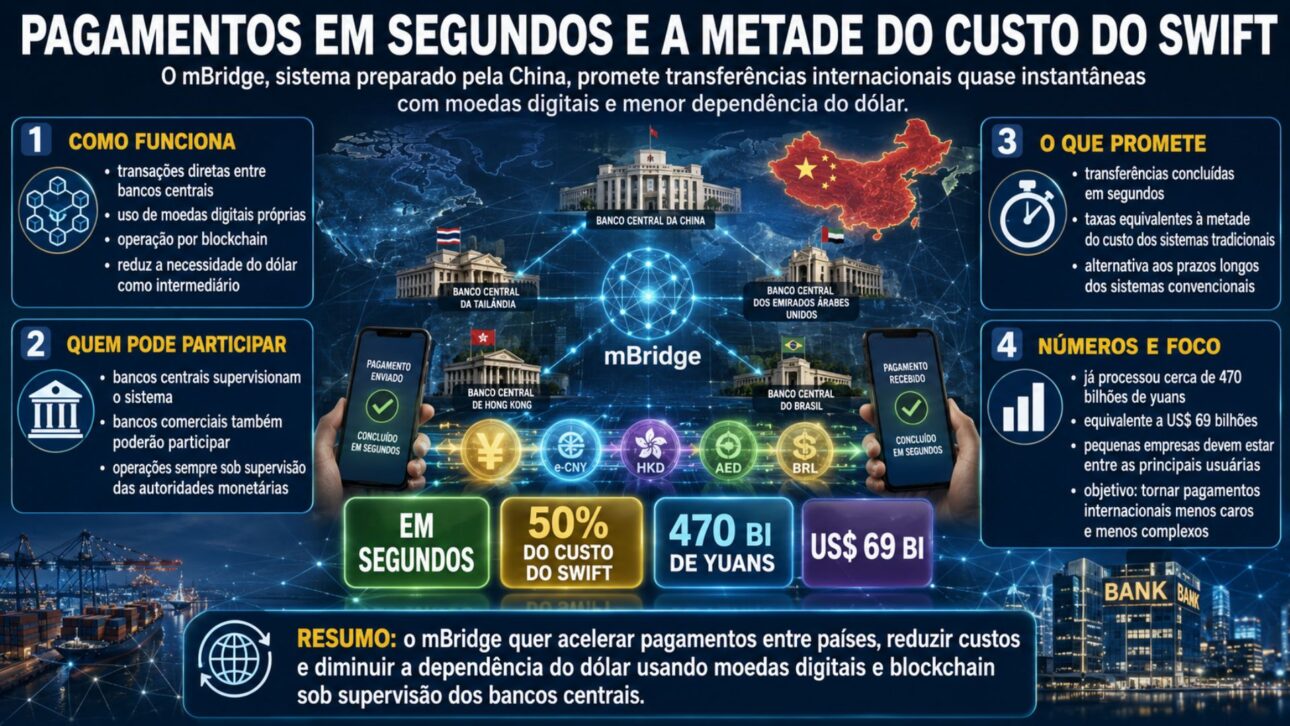
The central promise of mBridge, the system China is preparing, is to make transfers between countries almost instantaneous. According to information released in June by the portal Brasil 247, the technology allows direct transactions between central banks using their own digital currencies, operating via blockchain and reducing the need for the dollar as an intermediary currency in exchange operations. Commercial banks will also be able to participate, always under the supervision of the respective central banks.
-
Teen Invents Promising AI Device to Detect Eye Misalignment Using 3D-Printed Visor and Small Cameras for $300

-
Bosch Unveils Series 8 Dishwasher with Zeolith Drying, Voice Control, and Energy-Efficient Features

-
Brazilian Students Develop “Reminder Robot” to Help Seniors with Medication Management Using Arduino Technology

-
Canada Makes Historic Decision to Purchase New German Submarines in $70 Billion Defense Program, Replacing Aging Victoria-Class Fleet by 2033




The expectation is for operations to be completed in seconds, not the long timelines of conventional systems. Fees are expected to be half the cost of traditional international platforms, and the forecast is that small businesses will be among the main users, as they often face difficulties with systems like Swift, seen as expensive and complex. So far, mBridge has processed about 470 billion yuan, equivalent to US$ 69 billion, in transactions.
The Digital Renminbi and Beijing’s Strategy
The move fits into China’s effort to give its currency more global reach. The goal of mBridge is to strengthen the use of the digital renminbi, also known as e-CNY, in international transactions made more directly, quickly, and cheaply. The platform is presented as a way for the Chinese currency to occupy more space in trade between countries.
The push gained momentum amid recent international tension. The advance accelerated after the war in Iran, a period during which the adoption of Cips, China’s cross-border renminbi clearing and payment system, often compared to Swift, grew. However, mBridge is a separate and complementary initiative and emerges in a scenario of multiplying regional and private alternatives, such as Sepa from the European Central Bank, and private sector cross-border QR code networks, like Ant Group.
The Silent Struggle for Alternative Financial Networks
The growth of these initiatives points to a reorganization of the global payment system. Historically dominated by Swift, this system is undergoing a process that, according to experts, reveals a silent struggle for new financial infrastructures. “There is a silent arms race of alternative financial systems happening behind the scenes,” said Tom Keatinge, founding director of the Centre for Financial Crime and Security Studies at RUSI in the UK, commenting on the adoption of stablecoins by the United States under President Donald Trump.
The payment map no longer has a single center. Stablecoins are crypto-assets linked to currencies like the dollar, and, according to Gene Ma, head of China research at the Institute of International Finance, the global scenario has become divided among competing platforms, with mBridge poised to become one of them. Analysts believe the platform could reinforce China’s position in international trade and deepen ties with partners linked to the so-called New Silk Road.
Sanctions, US Pressure, and Anti-Money Laundering Rules
The project is closely monitored due to a specific geopolitical concern. Since adopting its current name and format in 2021, with the participation of the Bank for International Settlements and the central banks of Dubai, China, and the United Arab Emirates, mBridge has faced a recurring question: whether the system could allow countries or entities to reduce their dependence on the dollar and circumvent international sanctions. Its origin lies in a previous initiative between Hong Kong and Thailand, the Inthanon-LionRock.
The two sides of the controversy appear behind the scenes of governance. In 2024, the Bank for International Settlements transferred the project to the partners, a decision the report associates with pressure from Washington, although the then head of the BIS, Agustín Carstens, denied such pressure. The BIS and authorities from the People’s Bank of China assert that mBridge follows the anti-money laundering rules of the Financial Action Task Force, the body responsible for tackling illicit financing networks.
China is preparing the commercial launch of mBridge, a blockchain payment system supported by Saudi Arabia, the United Arab Emirates, Thailand, and Hong Kong, which promises international transactions in seconds at half the cost of Swift, reduces the role of the dollar as an intermediary currency, and boosts the digital renminbi.
The platform has already moved about 470 billion yuan, or US$ 69 billion, still without an official launch date, and is seen by experts as part of a silent race for alternative financial networks, where concern about sanctions coexists with the promise of complying with FATF’s anti-money laundering rules.
For Wang Jian, the chief financial sector analyst at Guosen Securities, the system “accelerates cash flow and reduces the risk of liquidity tensions” for exporters and can support the internationalization of the Chinese currency.
And you, do you believe that systems like mBridge can truly shake the dominance of the dollar in international trade, or is it still too early to say? Does a world with multiple competing payment networks bring more efficiency or more risk? Share your opinion and exchange ideas with other readers about the energy sector and global finance, with respect for different views.