Portuguese
  Spanish


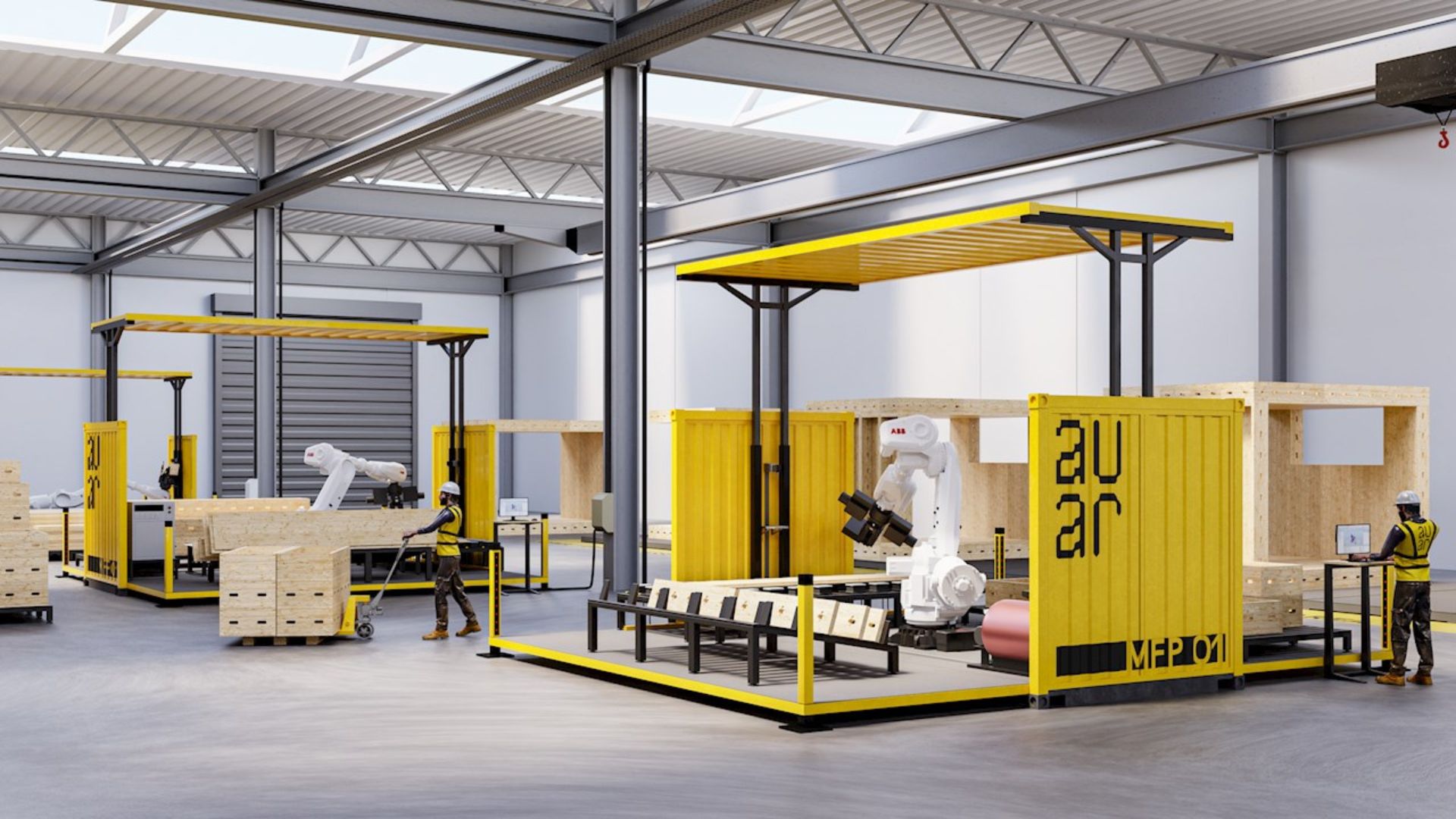

Compact technology changes the logic of construction by bringing the factory to the site and concentrating structural production in a few hours, promising to reduce costs, waste, and dependence on large teams.
The British AUAR has been testing a production model that shifts part of the construction to a compact, transportable, and automated unit, installed near the site where the building will be assembled.
In practice, the proposal is not to deliver a ready house in 24 hours, but to manufacture, within that timeframe, the structural wood panels that form the walls, floors, and part of the main envelope of the residence.
According to the company, a microfactory of this type can produce all the panels of a typical house in about eight hours.
-
28-meter, 156-ton titans traveled 20,000 km from China to the port of Santa Catarina: Portonave received 7 fully electric megacranes, part of a R$ 210 million package, to double container handling.

-
They exchanged the idea of a large house for a 35 m² warehouse, spent US$ 12,000 on the structure, and created a tiny house in Colorado with space to live and work.

-
A newly opened terminal in the middle of the Amazon has begun transporting soy and corn through Amapá, eyeing the queue of ships that is congesting the ports in the South.

-
Goodbye to old tiles: renovation technique without construction transforms bathrooms in a few hours, eliminates debris, and reduces costs with coverings using special paints, high-resistance adhesives, and modern finishes that completely renew the space.


In material released by ABB about the partnership with AUAR, the reference is similar, indicating that the core and structural shell of a dwelling can be manufactured in less than 12 hours, before proceeding to accelerated assembly on-site.
This shifts the center of gravity of construction, but does not eliminate the construction site nor does it dispense with workers.
Foundation, installation of components, closures, building systems, and finishes remain outside the microfactory, which positions automation as an industrial step of the structure, rather than a complete substitute for residential construction.
How the AUAR robotic microfactory works

The process begins with the MasterBuilder software, AUAR’s platform that converts the design into manufacturing data, sequencing, and quality control.
After this digital stage, the microfactory is brought to the site, installed in a few hours, and begins producing the panels in parallel with the construction schedule, with operation assisted by personnel trained by the company itself.
Instead of concentrating everything in a permanent industrial plant, the model bets on decentralized production.
AUAR states that the client does not need to purchase a factory, robots, or equipment, as the operation is offered in a service logic, while the remuneration is linked to the use of the system and the volume of panels produced.
The company also associates this format with margin gain and predictability.
On the official website, AUAR states that its microfactory can deliver a 20% lower cost than that of manufacturers of components and structural teams assembled directly on-site, an argument used to support the commercial viability of the model in markets with pressured labor and unstable schedules.
The choice of wood appears not only as a material decision but as part of the logistical engineering of the system.
Lightweight and modular timber frame panels are more compatible with robotized production, regional transport, and quick assembly, which helps explain why the company presents the microfactory as an alternative to fixed factories and sites marked by cutting, adjustment, and rework on-site.
In environmental discourse, AUAR and ABB link the proposal to waste reduction and manufacturing closer to the final destination of the construction.

ABB reminds us that construction accounts for about 40% of global CO2 emissions, although the environmental outcome of each project continues to be conditioned by the origin of the wood, transportation, energy consumption, and the other stages that follow outside the robotic cell.
Real projects and international expansion of the technology
The most concrete advancement disclosed so far appeared at the end of 2024, when AUAR announced the completion of its first building entirely manufactured by a pop-up robotic microfactory, in partnership with the Belgian construction company Vandenbussche.
The two-story building was designed as a housing unit but initially served as an office, with walls, floors, roof, and internal partitions produced in the automated system.
This case helped to take the technology out of the purely demonstrative field and put it into a verifiable application.
Specialized coverage of the project reports that the structure could be pre-fabricated in less than eight hours, using AUAR’s proprietary software to generate both the design and the code that guided the robotic production.
Another relevant front was opened in the United States, where Rival Holdings announced, in September 2024, the shipment of two AUAR microfactories to serve the Midwest market.
According to the American company, each unit has the capacity to produce up to 180 houses per year, a figure used to reinforce the thesis of scale without the need to deploy a heavy industrial plant in each region.
In February 2025, the partnership with ABB gained new visibility with the announcement of the ConstrucThor project in Belgium.

The installation was presented as a research center for energy-neutral infrastructure and climate-neutral building materials, combining industrial automation, wood manufacturing, and applied testing for a more predictable supply chain that is less dependent on waste.
AUAR also reports that there were already microfactories in operation or launched in the UK, Belgium, and the United States when this agreement was announced.
The central point of the model, since then, remains the same: to transform a container with robots and software into a manufacturing unit close to the construction site, capable of industrializing the structural phase without requiring a fixed factory for each builder.
The practical effect of this change is less about the idea of an “instant” house and more about the redistribution of work along the chain.
The manufacturing of the structure moves from the improvisation of the construction site, enters a controlled environment, and returns to the site with a function more concentrated on assembly, closure, and finishing, preserving human presence but altering where and how the heavy work truly begins.