






 Portuguese
  Spanish
  3 min of reading
  0 comments


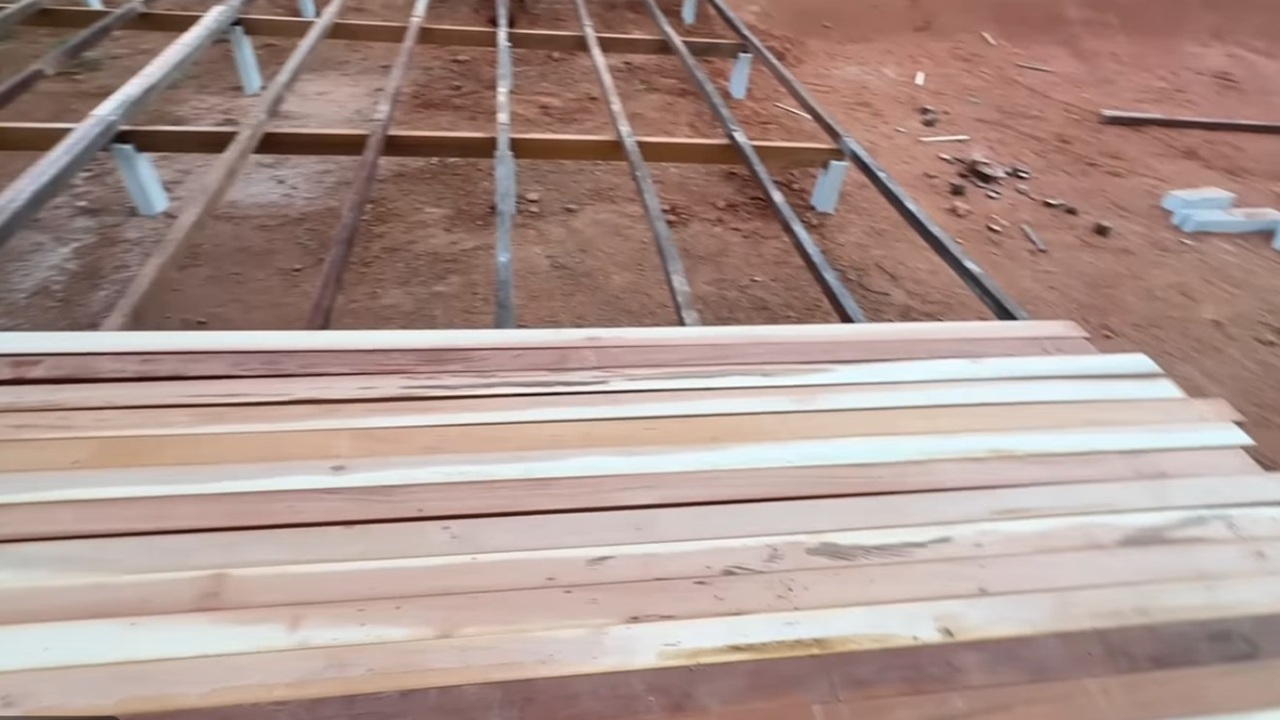
Homeownership project advances with the construction of an 8×8 meter deck, marked by 25 holes in the ground, concrete pillars, muiracatiara wood, and unforeseen events that delayed the work
The homeownership project began to take shape amidst cold, cloudy skies, improvisations, and a lot of determination in a video on the channel Faby Franco – Obras, Reformas e Diy.
On the land chosen for its privileged view, Faby Franco started one of the most important stages of construction: assembling the 8 by 8 meter deck, a structure that will serve as the base for the project’s first house.
Land marking and choice of pillars
Before any drilling, it was necessary to square the area. Since the land didn’t appear visually aligned, the marking was based on the back and side fences. The structure was positioned on a firmer part of the soil, avoiding a region with a steep slope and loose soil, where a retaining wall or even a suspended porch might be needed in the future.
-
Science still cannot explain how a two-year-old child with an IQ of 146 absorbed more knowledge than most adults and became the youngest person in history to enter the world’s largest academy for the gifted.

-
One of the most respected economists in Brazil was devastated because he forgot everything he read in two months. He created a secret handwritten method in 1979 that no app can imitate, and today he has 60 notebooks that prove memory is not a gift, it’s discipline.
-
Dona Floripes is 103 years old, drinks Coca-Cola every day, dances alone at home, makes the doctor wait, and says she doesn’t consider herself old because old is what you throw away.
-
United Arab Emirates build a 600-meter intake channel and a 3.6 km submarine outfall to create a desalination plant that will draw in saltwater and produce 681 million liters of potable water per day.




The chosen solution to support the deck was to use reinforced concrete pillars, made with EPS forms. The initial idea was to use eucalyptus, but concrete won out for its durability, especially since it would be buried. The pillars were already waterproofed and water-repellent.
Hard drilling, new machine, and improvised work
With the space marked, the stage of 25 holes began, distributed in five rows of five stakes, with a distance of 2 meters between each point. To tackle the hard soil, Faby and Neto bought a soil auger, an investment of almost R$ 1,000. Even with the machine, the work was tough. In 25 minutes, only three holes had been made.
The work also had a camping atmosphere. They brought packed meals, improvised a fire to heat food, and spent the night in a tent set up on the land. The portable power station helped charge phones, power a coffee maker, sandwich maker, and tablet, functioning with a solar panel.
Wood, adjustments, and unforeseen events on the deck
On the second day, the wood arrived, but the assembly required adjustments. The pieces didn’t fit perfectly on the concrete pillars, so Faby used a battery-powered planer to make recesses. Then, the wood was leveled and tied with 6×6 beams.
The wood chosen for the finish was muiracatiara, with pieces specifically for decking, 10 centimeters wide by 2 centimeters thick. Even so, it was necessary to align edges, correct warps, and use a ratchet to tighten the boards before fixing them.
In the end, the main structure was ready, but the work had to stop because the wood ran out. The deck was partially covered, with about 2 meters completed. The continuation will be for another stage, with finishing, wood treatment, and a possible small staircase to facilitate access.


Be the first to react!