Portuguese
  Spanish


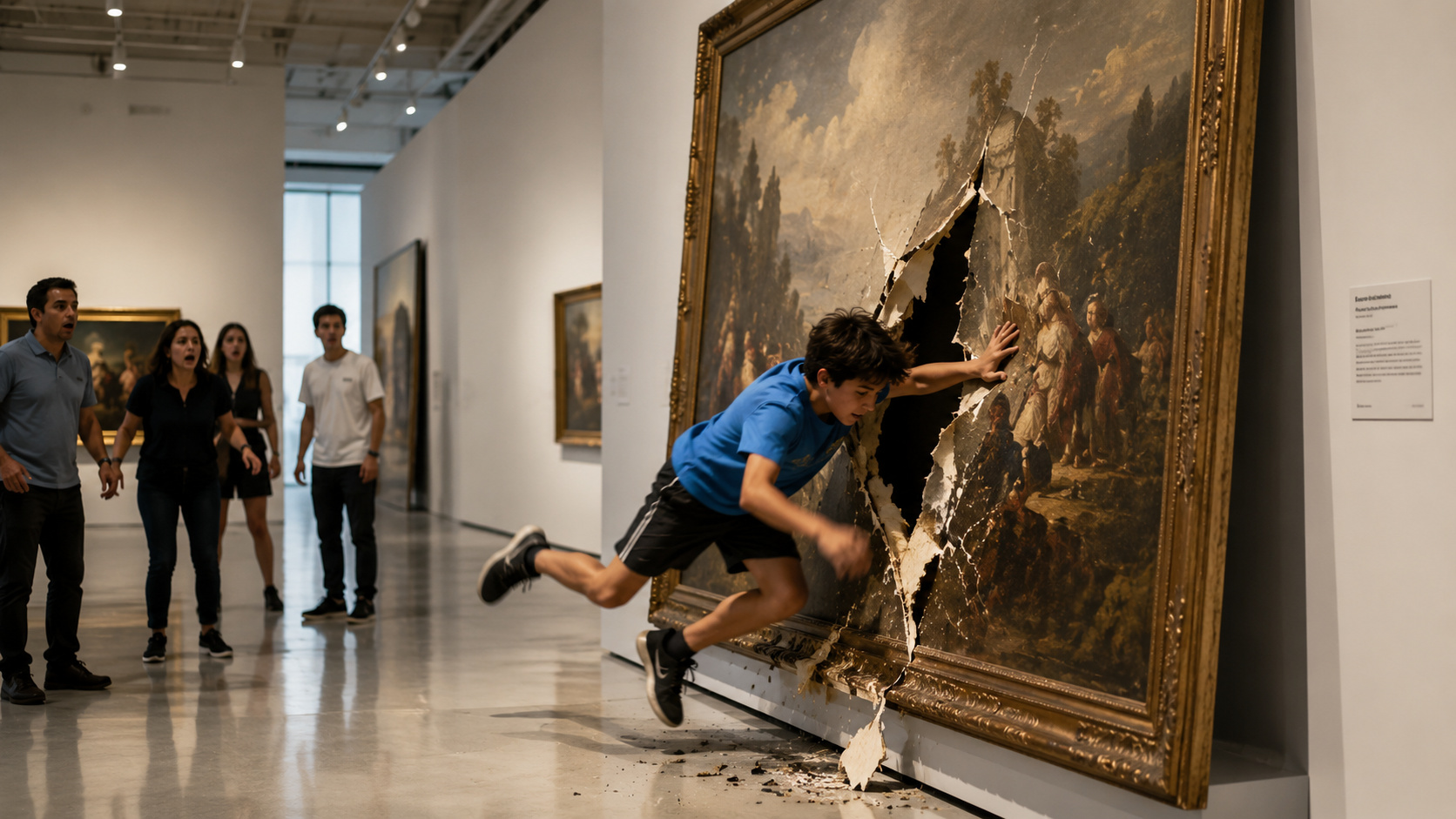

Internal circuit images captured the exact moment when the boy lost his balance and leaned on the canvas during a visit to a popular exhibition in the Taiwanese capital


A moment of carelessness during a school visit turned into one of the most talked-about episodes in the art world in 2015. A 12-year-old boy found himself in an extremely embarrassing situation when he tripped inside an exhibition of Renaissance paintings in Taipei, the capital of Taiwan, and ended up damaging a work valued at millions of dollars.
The incident occurred during a guided tour when the boy was walking distractedly, with a cup in hand, paying attention to the guide’s explanations. Unaware of the obstacle ahead, he lost his balance and fell forward. In an attempt to steady himself, his hand hit the framed canvas directly, creating a fist-sized hole in the lower right part of the painting.
The affected work, titled “Flowers,” is an oil painting by the Italian artist Paolo Porpora, with over 350 years of history. Valued at $1.5 million — equivalent to approximately R$ 5.2 million at the exchange rate of the time — the piece is considered rare: it is the only publicly known signed work by Porpora on display. The information was released on August 25, 2015, by the British newspaper The Guardian, based on reports from the exhibition organizers, and also resonated in Brazil through the Extra portal.
-
8-Year-Old Girl from San Antonio Launches Candle Brand, Sells Over 1,000 Candles in 5 Months to Save for First Car

-
Rising Food Inflation Strains Family Budgets and Challenges Food Security in Brazil

-
Discover Treze Tílias: How a Former European Minister Brought a Touch of Austria to Southern Brazil

-
6.03-Carat Diamond Discovered Live on TikTok by Jack Pearadin and Michael Schumacher at Arkansas Diamond Park, Fourth Largest Since 1972


An accident recorded by cameras and the reaction of the exhibition organizers
The internal monitoring cameras of the exhibition captured every detail of the episode. In the video, it is possible to see the boy walking casually through the space, holding a cup, until the moment he trips and falls with his body practically towards the wall where the canvas was. The impact was enough to tear part of the painting, but not to displace the frame or cause more severe structural damage to the work.
According to the exhibition organizer, Sun Chi-hsuan, in a statement given at the time to the international press, the boy was extremely nervous after the incident. According to his account, reproduced by the British newspaper, the lower right corner of the painting suffered the direct impact of the child’s hand, resulting in a visible hole in the centuries-old canvas.
Despite the apparent seriousness of the incident, the museum’s response drew attention for its calmness. The exhibition organizers chose not to hold the boy or his family responsible for the incident, classifying it as a rare and isolated accident. In this regard, the financial repair of the artwork was covered by the insurance specifically contracted for the exhibition — a common practice in exhibitions that gather pieces of high historical and financial value.
Quick Restoration and Details on the Importance of Porpora’s Work
In light of the case’s repercussions, the museum’s conservation team acted quickly. With the presence of an Italian specialist who was already accompanying the exhibition, the painting was removed from circulation for a short period to undergo a local restoration process. Shortly thereafter, the artwork was back on public display, reintegrated into the set of exhibited pieces.
On the other hand, the case also brought to light details about the historical significance of the damaged painting. According to the museum’s head of conservation, Tsai Shun-Jen, the fragility of the piece had been known for some time, as it is one of the rare remaining paintings from the collection of Neapolitan artist Paolo Porpora, born in the early 17th century. Although he began his artistic career in Naples, Porpora established himself professionally in Rome, where he worked directly for the influential Chigi family — one of the most significant dynasties of the Italian aristocracy of the time.
The exhibition where the incident occurred gathered pieces of great historical value, including portraits attributed to Leonardo da Vinci and another 55 selected paintings, according to the organizers, from the collections of “some of the world’s best art collectors.” In this context, the boy’s episode gained even more international notoriety, not only for the financial value involved but also for the rarity of the affected piece.
Even so, the case reinforces a recurring debate among museums and curators: the balance between making rare works accessible to the public and ensuring their physical protection against unforeseen events. Episodes like this, although occasional, show how small slips can generate significant repercussions when they involve artistic heritage of high historical value — and how foresight through insurance has become an increasingly common practice among major international exhibitions.