






 Portuguese
  Spanish
  5 min of reading
  0 comments


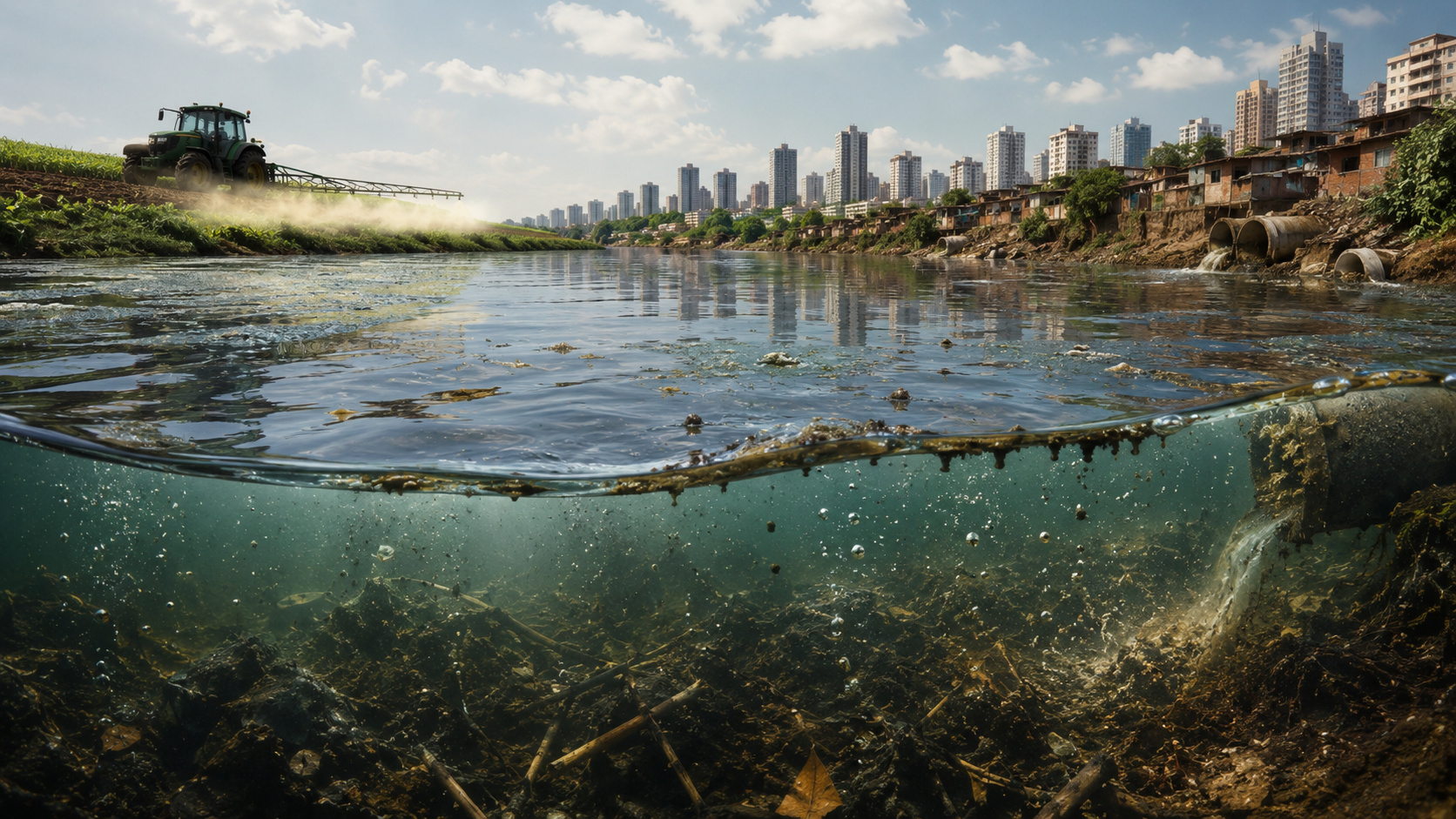
Global study with 550 rivers shows that pollution and warming accelerate the decomposition of organic matter and increase CO₂ and methane emissions.
A study published in Science showed that human action is altering the functioning of rivers on a planetary scale. The research gathered data from 550 rivers in 40 countries and produced the first global map of decomposition rates in rivers and streams, indicating that nutrient pollution and water warming are accelerating the breakdown of aquatic organic matter. This process increases the release of CO₂ and methane, reinforcing the role of rivers as emitters of greenhouse gases.
The result is noteworthy because rivers and streams do not function only as water transport channels. They are also part of the global carbon cycle, being able to both help transfer carbon for long-term storage and return it quickly to the atmosphere. When decomposition accelerates, this balance is disrupted, and gas emissions increase.
Rivers and streams have a central role in the carbon cycle
Organic matter produced on land, such as leaves, branches, and other plant debris, ends up being carried to rivers and streams.
-
Alibaba launches artificial intelligence for robots in China and reveals why big techs now want machines that do much more than just talk

-
Google releases Android 17 with a Pixel Drop packed with AI, Gemini Omni for videos, Lyria 3 for music, and Wear OS 7 to make phones and watches more connected than ever.
-
While scientists test giant balls on the seabed, a startup wants to sink concrete and steel tanks held by cages filled with stones up to 700 meters deep to transform compressed air into an invisible underwater battery.

-
Former NASA engineer transforms drones into “seed helicopters” capable of firing 300 balls per minute, targeting degraded areas with half-meter precision, and planting up to 40 million trees per year in a new race for aerial reforestation.



Part of this carbon travels to oceans, wetlands, and sediments, where it can remain stored for long periods. Another part is decomposed by aquatic microorganisms and returns to the atmosphere in the form of carbon dioxide and methane.
The central point of the study is that this natural process is being intensified by human activity. By raising water temperature and increasing the input of nutrients such as nitrogen and phosphorus, humans accelerate microbial activity and push rivers towards a more emitting functioning.
Cotton method allowed measuring decomposition in 550 rivers
To standardize the comparison between rivers from different continents, researchers used strips of cotton fabric submerged in water. Cotton is composed of cellulose, a substance similar to that present in plant organic matter. By measuring the speed at which this material decomposed, the team was able to estimate microbial activity at each analyzed location.
This method allowed the construction of a comparable global database, including areas historically underrepresented in international research, such as tropical regions. From these field data, scientists also applied predictive modeling to identify the environmental factors that most explain the increase in decomposition.
Pollution from fertilizers and sewage accelerates microbial activity
The study identified that one of the most important drivers of this process is nutrient pollution, especially the entry of agricultural fertilizers and urban sewage into watercourses. These compounds act as fuel for bacteria and fungi, which begin to decompose organic matter more quickly.


When this decomposition accelerates, more carbon stops being stored and is released into the atmosphere. Instead of operating closer to equilibrium, the river becomes a more active cog in the emission of greenhouse gases.
Water warming amplifies the problem and makes tropical rivers more vulnerable
The second central factor pointed out by the study is the increase in water temperature. Biological and chemical reactions tend to become faster in warmer environments, and this directly favors microbial decomposition. In tropical regions, where water already starts at higher temperatures, this effect becomes even more sensitive.
Therefore, tropical rivers appeared as critical areas on the global map. They combine heat, high biological activity, and, in many cases, a high nutrient load, creating an environment conducive to more intense carbon emissions.
Second study shows that a large part of riverine CO₂ comes from ancient carbon
A subsequent study published in Nature deepened the problem by showing that about 59% of global CO₂ emissions from rivers come from ancient carbon, stored for millennia in soils, sediments, and geological formations. This means that rivers are not only recycling recent carbon from current vegetation but also mobilizing ancient reserves that were previously relatively stable.
According to this work, the release of this ancient carbon is linked to the lithology of the basins, the type of soil, and the biome. The result broadens the climate alert because it shows that rivers may be functioning as an escape route for ancient terrestrial carbon stocks, and not just as a reflection of recent biological production.
Changes in rivers affect climate and biodiversity at the same time
The acceleration of decomposition not only has a climate impact. Organic matter also supports the energy base of many aquatic ecosystems. When it is consumed too quickly, there is less resource available for invertebrates, aquatic insects, fish, and other species that depend on this food chain.

This means that the transformation of rivers occurs on two fronts at the same time. On one side, the emission of gases like CO₂ and methane increases. On the other, the ecological stability of the aquatic environments themselves weakens. The change, therefore, is not only chemical. It is also biological and structural.
Pollution, climate, and land use are pushing rivers towards a new functioning
The scenario described by the two studies shows that rivers are at the center of a silent connection between pollution, climate change, and intensive land use. Excess nutrients, water warming, erosion, and disturbance of watersheds work together to alter the way carbon circulates in these ecosystems.
The most important thing is that this transformation does not seem isolated or sporadic. It already appears on a global scale, involves hundreds of rivers, and suggests that part of the aquatic ecosystems is ceasing to function as a link for transport and storage to increasingly act as an active source of greenhouse gases.







Be the first to react!