Portuguese
  Spanish


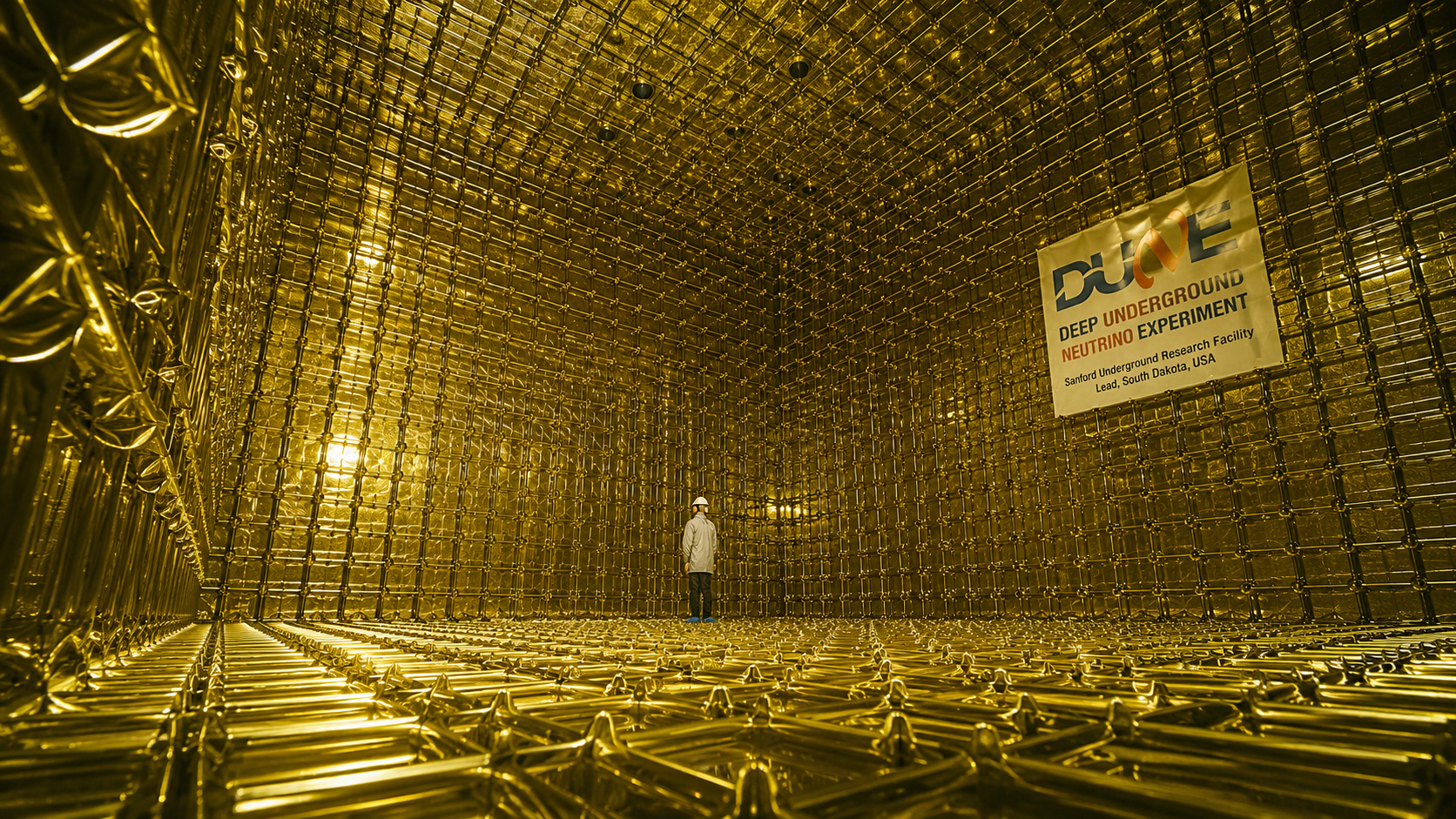

DUNE Project will bury 70 thousand tons of liquid argon to study neutrinos and the origin of matter in the Universe.
In 2026, in the deep underground of Lead, South Dakota, the Fermi National Accelerator Laboratory, linked to the U.S. Department of Energy, advanced one of modern physics’ most ambitious machines: the Deep Underground Neutrino Experiment, DUNE. According to Fermilab, the international experiment was designed to investigate why the Universe is dominated by matter and not antimatter, using giant detectors installed almost 1.5 kilometers deep at the Sanford Underground Research Facility.
The scale of the structure seems straight out of science fiction. According to the Sanford Underground Research Facility, on May 7, 2026, DUNE entered a new phase with the start of the descent of 10 million pounds of steel girders to form the underground detectors, each designed to house 17 thousand tons of liquid argon. When operational, the system will send the world’s most intense neutrino beam about 800 miles, or 1,300 kilometers, from Fermilab in Illinois to the buried detectors in South Dakota, passing through rock and earth without the need for a tunnel.
The ultimate goal is to observe how these nearly invisible particles change during their underground journey and to discover if neutrinos hold clues about the origin of the asymmetry between matter and antimatter after the Big Bang.
-
Researchers Identify Factor Influencing Dementia Risk Beyond Age and Genetics

-
Iranian Engineers Develop Solar-Powered Mobile Water Purification System for Isolated Regions, Offering Sustainable Solution for Water-Scarce Communities
-
Pedal-Powered Washing Machine Made from Bicycle Parts Cleans Clothes in Three Minutes Without Electricity, Leaves Them 80% Dry.

-
Sixth-grader in Miami wins Lemelson Young Inventor Prize for creating water-absorbing concrete using discarded oyster shells and charcoal.




DUNE aims to solve why matter triumphed over antimatter after the Big Bang
One of the biggest questions in modern physics involves the existence of matter. According to current models, the Big Bang should have produced matter and antimatter in virtually equal quantities.
The problem is that when matter and antimatter meet, both annihilate each other. Even so, the current Universe is dominated by matter. Scientists believe that neutrinos may hold the answer to this cosmic imbalance.
These particles have extremely unusual properties and change “type” as they travel through space. DUNE was designed precisely to study these transformations with unprecedented precision.
Project will bury 70 thousand tons of liquid argon in gigantic detectors
The heart of the experiment will be formed by enormous detectors filled with ultrapure liquid argon. In total, the system is expected to use about 70 thousand tons of this material in gigantic underground tanks.

Liquid argon functions as a detector medium because it produces signals when neutrinos interact with its atoms.
DUNE’s main observatory will be installed at the Sanford Underground Research Facility, in the state of South Dakota. The facility is located more than 1 kilometer below the surface, protected by enormous layers of rock. This depth reduces interference caused by cosmic rays and other atmospheric particles.
Neutrino beam will cross Earth for 1,300 km
The experiment will have two main points. The first will be at Fermilab, near Chicago, where scientists will produce intense neutrino beams.
These particles will be launched towards the underground detector in South Dakota, traversing about 1,300 kilometers of solid rock without the need for tunnels. Neutrinos are known as “ghost particles”.
They have extremely small mass and hardly interact with matter. Trillions of them pass through the human body every second without any perceptible effect.
This makes their detection extremely difficult and requires gigantic machines to register extremely rare collisions.
Liquid argon helps capture extremely rare events
When a neutrino finally interacts inside the detector, it produces charged particles that leave traces in the liquid argon.

Ultrassensitive sensors record these signals to reconstruct the event. The system works almost like a three-dimensional camera for invisible particles. The project is part of the new generation of giant observatories dedicated to the study of neutrinos.
Alongside projects like Hyper-Kamiokande, JUNO and IceCube, DUNE is part of the global race to understand these mysterious particles. The difference is that each experiment uses different methods and sources.
Project can also detect distant star explosions
In addition to artificial neutrino beams, DUNE will be able to record natural neutrinos coming from space. Supernova explosions, for example, release enormous quantities of these particles.
Detecting this type of event would help scientists study extreme phenomena linked to the death of giant stars. The size of the detectors has turned the project into an enormous engineering challenge.
Underground caverns had to be excavated to accommodate gigantic structures filled with cryogenic liquid argon. Maintaining thermal stability, chemical purity, and adequate insulation is a critical part of the experiment.
Extremely low temperatures keep argon in a liquid state
Argon only remains liquid at extremely low temperatures. This requires complex cryogenic systems operating continuously within the underground facility.
Any contamination or significant temperature variation can compromise measurements. DUNE will produce gigantic quantities of information.

Advanced artificial intelligence systems will be used to identify relevant events amidst the enormous volume of recorded signals. Without this automated processing, it would be practically impossible to analyze so much data.
Scientists hope to find clues about physics beyond the current model
Beyond the matter and antimatter question, DUNE may reveal still unknown phenomena. Researchers are looking for signals that could indicate new particles, new forces, or behaviors not predicted by the Standard Model of physics.
This makes the experiment one of the most important bets in contemporary physics. The most impressive aspect is perhaps the geographical scale of the system.
Neutrinos will be fired from one American state to another, traversing the planet itself. In practice, the entire Earth functions as part of the experimental infrastructure.
DUNE shows how modern physics depends on gigantic machines to study invisible particles
Neutrinos almost never interact with matter. Therefore, detecting these particles requires colossal observatories, buried deep and equipped with thousands of sensors.
DUNE represents exactly this trend in modern science: building gigantic machines to investigate almost invisible phenomena. The central question remains one of the deepest in science.
If matter and antimatter arose together, why is the current Universe dominated by matter? Scientists hope that neutrinos hide part of this answer.
The underground machine built in the USA tries to capture particles that cross the entire Earth without leaving a trace
DUNE seems futuristic because it combines extreme elements:
- almost invisible particles
- gigantic underground caverns
- cryogenic liquid argon
- beams traversing 1,300 km of rock
- ultrasensitive sensors
All this to try to answer fundamental questions about the origin of existence.
Did you imagine that scientists would need to bury 70 thousand tons of liquid argon and shoot particles through the entire Earth to try to discover why the Universe didn’t disappear into antimatter right after the Big Bang?