






 Portuguese
  Spanish


In Huludao, in northeastern China, Wang Rishang designed, welded, and assembled by himself, in 2020, a homemade cable car that connected the fifth-floor window to a pole on the street. The retired engineer even patented the invention and used it for five years until the authorities ordered it to be dismantled.
Tired of facing five flights of stairs every day to get home, a retired Chinese engineer decided to solve the problem in the way he knew best, with engineering. Wang Rishang, 72, a resident of Huludao, in Liaoning province, built a homemade cable car in 2020 that went directly from the window of his fifth-floor apartment to a streetlight pole. It was no joke: he designed, welded, and assembled everything by himself. The story was told by the South China Morning Post.
What seemed like a brilliant solution had a bitter end. After using the equipment without problems for five years, the case went viral on the internet in 2025, and the fame brought along inspections. The authorities of Huludao, alongside the residents’ committee, ordered the elderly man to destroy his own creation. The ingenuity that got him out of trouble became, in the end, a reason for a demolition order. It’s the twist that makes this story hurt.
Five floors, no elevator, and the mind of an engineer

The starting point is a silent drama for many people: living in a building without an elevator. For a man over 70 years old, climbing up and down five floors several times a day stops being exercise and becomes torture. Knees, breath, and heart demand their toll. It was this heavy routine that led Wang Rishang to seek a way out.
-
Neymar’s 14-year-old son, Davi Lucca, launches 3D dinosaur brand “Amigo Dino,” gaining attention on social media for his entrepreneurial spirit.

-
Improper Outlets Can Cause Fires and Damage Devices: How to Identify the Correct 10A or 20A Model for Each Appliance
-
Entrepreneur Who Started at 13 Delivering Flyers by Bike in São Paulo Now Runs a 4,000 m² Culinary Complex in Brazil

-
In China, Workers Use VR Goggles and Body Sensors to Train Humanoid Robots for Tasks Like Folding Clothes and Stocking Stores



The difference is that Wang was not just any resident. As a retired engineer, he had the technical repertoire to turn the complaint into a project. Instead of just complaining about the building without an elevator or waiting for a renovation that might never come, he decided to build his own means of vertical transportation.
China, it is worth remembering, has millions of old low-rise buildings built without elevators, so his problem is that of a multitude.
The idea was bold just enough: a homemade cable car, simple enough to be made at home, but functional enough to save legs every day. The retired engineer aimed precisely at this balance between improvisation and real engineering.
One year of work and 8,000 yuan
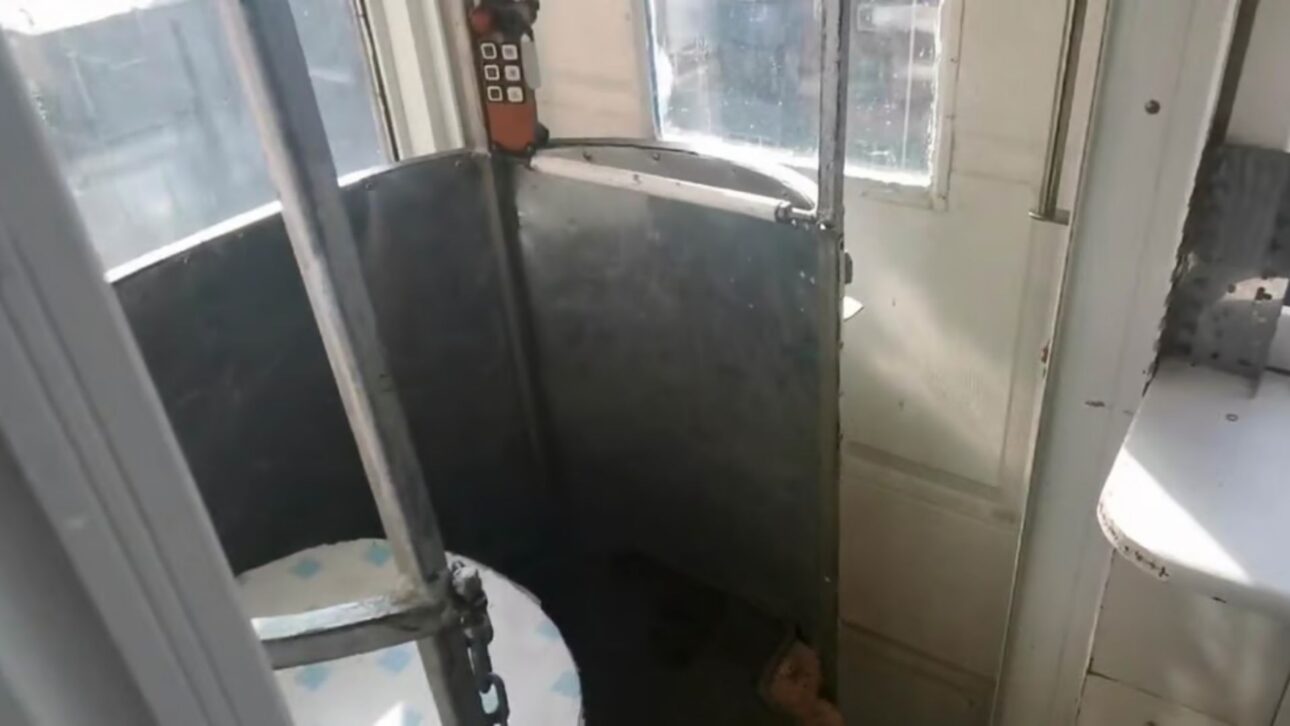
Bringing the idea to life wasn’t quick. Wang dedicated about a year to the project, researching online, studying the workings, and gradually purchasing the materials.
The total cost was 8,000 yuan, equivalent to about $1,100, or approximately 6,000 reais. For a private engineering work, it was a modest budget considering the result.
All the manual work came from his hands. Wang designed the system, welded the pieces, and assembled the entire structure by himself, without hiring a company or team. This total authorship is part of what made the homemade invention so admired when the case became public: it wasn’t a ready-made kit, it was knowledge applied with his own hands.
The homemade cable car ended up compact, the size to accommodate only one chair. A cable connected Wang’s house window to a streetlight near the residential block.
It was enough for what he wanted: to replace the tiring staircase with a short, seated journey to the height of his home.
How the homemade cable car worked
The principle was the same as a mountain cable car, only on a domestic scale. The chair attached to the cable went up and down between the street and the fifth-floor window, overcoming the height that previously required dozens of steps. Instead of facing the stairs, the retired engineer settled in and made the journey through the air.
The seriousness of the project is clear in a detail that few would expect from a homemade invention: Wang even registered a patent. In October 2020, he obtained recognition from the National Intellectual Property Administration of China for his system.
In other words, it wasn’t just any contraption; it was a solution considered original enough to become an official patent.
For five years, the homemade cable car served its purpose without any reported incidents. Wang used the equipment daily as one uses an elevator, turning the frustration of living in a building without an elevator into a resolved routine. It worked, and it worked for a long time, which makes the outcome even more frustrating.
Five years later, the order to destroy
The turning point came precisely from its success. When videos of the homemade cable car hit the internet in 2025, Wang’s creation captivated netizens and gained national reach.
But the same visibility that earned praise also caught the attention of the authorities. Local authorities in Huludao, together with the residents’ committee, began to pressure the elderly man to dismantle the equipment.
The reason given has a legal basis. According to the report from the portal Nestia, the system built by Wang did not comply with China’s Special Equipment Safety Law, which regulates machines such as elevators, passenger cable cars, and large amusement park rides.
According to the regulation, a structure of this type, especially one anchored to a public pole, could not operate without certification.
Therein lies the crux of the story. From a legal standpoint, the concern for safety makes sense, because a broken cable at that height would be fatal. But from a human standpoint, there is a sense of injustice: a retired engineer solved a problem on his own that the public authorities did not solve for him, used the solution for five years without an accident, and was still forced to destroy it. The homemade invention clashed with the rule that exists to protect those who use it.
The ingenuity that the rule did not foresee
The case went viral because it touches on a sensitive point. On one hand, there is the obvious admiration for the ingenuity of a 72-year-old man capable of building and patenting his own homemade cable car.
On the other hand, there is the frustration of seeing this effort undone by a stroke of the pen. Netizens were divided between applauding the engineer and questioning the lack of an alternative offered by the authorities.
The question that lingers is uncomfortable. If the equipment was illegal, what was Wang’s option? To go back to climbing five flights of stairs at 72 years old?
The episode exposes a gap: the regulation prohibits the makeshift solution, but no one came up with the official solution for the building without an elevator where he lives. The homemade invention was condemned, and the original problem remained.
This type of impasse is what separates stories of homemade inventions that are merely amusing from those that make you think. Wang’s story makes you think. It shows individual genius clashing with bureaucracy and makes it clear that ingenuity alone does not always overcome the lack of public policy.
The real problem: aging in a building without an elevator
Behind the curiosity, there is a serious and growing issue. Populations are aging worldwide, and many elderly people live in old buildings without elevators, built in a time when no one thought about accessibility. For these people, each floor is a daily barrier, and the case of Wang Rishang in China is just the most creative version of a common drama.
In Brazil, the scene is familiar. Millions of Brazilians live in buildings with three, four, or five floors without elevators, and the elderly feel the weight of the stairs.
The difference is that not everyone is a retired engineer with the time, money, and talent to build a homemade cable car. For most, the solution ends up being to isolate themselves at home or rely on the help of others.
That’s why Wang’s ingenuity goes beyond viral curiosity. It raises an alert about accessibility and housing for the elderly, a topic that tends to grow as the population ages. His homemade invention may have been banned, but the problem it tried to solve will not disappear anytime soon.
Wang Rishang’s story mixes admiration and outrage in equal measure. A retired engineer who turns the frustration of a building without an elevator into a functional, patented homemade cable car, used for five years, and in the end is forced to destroy everything. Ingenuity overcame the physical challenge but lost to the rule.
And you, do you think the authorities should have helped Wang to regularize the equipment instead of ordering its destruction? Or does safety speak louder in this case? Tell us in the comments what you would do if you lived on the fifth floor of a building without an elevator.


