






 Portuguese
  Spanish


On a farm in Leoberto Leal, an 81-year-old man single-handedly preserves an entire piece of Santa Catarina’s rural memory, among mills, atafonas, and tools that have spanned generations
Amidst the mountains of Santa Catarina’s interior, far from the rush of big cities, a farm holds something rare: time seems to have stopped, but life remains intense. There lives Mr. Sebastião, or just “Bastião,” as he prefers to be called. At 81 years old, he is the guardian of a heritage that few still preserve — a collection of machines, tools, and stories that hark back to a rural Brazil increasingly rare to find intact.
The property belongs to the Steinhauser family and is located in the municipality of Leoberto Leal, in the interior of Santa Catarina. There, every corner tells a story. There is a sugarcane mill still in full operation, an atafona used to produce cornmeal, and a collection of handmade objects that Sebastião crafted — or inherited — over decades of work in the fields.
But what really draws attention on his property is not just the objects. It’s Sebastião himself: a farmer with unshakable good humor, who never misses a chance to tell a joke or propose a challenge to those visiting the place. Even before he starts explaining his relics, he tests the visitors’ strength, joking about tying vines and measuring resistance with his own hands. It’s like this, between laughs and stories, that he leads each conversation — and gradually reveals a lifetime of work, love, and tradition.
-
Over 15 Years After Michael Jackson’s Death, Convicted Doctor Opens Own Clinic in Trinidad and Tobago, Reigniting Debate Over His Career

-
After 100 Job Rejections, 17-Year-Old in Brazil Starts Car Wash Business and Attracts Offers

-
Indonesian Woman in Her 80s Sells Out Traditional Lupis Dessert by 9 AM Daily in Yogyakarta Since 1963
-
8-Year-Old Discovers 1,700-Year-Old Roman Statuette Fragment Potentially Depicting Jupiter During Routine Outing


The information about Sebastião’s routine and collection was shared by the Vale Agrícola channel on YouTube, in a report published on June 11, 2024. The material documents, in detail, the farmer’s daily life and the historical value of each item kept on his property.
The agriculture office and the tools that have spanned three generations
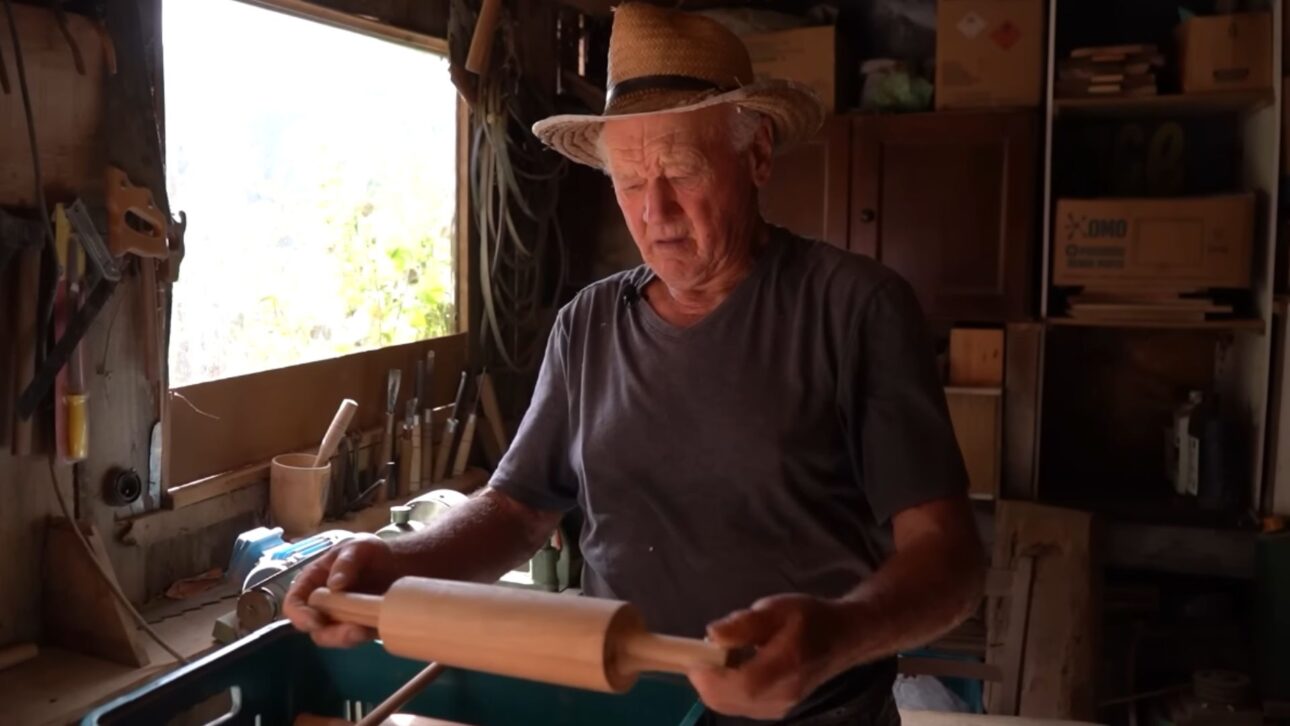
Right at the entrance of the property, Sebastião presents what he himself calls the “agriculture office”: a small shed where he handcrafts essential tools for rural work. Wooden spoons used to stir lard, grain pounders, cassava graters, and even handmade toys, like a wooden boat made from leftover materials — everything passes through the farmer’s hands before fulfilling its function in the daily life of the house or the farm.
Among the pieces, there are even orders in progress. Sebastião reveals that he still makes items to order, using woods like perobeira, valued for its resistance. According to him, a solid rolling pin, made by hand, is much more durable than the models sold in stores — which, according to the farmer, “spin weakly” because they are made with pins.
This knowledge was not born with him. It was inherited. The craft of shaping wood and creating utensils began with Sebastião’s grandfather, passed to his father, and later reached him. An emblematic example of this transmission of knowledge is the gamela — a type of large solid wood bowl, traditionally used to prepare bread dough. Sebastião recalls making his first gamela in 1963, using the root of a tree felled by his own father.
Furthermore, the farmer recalls that in 1964, he left the family home to work as a sharecropper on an aunt’s property. It was precisely during this period that he met, through another relative, the woman who would become his life partner. The story of their meeting, told with humor, reinforces the affectionate and nostalgic tone that runs through Sebastião’s entire narrative: decades of partnership, joint work on the farm, and raising a family, always side by side.
The sugarcane mill and the atafona: rural technology that withstands time
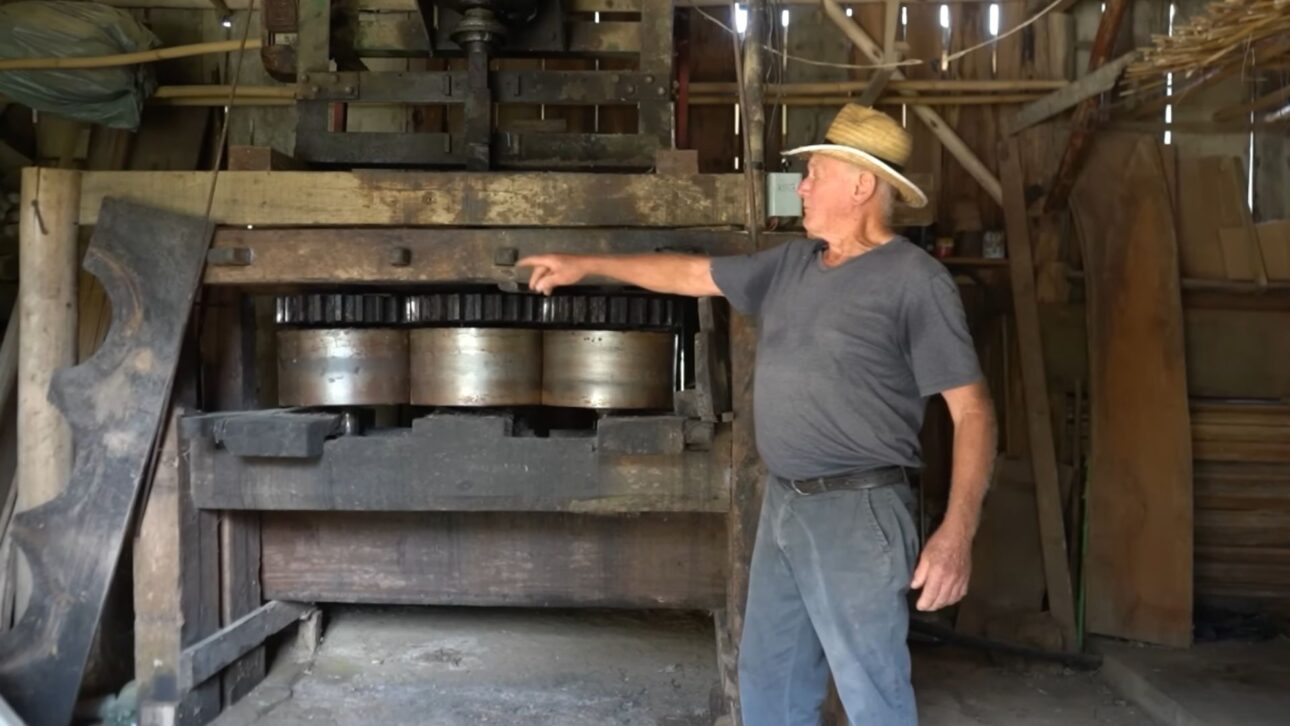
Among the most expressive relics of the site is the sugarcane mill, still in operation. The structure — also called a mill — is used to crush the cane and extract the juice, later cooked to produce molasses. Currently, the equipment operates through an improvised mechanical system, but, according to Sebastião, it has gone through different forms of traction over the years: first powered by oxen, then by horses, and later by water power, through a water wheel — a rotating piece that harnessed the nearby stream’s current.
The relationship of the mill with the past, however, also carries harsher memories. Sebastião reports that, in the past, when the mill was operated by oxen, this type of work posed a real risk to the people involved. He mentions the case of a 12-year-old girl who lost her life after an accident with the equipment, decades ago — a reminder that the modernization of tools, albeit slow, also brought more safety to work in the field.
Today, the process is simpler and safer. The sugarcane is inserted into the mill with the help of a protective board, the bagasse is automatically directed outwards, and the extracted juice is collected in containers positioned behind the mill. After being boiled to the right point, the molasses is finished in a large wooden trough — also produced by Sebastião himself, in a process that, according to him, can take more than two days of manual work.
Not far from the mill is the atafona, a traditional piece of equipment used to grind corn and produce cornmeal. In the video, Sebastião shows white corn grains drying in the sun before being processed — a fundamental step to ensure the quality of the flour. He explains that, previously, it was necessary to chop the corn manually before producing hominy and only then the cornmeal. Today, the process is more straightforward: the corn is poured directly into the atafona, which grinds the grains and separates the flour through a rotating sieve.
While describing this process, the farmer also presents other rare machines from his collection, such as an old piece of equipment used to clean impurities from corn, beans, and rice — operating, at the time, exclusively by human power, as the property did not have electricity. There is also a smaller machine used to remove seeds from brooms made of “foot” straw, another traditional practice that Sebastião keeps alive to this day.


A natural sanctuary and the routine that withstands advanced age
On the other hand, Sebastião’s property also holds a surprise that goes beyond the agricultural tools and machines. Near a waterfall, the farmer transformed a natural cavity into a small sanctuary. According to him, the discovery happened unexpectedly: during a land leveling work requested by a priest seeking water for a religious camp, the excavation revealed a formation that ended up becoming a grotto.
Still, even after more than eight decades of life, Sebastião remains active in the property’s routine. He reports that he personally maintains the mowing along the roadside leading to the site — a task he considers essential to prevent accidents, as he lives on a constantly traveled road. Before concluding the visit, he also demonstrates the care of manually sharpening his hoe on a natural stone, ensuring a more efficient cut for work in the field.
However, it is amidst the corn plantation that Sebastião reveals, once again, his playful side: he jokingly warns that he intends to cut some corn stalks on purpose, pretending to be “playing a trick,” before surprising visitors with the discovery of animal nests hidden among the crops.
Stories like Sebastião’s highlight a silent but persistent movement in various regions of the Brazilian countryside: that of farmers who, even as they age, remain active and willing to preserve techniques, equipment, and traditions at risk of disappearing. In this sense, such cases gain relevance not only as an affectionate portrait of an individual journey but also as a historical record of agricultural practices that have shaped entire generations in the field.
Even so, the simplicity of life on the farm coexists with an enormous symbolic richness. Each wooden bowl, each tool, and each piece of the mill carries with it decisions, efforts, and memories accumulated over more than half a century. Therefore, more than just a simple rural workspace, the Steinhauser family property consolidates itself as a true living archive of Santa Catarina’s agricultural culture — maintained, day after day, by the hands of a man who, despite his age, has not stopped creating, telling stories, and tending to the land.


