






 Portuguese
  Spanish


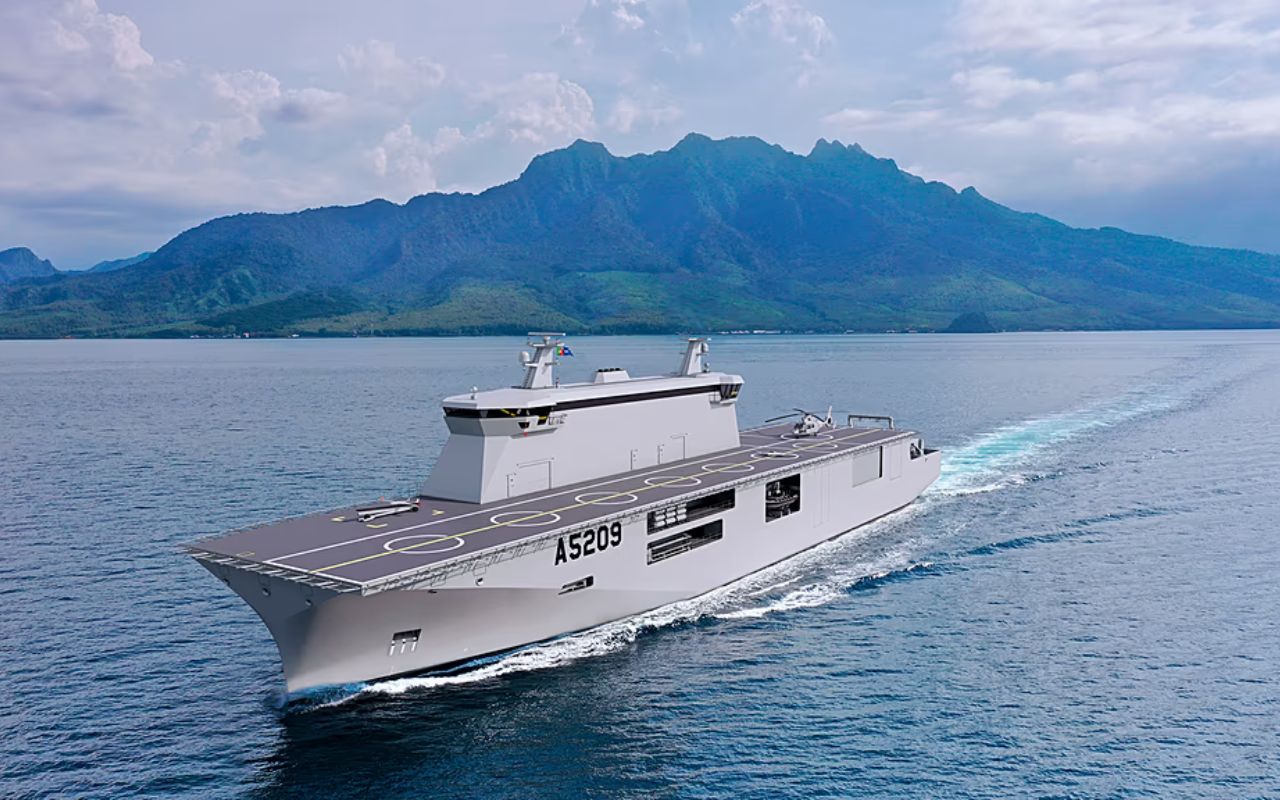


Portugal Prepares To Operate The NRP D. João II, The First Drone Carrier In Europe, Strengthening Maritime Surveillance, Science, And Security In The Atlantic.
By investing in the construction of the NRP D. João II, Portugal takes a decisive step towards modernizing its Navy and joins a select group of countries that invest in ships dedicated to operating unmanned systems.
Scheduled for delivery in the second semester of 2026, the project positions the country as a European pioneer in the use of a large-scale drone carrier.
The vessel is being built by the Damen Shipyards in the city of Galați, Romania, and is designed to meet new strategic demands.
-
U.S. Navy’s Ticonderoga-class Cruiser Becomes a 9,800-Ton Missile Fortress with Advanced Aegis System Capable of Tracking Hundreds of Targets

-
France’s Charles de Gaulle: The Sole Nuclear-Powered Aircraft Carrier Outside the US, Weighing 42,500 Tons and Equipped with Two Atomic Reactors

-
The military spaceplane that almost took the Cold War into orbit: Boeing X-20 Dyna-Soar was designed to re-enter above Mach 20, fly for up to 40 hours, land like a plane, and transform Titan rockets into a gateway to a new era of orbital warfare.
-
FAB bets on national drones and increases investments to strengthen the Brazilian aerospace industry




Instead of focusing solely on traditional firepower, the ship prioritizes technology, automation, and the ability to operate drones in various maritime environments.
Why Did Portugal Decide To Invest In A Drone Carrier?
Portugal’s decision to develop the NRP D. João II is directly linked to the transformation of naval operations in the 21st century.
With the rapid advancement of drones, navies around the world have begun seeking platforms capable of launching, controlling, and recovering these systems safely and continuously.
In this context, the drone carrier emerges as an efficient solution. It reduces risks for crews, extends mission ranges, and allows operations in vast ocean areas, which is especially relevant for a country with a strong historical and strategic connection to the Atlantic.
NRP D. João II: A Ship Designed For Multiple Functions
Weighing approximately 7,000 tons and measuring 107.6 meters in length, the NRP D. João II is designed as a multifunctional naval platform.
Its main focus is supporting aerial, surface, and underwater drones, but its capabilities go beyond that.
The ship will feature a large flight deck of about 94 meters, as well as hangars and technical areas dedicated to the maintenance and control of the equipment.
This structure allows for extended missions, even in regions far from the coast, without the need for constant support on land.
Reduced Crew And Space For Specialists
One of the differentiators of the Portuguese drone carrier is the way it will be operated.
The base crew will consist of 48 military personnel, a relatively low number for a ship of this size, thanks to the high level of onboard automation.
Additionally, the NRP D. João II can accommodate up to 42 specialists, including drone operators, technicians, and researchers.
For specific missions, the ship will also have the capacity to temporarily accommodate between 100 and 200 people, which expands its use for humanitarian operations or emergency support.

European Funding And Strategic Innovation
A large part of the funding for the construction of the NRP D. João II comes from the European Union Recovery And Resilience Plan.
The funding reinforces the strategic nature of the project, aligned with European goals of innovation, sustainability, and security.
For Portugal, the investment represents an opportunity to modernize its fleet while simultaneously developing operational knowledge in unmanned systems, an area considered essential for the future of navies.
Drone Carriers And The Future Of Naval Operations
Experts assess that ships like the NRP D. João II are likely to gain prominence in the coming years.
Unlike large aircraft carriers, drone carriers offer greater flexibility and lower operational costs, making them ideal for countries seeking efficiency without compromising on advanced technology.
These vessels can be used in maritime surveillance, environmental monitoring, scientific research, search and rescue, and rapid response to natural disasters.
Thus, the concept of drone carriers expands the role of navies in civil and military missions.
NRP D. João II Reinforces Portugal’s Role In The Atlantic
With the incorporation of the NRP D. João II, Portugal strengthens its presence in the Atlantic and consolidates a prominent position in European naval innovation.
The drone carrier enhances the country’s operational capacity in strategic maritime zones and signals a clear commitment to technology and automation.
More than just a new ship, the project symbolizes a change in mindset.
Portugal now views unmanned systems as central elements of its naval strategy, anticipating trends that will shape the future of maritime operations in Europe.
With information from the website Poder Naval








ENQUANTO ISSO, O BRASIL SÓ OBSERVA.
Excelente iniciativa ..médio mas eficaz p a eventual guerra moderna …vigilância da área sob tutela de Portugal sem.muito custo…e a tecnologia …as latinhas que só pensam em Dinossauros vejam e analisem ….custos são importantes .
José Fernando