






 Portuguese
  Spanish


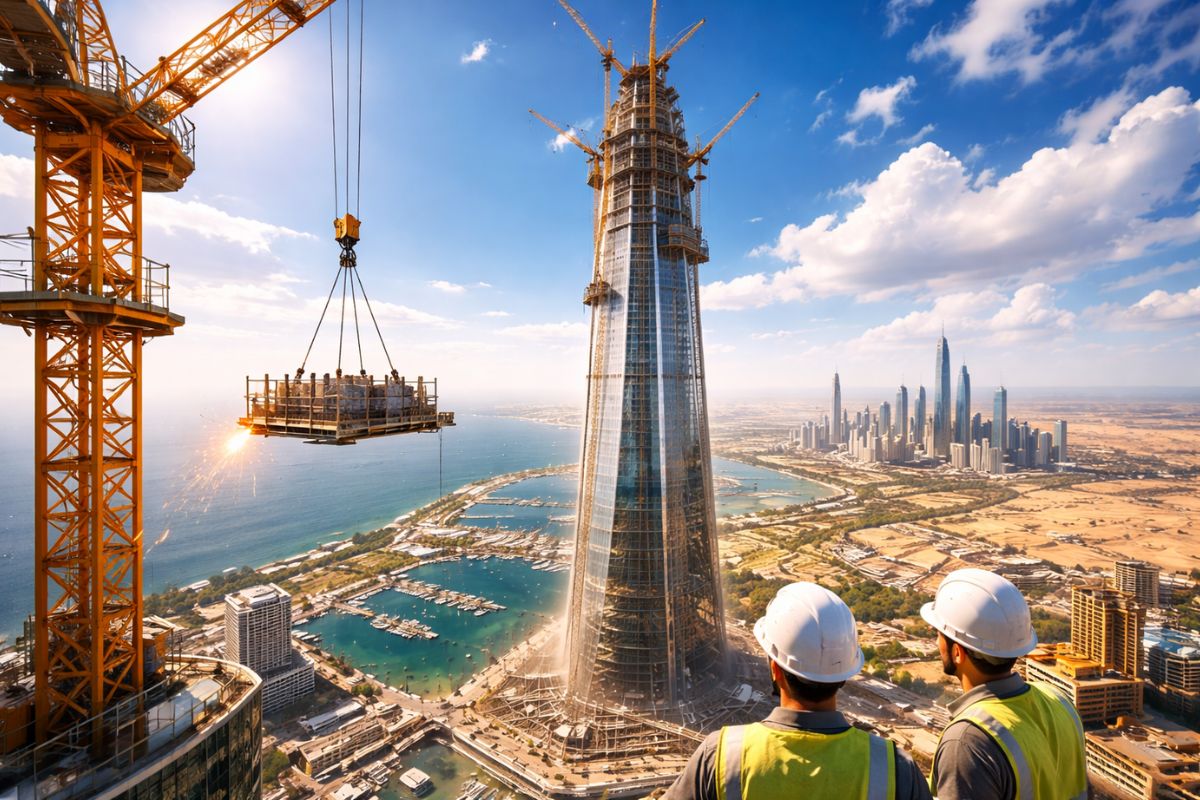


After Seven Years of Construction Stopped in the Desert, the Jeddah Tower is Back in Action, Resumed at an Accelerated Pace, and Now Adds Dozens of Floors, with Potential to Become the Tallest Building in the World and Change the Game of Civil Construction Forever.
For years, this tower was treated almost as an engineering ghost: empty construction site, halted structure, hundreds of millions of dollars immobilized in the sand, and the feeling that the dream had died there. However, silently, this began to change. By the end of 2025, the Jeddah Tower surpassed the mark of 80 completed floors and, what caught the most attention, entered a pace where a new floor is built every three days, once again putting on the horizon the goal of reaching 1,000 meters in height and competing for the title of tallest building in the world.
At the same time, this resumption is not just good news in terms of speed. It requires solving concrete, steel, wind, foundation, and logistics challenges on a scale that the civil construction industry has rarely seen. After seven years of paralysis, raising a mega-structure of this magnitude raises an inevitable question: are we facing a historic return or preparing for another slow-motion collapse?
The Billion-Dollar City Built Around the Future Tallest Building in the World

The Jeddah Tower was never conceived as an isolated skyscraper thrown in the middle of the desert. It is the centerpiece of an urban project worth about 20 billion dollars called Jeddah Economic City, planned along the coast of the Red Sea, with commercial neighborhoods, luxury residential areas, and tourist attractions.
-
Tired of Seeing Homelessness, New Westminster in Canada to Open Region’s First Tiny Home Village: 30 Container Homes with Central Kitchen, Meals, and Facilities

-
Brazil’s Santa Catarina Port Drives 770 Tons of Steel Piles into the Sea, Reaches Midpoint of $100 Million Project to Dock Two Ships Simultaneously by October
-
Expanded Polystyrene Gains Ground as a Lightweight Alternative to Traditional Masonry in Construction
-
Abandoned Brazilian Coastal Stadium, Once Hosting Major Soccer Matches, to Be Demolished for $10 Million NASCAR-Inspired Racetrack


This new district was designed to occupy millions of square meters and function as an alternative urban center, capable of attracting international investors, diversifying the economy, and relieving pressure on the traditional city center.
Building the tallest building in the world there is not just vanity: it is a way to stake a claim on the map that the region wants to be a leader in innovation, high-end tourism, and international trade.
Jeddah was chosen precisely for this strategic role. Located on the coast of the Red Sea, it is simultaneously the gateway to Mecca and a port that connects Africa, Asia, and Europe. Raising the tallest tower on Earth at this point is a very clear political and economic message.
How the Idea of Piercing the 1,000-Meter Barrier Came to Be
The idea for the tower began to take shape around 2008, when Saudi Arabia sought a world-class architectural icon. It was not enough to build tall; it was necessary to go beyond everything that had already been done.
Architects Adrian Smith and Gordon Gill, from a Chicago firm responsible for other engineering giants, took on the mission of designing the tower to comfortably surpass existing skyscrapers.
The plan: create a structure that not only competed for the title of tallest building in the world but also broke the symbolic barrier of 1 km in height.
From the beginning, it was clear that this would not just be an architectural work. It was an engineering problem in little-explored territory, where each additional meter in height multiplies the forces involved, the total weight, the wind impact, and the foundation requirements.
Concrete, Steel and the Physical Challenge of Raising a Kilometer Tall Tower
Restarting a mega-structure after years of stagnation is difficult on any scale. Doing this while trying to build the future tallest building in the world is almost a technical nightmare. The first obstacle lies in the basic material: concrete.
Every cubic meter of concrete used in the base of this tower must withstand pressures that would crush common buildings.
More than half of the concrete work has already been completed, with hundreds of thousands of cubic meters poured, enough to raise the structure to more than 300 meters in height.
But as the tower grows, concrete pumping becomes a logistical puzzle. The most advanced pumps operate at extremely high pressures and, even so, have practical limits around a few hundred meters.
Above that, transporting the material relies on cranes and suspended buckets, which is slower, more expensive, and riskier.
To avoid being a hostage to these limits, engineers made a radical decision: in the higher parts, concrete gives way to steel.
Why the Top of the Future Tallest Building in the World is Made of Steel
The solution adopted in the Jeddah Tower follows what other super-skyscrapers have already done: use concrete in the lower parts and transition to a steel structure in the upper levels.
This eliminates the bottleneck of pumping at extreme heights, accelerates the assembly of the higher floors, and reduces the self-weight of the structure.
The top of the tower, spiraling in shape, was designed to extend hundreds of meters above the occupied part, primarily functioning as technical support and a visual symbol.
This upper “spire” is not a space full of offices or apartments. It houses equipment, systems, and components that help the tower surpass the 1,000 meter limit while simultaneously laying claim to the title of the tallest building in the world with an unmistakable silhouette on the horizon.
To achieve this, it will be necessary to use tens of thousands of tons of structured steel, assembled at a pace that needs to keep up with the speed of the concrete floors without creating bottlenecks.
Extreme Wind and the Controlled Sway of a 1 km Structure

The higher you go, the more the wind stops being a detail and becomes a protagonist. At heights above 500 meters, horizontal forces increase dramatically compared to common buildings. At 1,000 meters, this difference is even more dramatic.
Wind tunnel simulations and tests with the structural core show that, in strong gusts, the top of the tower can sway up to a few meters, while high floors may feel perceptible, though controlled, movements. These numbers may seem frightening, but this type of flexibility is part of the design.
A structure of this scale does not “defeat” the wind with brute force. It learns to coexist with it. The shape of the tower, often described as a three-petal volume at the base, was designed to break wind vortices before they form and reduce comfort or safety. The idea is for the building to deform slightly, absorb the energy, and return to position without damage.
At this scale, controlled sway ceases to be a defect and becomes an indicator that the engineering is functioning as it should.
Deep Foundations to Secure a Giant in the Sand
If the top needs to be light and flexible, the base of the future tallest building in the world needs to be practically unshakeable. And the chosen ground does not facilitate this at all.
The tower is being erected on coastal soil, primarily composed of sand and limestone layers that compress and move under heavy loads. Instead of finding solid rock just below the surface, engineers had to dig deep.
Hundreds of massive piles have been installed, driven over 100 meters deep in some areas, connected by a concrete slab several meters thick. It’s like tying an artificial mountain to more stable geological layers, away from the most fragile zone.
Furthermore, the proximity to the sea brings another enemy: corrosion caused by saltwater. To deal with this, the project uses high-performance concrete and special steel reinforcements designed to withstand decades of salinity, intense heat, and humidity. Buried sensors monitor the behavior of the soil and the structure.
None of this is designed to last just a few years. The ambition is for this set to support the building for decades, even in an aggressive environment.
Seven Years of Construction Stopped and the Return of the “Impossible” Building
The recent history of the Jeddah Tower is not just one of advances. In 2018, construction was halted after the tower had already risen well off the ground. Financial problems, internal tensions, and a turbulent political context practically froze the project.
For years, the unfinished structure became a symbol of a dream too big, too expensive, and perhaps impossible to finish. Many people proclaimed that this candidate for the tallest building in the world would never be completed.
Everything began to change at the end of 2024, when the project was officially relaunched with a new contractual arrangement, reinforced financial support, and a political green light to move forward.
When teams returned to the construction site in early 2025, they did not find an empty lot, but a tower hundreds of meters tall that had spent years exposed to heat, humidity, winds, and the salty climate of the coast.
Before raising any new floor, it was necessary to conduct careful audits of the existing concrete, steel reinforcements, and foundations. Only after verifying that the old structure remained safe could the work resume on a large scale. From there, progress was rapid.
Millimeter Coordination to Keep the Pace of One Floor Every Three Days
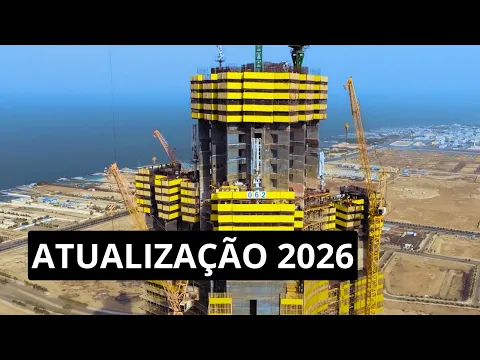

Today, the Jeddah Tower is once again a credible construction site, observed by the entire world. But building the possible tallest building in the world is not just stacking floors. It is, primarily, a problem of logistics and daily coordination.
With a pace of a new floor every three days, any failure of synchronization between teams, materials, equipment, and tests can lead to delays, increased costs, and risks for the image of the project.
The project management relies on advanced digital planning tools, three-dimensional models, logistical simulations, and real-time monitoring.
The goal is to identify bottlenecks before they appear at the construction site. At this scale, success does not depend on a single big idea but rather on a sequence of correct decisions, repeated day after day.
Elevators, Vertical City, and the Observation Deck in the Heights
Raising a 1 km tower is only half the story. The other half is making it function as a habitable place. Daily life within the building depends on something simple yet complex: elevators.
In total, dozens of elevators will be installed, including two-story models capable of transporting two groups of passengers at the same time. No one gets into an elevator on the ground floor and goes straight to the top.
The tower is organized into zones, with large intermediate transfer lobbies. A person takes an express elevator to one level, switches to another that serves a specific range of floors, and so on.
This strategy reduces the required size of cables and improves efficiency. The technology of lighter cables, using materials like carbon fiber, helps decrease the weight and energy consumption of the systems.
In terms of speed, the elevators have been designed to be fast, but without making trips uncomfortable over such long distances.
When completed, the tower should house offices, hundreds of luxury apartments, a five-star hotel, restaurants, leisure areas, a spa, pools, and a series of amenities typical of a “vertical city.”
The most eye-catching highlight, however, should be an observation deck located hundreds of meters above the ground, designed to be one of the highest on the planet.
From there, it will be possible to see the Red Sea, the surrounding desert, and the entire urban expansion of Jeddah stretching to the horizon.
2028 and Beyond: What is at Stake in the Race for the Tallest Building in the World
If the current schedule is maintained, the Jeddah Tower is expected to be completed around 2028, surpassing the height of other giants and assuming the position of the tallest building in the world, with a significant lead over existing skyscrapers.
Besides setting a record, the tower carries an important symbolic weight. It materializes a vision of the future in which the country tries to reposition itself beyond oil, betting on tourism, services, and mega-projects.
At the same time, the vertical race should not stop there. There are already talks of even taller projects in other cities, with proposals imagining structures close to 2 km. For now, however, all eyes are on what is happening by the Red Sea.
There, a project that barely avoided becoming a permanent ruin is now rising at an impressive speed, floor by floor, testing the limits of engineering and the patience of those following each update.
And you, do you believe that the Jeddah Tower will be completed on time and hold the title of the tallest building in the world for many years, or do you think another project will steal that crown?


Os descendentes de Ninrod construtor da torre de Babel ainda estão aquo na terra desafiando a ordem do Criador de encher a terra e nos espalhar, mas desafiam a Deus querendo tocar no firmamênto, e gastando tanto dinheiro à toa
Quanto desperdício de tempo e dinheiro
E vidas humanas que com certeza numa obra **** dessa morre muito trabalhador