Portuguese
  Spanish


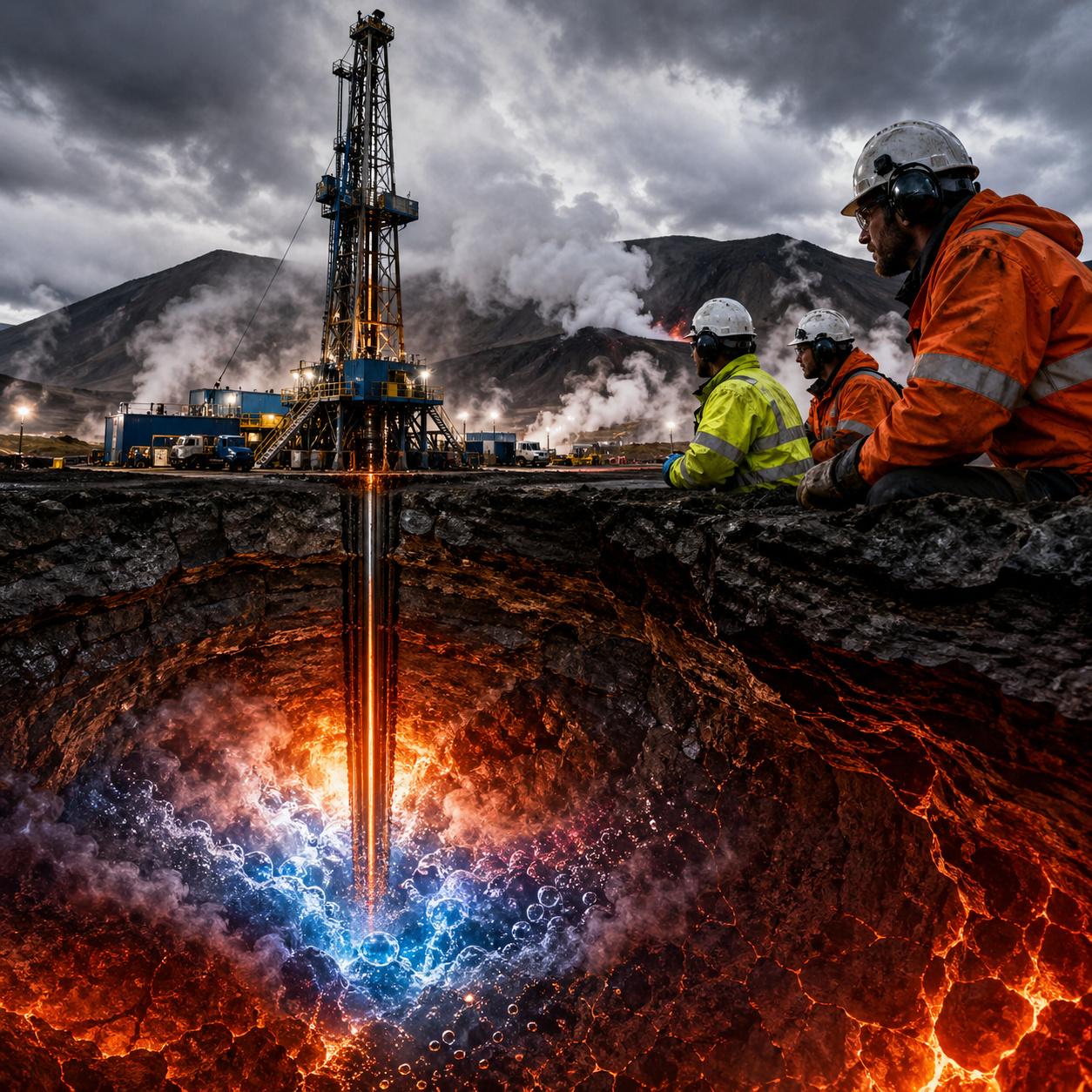


Drilling in Iceland reaches 4,659 m and finds supercritical fluids at 427°C, opening a new frontier in geothermal energy generation.
On January 25, 2017, engineers and scientists from the Iceland Deep Drilling Project completed one of the most ambitious drillings ever undertaken in a geothermal environment. The IDDP-2 well, opened in the Reykjanes field, in southwest Iceland, reached a measured depth of 4,659 meters, with approximately 4.5 km of vertical depth, entering a zone of extreme heat and pressure that the project itself describes as a successful foray into supercritical geothermal conditions. According to technical data published by the project and subsequent scientific studies, the well registered approximately 426°C after initial heating and a pressure of approximately 34 MPa, or 340 bar, values above the critical point of pure water, which is 374°C and 22.1 MPa.
Under these conditions, the fluid enters a supercritical state, ceasing to behave as a conventional liquid or vapor and beginning to concentrate much more energy per unit volume, which explains why IDDP-2 has become a global benchmark for high-enthalpy geothermal engineering.
This point marks a physical transition rare in nature and extremely relevant for energy engineering, as the fluid begins to carry a much greater amount of energy per unit volume.
-
Spain Launches World’s Largest Floating Dry Dock: 56-Meter Giant Produces Massive Concrete Structures in A Coruña Using Technology Proven in Brazil

-
AI-powered toys that talk, recognize faces, and collect data face scrutiny from Brazilian government over children’s privacy concerns

-
4,000-Year-Old Child’s Skull Unveils Ancient Burial in 7,500-Year-Old Norwegian Rock Shelter, Impressing Archaeologists

-
Norway Defeats Brazil in World Cup but Invests Billions to Preserve the Amazon, Strengthens Amazon Fund, and Joins Brazil in Leading Global Effort Against Tropical Deforestation



Supercritical state represents a radical change in water behavior at depth
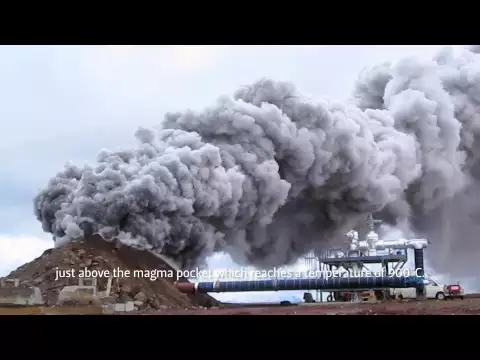

To understand the importance of this discovery, it is necessary to comprehend what a supercritical fluid means. Under normal conditions, water exists as a liquid or vapor, depending on temperature and pressure. However, above approximately 374°C and 22.1 MPa, it enters a state where these distinctions cease to exist.
In this regime, the fluid exhibits hybrid properties: it can expand like a gas, but maintain a density close to that of a liquid.
This behavior allows the fluid to transport much more thermal energy than conventional geothermal steam, which opens up an unprecedented technical possibility for electricity generation.
Drilling in Iceland required overcoming an extreme environment with high temperatures, pressure, and corrosion
The execution of IDDP-2 was not only a scientific challenge but also an extreme engineering test. Drilling in deep volcanic environments faces conditions that rapidly degrade equipment. Among the main obstacles were:
- Temperatures above 400°C
- Extremely high pressures
- Presence of corrosive fluids rich in gases and minerals
- Geological instability associated with volcanic activity
These conditions required the use of special materials, advanced drilling techniques, and constant well monitoring. The ability to maintain the structural integrity of the drilling to this depth was one of the project’s major milestones.
Reykjanes field directly connects the geothermal system to the Atlantic Ocean and the success of drilling in Iceland
The chosen location for the drilling was not random. The Reykjanes geothermal field is located on the Mid-Atlantic Ridge, where the Eurasian and North American tectonic plates diverge. This creates a unique geological environment with an intense heat flow coming from the Earth’s interior.
Furthermore, the region exhibits direct interaction between seawater and hot rocks at depth, forming a highly active hydrothermal system.

This combination makes Reykjanes one of the few places in the world where it is possible to naturally access fluids in conditions close to the supercritical state.
Potential energy of supercritical fluids found in Iceland drilling can be up to ten times greater than conventional systems
One of the most relevant aspects of IDDP-2 is the energy potential of the fluid found. Studies indicate that a single well operating under supercritical conditions can produce up to five to ten times more energy than a conventional geothermal well.
This is because the fluid, in addition to being at a higher temperature, has greater energy density and heat transfer capacity.
In practice, this means fewer wells would be needed to generate the same amount of energy, reducing environmental impact and operational costs.
Project IDDP-2 can redefine the limits of geothermal generation worldwide
Traditional geothermal exploration is already an important source of renewable energy, especially in countries like Iceland. However, access to supercritical zones represents a new technological frontier.
If commercial systems capable of operating under these conditions can be developed, geothermal energy could gain global competitiveness, especially in regions with volcanic or tectonic activity.
IDDP-2 has not only demonstrated that this frontier exists, but also that it can be technically accessible.
Technical challenges still limit large-scale commercial application
Despite the potential, the exploration of supercritical fluids still faces significant challenges.

Among them are:
- Long-term material resistance in extreme environments
- Corrosion control caused by aggressive fluids
- Structural stability of wells under high pressure
- Development of turbines and systems capable of operating under these conditions
These factors still limit commercial application, although technological advancement continues to develop. IDDP-2 functions more as a proof of concept than as an immediate large-scale solution.
Iceland consolidates its position as a natural laboratory for energy innovation
Iceland holds a unique position in the global geothermal energy landscape. About 90% of the country’s homes are heated with geothermal energy, and a significant portion of electricity also comes from this source.
Projects like IDDP reinforce the country’s role as a natural laboratory for renewable energy innovation. The combination of intense geological activity and operational experience places Iceland at the forefront of this technology.
While not all countries have geological conditions similar to Iceland, research in deep zones can expand the use of geothermal energy.
Regions with tectonic activity, such as parts of North America, Asia, and Africa, can benefit from advancements in this area. Furthermore, technologies developed for extreme environments can be adapted for other energy contexts. This extends the potential impact of IDDP-2 beyond Iceland.
Discovery from project IDDP-2 shows that the physical limits of water still hide energy opportunities
The encounter with supercritical fluids highlights an important point in science: even common substances, like water, can exhibit underexplored behaviors under extreme conditions.
This type of knowledge has implications not only for energy, but also for geology, physics, and materials engineering. Understanding these limits opens up space for new technological and scientific applications.
Given this advance, how far can engineering go in the search for energy in extreme environments?
The IDDP-2 project shows that exploring extreme environments is not only possible but can reveal energy sources with significant potential.
As the global demand for clean energy grows, technologies that harness the Earth’s deep heat gain relevance.
The question that remains is straightforward: if it is already possible to access fluids in such extreme conditions, to what depth and temperature will engineering be able to advance to transform these resources into usable energy on a large scale?