Portuguese
  Spanish


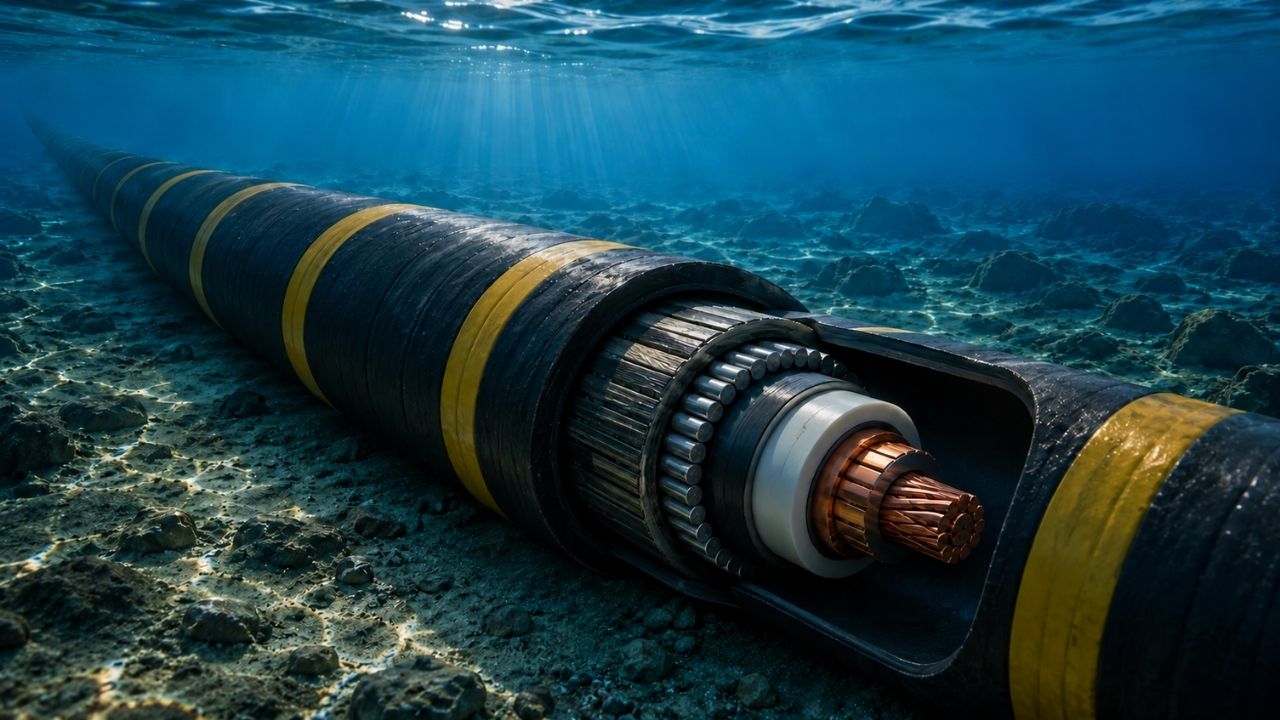

GREGY Project foresees an HVDC submarine cable between Egypt and mainland Greece, with a capacity of up to 3,000 MW, bidirectional operation, and a strategic role in exporting African renewable energy to Europe via the Eastern Mediterranean.
High-voltage submarine cable between Egypt and Greece entered the European radar after the feasibility stage planned for 2023 and appeared in a European Union technical document dated May 15, 2024 as an HVDC interconnection of approximately 954 km across the Eastern Mediterranean. The **GREGY** project foresees a maximum capacity of **3,000 MW** to transport renewable energy to Europe and appears as a new electrical route between Africa and the European Union.
The curious twist lies in the scale of the ambition: according to the European Commission, through the Directorate-General for International Partnerships, it’s not just about connecting two countries with a cable at the bottom of the sea, but about forming a kind of **green energy highway** between North Africa and the European Union. Electricity generated by renewable sources in Egypt could reach Greece and, from there, continue to other European markets.
GREGY aims to transform the Mediterranean into a renewable energy corridor
The GREGY project was designed to connect the Egyptian electrical system to the European continent via Greece.
-
A newly discovered caterpillar in Hawaii wears the remains of its prey that it devoured as a macabre armor, stitching bones and insect shells to its own back for camouflage.

-
She heard for decades that space was not a place for women, became a pioneer in aviation, was part of the Mercury 13, and at 82, finally traveled with Jeff Bezos before dying at 87.
-
Scientists investigate microplastics in the airways of patients with sleep apnea and reveal a new focus for research on environmental pollution, human exposure, and possible impacts on breathing quality.
-
For the first time, scientists have seen the ocean floor open up in real-time—plates moving apart by two meters in a few days and 160 million cubic meters of lava emerging on the seafloor.



According to the European Commission, the interconnection is part of the logic of the **Global Gateway**, an initiative that supports infrastructure projects in areas such as climate and energy. The proposal is to create a new renewable energy route in the Mediterranean basin, using Egypt as a generation hub and Greece as a gateway to Europe.
This design changes the function of the Mediterranean. In addition to being a historic maritime route for trade, transport, and geopolitics, the sea would now host strategic electrical infrastructure to move clean energy between continents.
In practice, the cable would be an energy bridge between **Africa**, **Greece**, and the **European Union**.
Submarine cable will be approximately 954 km long between Egypt and Greece
The most visual number of the work is its length: approximately **954 km** of submarine cable connecting Egypt to mainland Greece.
This distance places GREGY among the large electrical interconnection projects planned for the region, with underwater infrastructure and connection stations in both countries.
The foreseen technology is **HVDC**, used in long-distance projects because it allows for the more efficient transport of large volumes of energy in submarine cables.
The proposal also includes the necessary onshore infrastructure to integrate the cable into national electricity grids, allowing energy to reach the Greek system and continue to other European countries.
3,000 MW capacity is equivalent to a new electrical avenue for Europe
The maximum foreseen capacity is **3,000 MW**. This volume places the project on the scale of international energy infrastructure, not just as a bilateral connection.
GREGY was planned to permanently supply renewable energy, with reference to **8,760 hours** of operation per year, within the system’s capacity limit. The platform is also described as bidirectional, meaning it is capable of allowing energy flow in both directions, according to the conditions of the electrical system.
This point is important because interconnections are not just for transporting energy from one side to the other. They also help balance grids, enhance supply security, and reduce bottlenecks during periods of high demand or high renewable generation.
Energy would come from renewable sources in Egypt
The electricity transported by GREGY is presented as **100% renewable** energy, with contractual guarantee through specific power purchase agreements.
The objective is to export clean energy from Egypt to Greece and, from there, to Europe, especially during periods of high renewable generation.
The project developer states that the green energy transferred to Greece would be produced by **9.5 GW** of renewable sources to be built and operated by the group in Egypt.
This configuration places the African country in a strategic position: not only as a local energy producer, but also as a potential supplier of clean electricity to the European market.
Cable can strengthen Greece’s connections with Italy and Bulgaria
The impact of the interconnection would not be limited to the section between Egypt and Greece.
According to the European Commission’s page, simulations indicate that GREGY would increase the energy transfer capacity between cross-border networks connected to Greece, especially in the Greece-Italy and Greece-Bulgaria corridors.
The cited calculations point to a gain of at least 602 MW/h, potentially reaching 1,081 MW/h in the analyzed scenarios, compared to a situation without the project coming into operation.
This shows that the cable can function as part of a larger network. Energy would reach Greece, but its effect could spread through regional connections, strengthening European electricity integration.
Project aims for energy security and emissions reduction
GREGY emerges at a time when Europe seeks to diversify energy sources, expand renewables, and reduce dependence on fossil fuels.
The European Commission links the project to agendas such as the European Green Deal, the Clean Industrial Deal, the Affordable Energy Action Plan, and the Energy Union strategy.
The developer group states that the 3,000 MW transferred by the project could replace 4.5 billion m³ of natural gas per year and reduce CO₂ emissions by approximately 10 million tons annually.
These figures show why the cable is treated as strategic infrastructure: it combines energy, climate, industry, security, and geopolitics in a single submarine work.
European Commission already supports studies for cross-border energy infrastructure
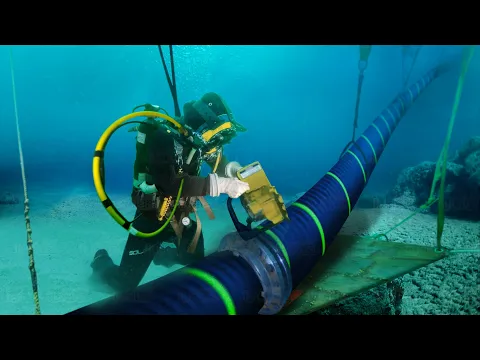

GREGY also appears within a larger scenario of European funding for energy connections between countries.
On January 28, 2026, the European Climate, Infrastructure and Environment Executive Agency reported that the European Commission would allocate approximately € 650 million from the Connecting Europe Facility program for 14 cross-border energy infrastructure projects.
The CEF program is described by the European Union itself as a financing instrument for sustainable and interconnected trans-European networks in the transport, energy, and digital services sectors.
This context helps explain why submarine electricity cables have gained prominence: the energy transition depends not only on generating renewable energy but also on transporting it to where there is consumption.
Developer ELICA leads proposal linked to Kopelouzos Group
The project developer is ELICA, a company linked to the Kopelouzos Group.
According to the European Commission, ELICA was expected to complete the project’s feasibility study by 2023, and GREGY began to be evaluated for its potential classification as a PCI project, a category used for strategic European energy infrastructure initiatives.
As it is a complex infrastructure, progress depends on studies, licensing, engineering, financing, power purchase agreements, and integration with national grids.
Therefore, the project should be treated as planned and under development, not as a cable already installed in the Mediterranean.
New electrical route shows how Africa can gain weight in the European energy transition
GREGY shows an important change in the energy map.
For decades, the discussion between Africa and Europe was closely linked to oil, gas, and traditional maritime routes. Now, projects like this place renewable energy, submarine cables, and electrical interconnections at the center of the relationship between the continents.
Egypt can become a clean energy export platform. Greece can strengthen its position as an energy gateway to the European Union. And Europe can gain an additional route to diversify supply and increase the share of renewables.
This is the point that makes the cable bigger than a technical work. It repositions the Mediterranean as a clean electricity corridor.
954 km cable could become a symbol of the new energy geography
The progress of GREGY reveals how the energy transition depends on works invisible to most people.
Solar panels, turbines, and renewable parks attract attention in the landscape. But electricity only gains international scale when it finds grids, interconnections, and cables capable of crossing borders.
With a planned extension of 954 km, a capacity of 3,000 MW, and a direct connection between Egypt and Greece, GREGY attempts to create one of these routes.
If it comes to fruition, the project could transform the bottom of the Mediterranean into an electrical avenue between Africa and the European Union, showing that the future energy dispute will involve not only those who produce clean energy, but also those who can transport it safely, at scale, and with regional integration.