






 Portuguese
  Spanish
  3 min of reading
  0 comments


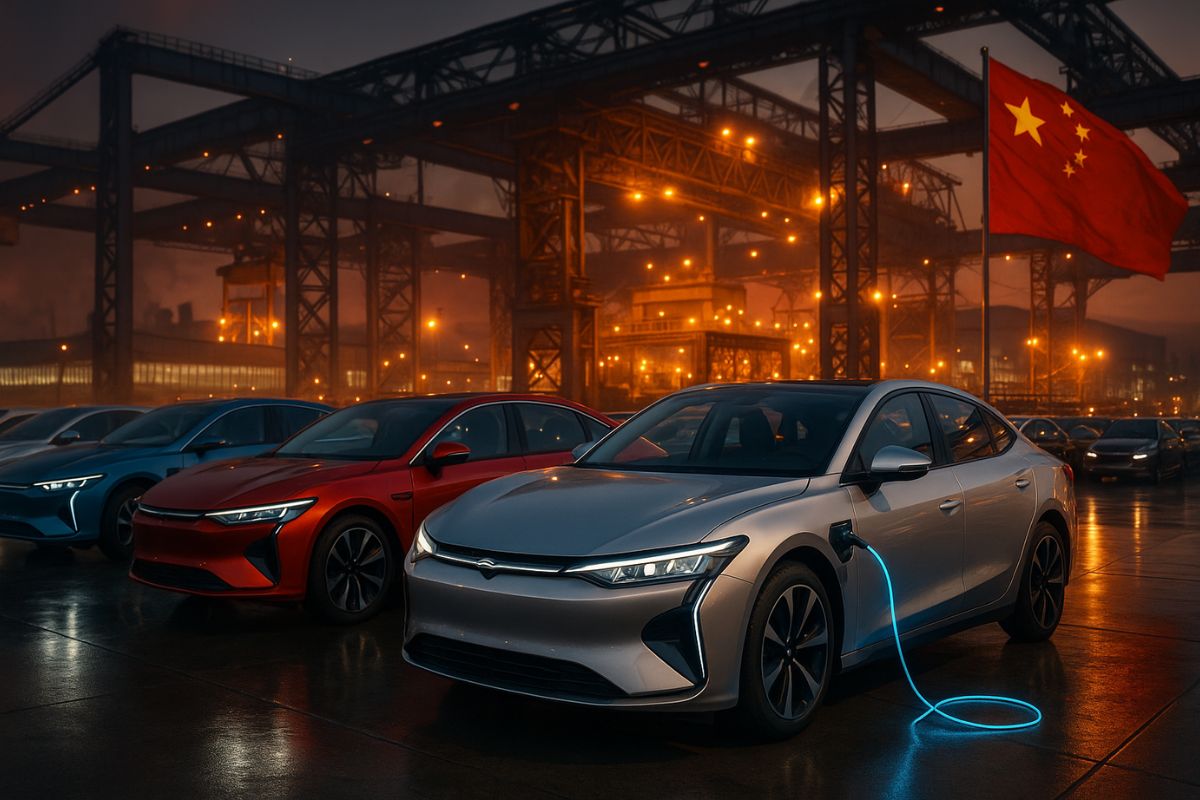
Country Reached 40.9% Market Share in the Domestic Market and Moved RMB 2 Trillion in 2024, Consolidating Global Leadership in Electric Vehicles, According to Exame
The China confirmed its global leadership in electric vehicles by producing over 13 million units in 2024, a result that represented 40.9% of the domestic market and moved RMB 2 trillion (over R$ 1.5 trillion). The data, released by Exame, reinforces the structural transformation of the automotive sector and the global impact of China’s industrial strategy.
For experts, this is a milestone that redefines the balance of power in the global automotive industry, putting pressure on Western competitors and accelerating the energy transition.
The Vice Minister of Industry and Information Technology, Xin Guobin, highlighted that the so-called NEVs (New Energy Vehicles) are at the center of the country’s innovation policies.
-
Two new 300cc models from QJ Motor are expected to arrive in Brazil as SBM to target the CB 300F and shake up the low-displacement market, with more power and liquid cooling than Honda.

-
Camaro may reappear in 2027, but not as you remember: Chevrolet prepares the return of the icon with four doors, manual transmission, and an extreme performance version to face the new era of sports cars.

-
Is the BYD Song Pro worth it? The Anderson Sincero channel says it doesn’t exceed R$ 140,000, and the price dropped by R$ 47,000, reinforcing the depreciation of the plug-in hybrid in the Fipe table.
-
Caoa Changan CS75 arrives for R$ 199,990 with 4.77 m in length, a trunk of up to 1,620 liters, 8-speed Aisin transmission, 180 hp, 37.2 inches in screens, and Zero Gravity seat with massage.


Explosive Growth in the Domestic Market
The global leadership in electric vehicles did not happen by chance. In just four years, the share of NEVs in the Chinese market jumped from 5.4% in 2020 to 40.9% in 2024, nearly half of all car sales in the country.
According to Exame, this consumption has moved entire supply chains, from lithium and rare earth mining to battery manufacturing and vehicle intelligence software.
This dynamism has solidified China as the largest global producer and seller for the tenth consecutive year, an accomplishment that demonstrates both the scale of the industry and the speed of domestic adoption of electric technology.
Technological Advancements Driven by the Five-Year Plan
The results were made possible thanks to the 14th Five-Year Plan, which focused investments on research and innovation.
Among the most relevant advancements are:
Average range of 500 km for passenger vehicles.
30% reduction in battery costs, making the models more affordable.
40% increase in battery life, reducing the need for replacements.
Charging speed three times faster than in 2020.
National expansion of charging points and fast battery swap stations.
These improvements have made the country not only a leader in scale but also a reference in technological innovation, as emphasized by Exame in its analysis.
Challenges That May Affect Global Leadership in Electric Vehicles
Despite the impressive numbers, the Chinese government admits that there are challenges.
Vice Minister Xin Guobin cited the scarcity of high-performance automotive chips, essential for smart vehicles, as well as the stiff competition among local manufacturers, which could jeopardize margins and the sustainability of the sector.
To tackle these obstacles, the strategy is to strengthen research in essential technologies, regulate competition, and maintain incentives aligned with market sustainability.
Thus, China seeks to preserve its global leadership in electric vehicles in an increasingly competitive environment.
Global Impact of Chinese Leadership
The consolidation of global leadership in electric vehicles by China has effects that transcend its borders.
The performance pressures Western automakers to accelerate their electrification programs, redefines global supply chains, and expands China’s influence in the technological race for electric mobility.
According to an analysis by Exame, the sector already represents one of the main engines of Chinese economic growth, with direct reflections on international trade and clean energy geopolitics.
China has reaffirmed its global leadership in electric vehicles by combining scale, innovation, and planned industrial policies.
More than just numbers, the 13 million units produced in 2024 represent a historic turning point that could dictate the course of the global automotive industry in the coming years.
And you? Do you believe that China’s global leadership in electric vehicles will be sustainable in the face of global competition or will the sector face barriers that could slow this advance?
Leave your opinion in the comments — we want to hear from those closely following this transformation.


Be the first to react!