






 Portuguese
  Spanish
  6 min of reading
  0 comments


The retreat of the waters revealed preserved marks of an ancient Greek community and brought back constructions that had been hidden for decades under one of the main reservoirs linked to the supply of Athens.
The ruins of Kallio, an ancient Greek village submerged to make way for the Mornos reservoir, have reappeared at the bottom of the artificial lake that supplies Athens.
The phenomenon, strongly recorded in September 2024, revealed walls, houses, and stretches of cracked soil after a sharp drop in water levels, associated with years of drought, extreme heat, and little snow in winter in Greece.
The image gained repercussion due to the contrast between the current use of the reservoir and the history of the community that once existed there.
-
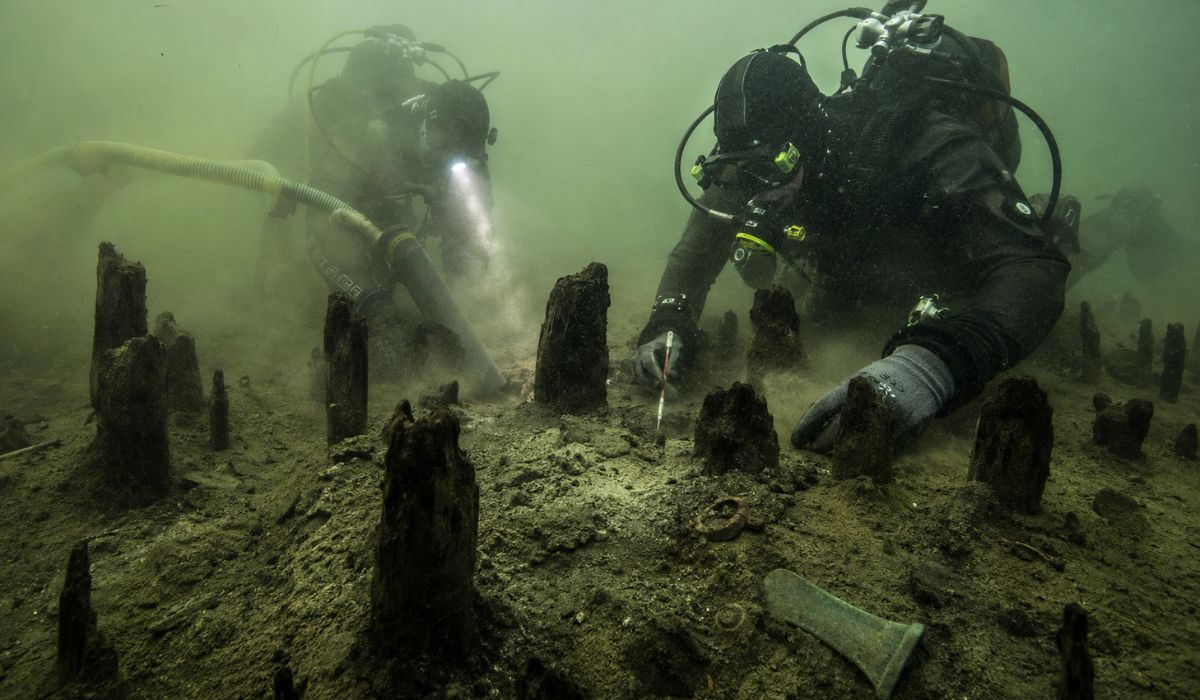
An entire village lay asleep at the bottom of a lake for 3,000 years: divers suction sediments in Italy and reveal more than 600 wooden stakes, bronze tools, and traces of a Bronze Age settlement hidden underwater.

-
They call it the “Shopee house” and even cardboard, but the R$ 20,000 house is a certified Wood Frame from Alea, financed by Minha Casa Minha Vida: understand if it’s worth more than masonry.

-
Egypt wants to divert 10 million m³ of Nile water per day, equivalent to 4,000 Olympic swimming pools, to build a glass city in the desert and irrigate 2.28 million acres, in a project that attempts to push life out of the country’s most contested valley.
-
Brazilian military personnel spend weeks in extreme training in the Amazon and receive a badge reserved for Jungle Warriors during the celebration of the 60th anniversary of one of the most demanding and respected courses in the world.

What is now described as a ghost village was once an inhabited village before disappearing under the waters in 1980.
Kallio was emptied in a planned manner during the construction of the system that formed Lake Mornos, created to reinforce the water supply of the Greek capital, located about 200 kilometers away.
Although the reappearance gained international attention in 2024, the case remains relevant because the reservoir continues to be linked to the water security of the Athens region.
Data compiled by iMEdD Lab from information by EYDAP, the company responsible for the supply, show that the extractable reserves of Athens’ reservoirs fell by 50% between August 1, 2023, and August 1, 2025.
In 2026, a wetter period brought some relief, but levels still remain below those observed in the previous decade.
Village submerged in Athens reservoir
Kallio was not engulfed by a sudden flood or an accident.
The village was in the way of an infrastructure project planned to meet the growing demand of Athens.
With the filling of the Mornos reservoir, houses, a school, a church, and streets were covered by water, while the residents left the area.
The displacement became part of the history of the families who had lived there for decades.
Some of the former residents moved to Athens or other urban centers.
Others remained nearby, in higher areas, forming a new community above the old village.
According to the original text published by Diario AS, about 60 people had to relocate when the dam was built.
The same report states that approximately 80 buildings were submerged, including the primary school and the village church.
With the drop in the lake level, part of this past resurfaced.
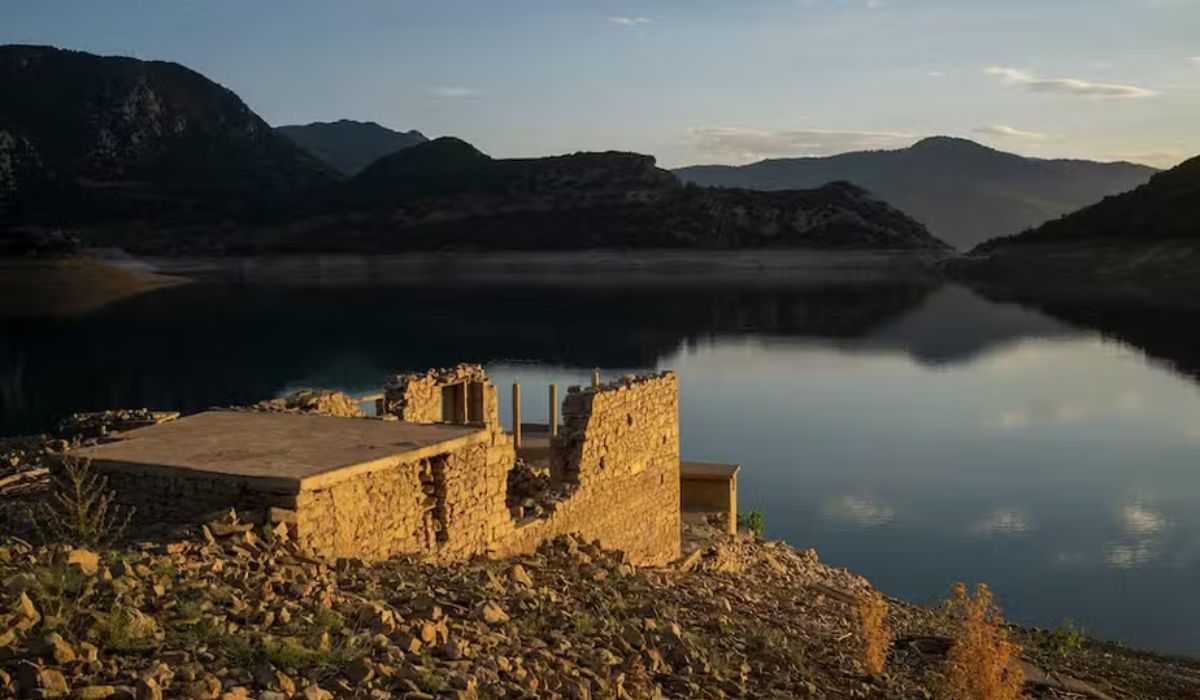
The stone school, once hidden under the reservoir, became visible again.
The church walls, however, had not yet emerged at the time of the original reports.
Ruins of Kallio Reappear with the Drought
The reappearance of Kallio led the lakebed to expose material records of the ancient village.
Remains of buildings, bricks, stones, and strips of dry land began to indicate sections of a community that had been submerged for decades.
Reuters reported on September 3, 2024, that the houses were re-emerging under Lake Mornos almost 45 years after the village disappeared.
At the time, the mayor of the municipality of Dorida, Dimitris Giannopoulos, summarized the speed of the change in a short phrase: “Day by day, the water recedes.”
For former residents, the reappearance of the structures also has an emotional impact.
Apostolos Gerodimos, cited as a representative of the displaced community, described the situation as “a nightmare situation.”
He further stated that the more the water level dropped, the more submerged constructions reappeared, and warned that the lack of rain could worsen the problem.
The scene brings together local memory and environmental concern in the same setting.
While the constructions arouse curiosity, the retreat of the water indicates pressure on one of Athens’ main water supply sources.
Lake Mornos and Athens’ Water Supply
The Mornos reservoir is located in central Greece and is part of the water supply system for the metropolitan region of Athens.
EYDAP reports that it mainly uses surface resources from Marathonas, Yliki, Mornos, and Evinos.
Within this group, Mornos and Evinos are classified as main sources, while Yliki and Marathonas function as auxiliary sources.
The artificial lake was formed by the damming of the Mornos River.
According to EYDAP’s technical data sheet, the construction of the dam began in 1969, the reservoir filling started in 1979, and the works were completed in 1981.
The structure is 126 meters high, and the reservoir has a maximum capacity of 764 million cubic meters of water.
The reduction in volume, therefore, is not limited to the visual reappearance of the constructions.
When the lake shrinks, the old houses serve as a concrete indicator of the pressure on the supply of a densely populated region.
In 2024, according to Reuters, the reserves of Mornos and the other three reservoirs supplying Attica had fallen to 700 million cubic meters in August.
In 2022, this volume was 1.2 billion cubic meters.
The Greek Ministry of Environment also reported that the lake’s surface had decreased from about 16.8 km² in August 2022 to 12 km² in 2024, based on satellite images from the National Observatory of Athens.


Drought in Greece pressures reservoirs
Greece has a Mediterranean climate and usually faces hot summers.
In recent years, however, the sequence of dry winters, heatwaves, and low precipitation has made the scenario more severe, according to records and reports on the region.
In 2024, the country came from a winter with little snow and a summer marked by high temperatures, a condition that helped reduce the volume of Lake Mornos.
The Copernicus Agency, the European Union’s Earth observation program, also recorded the lake’s retraction.
In October 2025, satellite images showed that the water surface area of Mornos had decreased from about 19.1 km² at the beginning of 2022 to 8.7 km² in September 2025.
The loss was associated, among other factors, with prolonged drought and reduced rainfall in recent years.
The situation led EYDAP to activate alternative sources and plan reinforcement measures.
In a semiannual report of 2025, the company reported that it had put pumping stations into operation in Yliki, activated wells in Mavrosouvala, and developed a plan to ensure Athens’ water sufficiency, combining immediate interventions and long-term solutions.
There were also proposals of greater scope.
In November 2025, the Greek government presented a plan to tackle the water crisis, with a special focus on Attica.
Among the measures mentioned were the Evrytos project, related to the use of water from the Evinos River, and the analysis of desalination plants in Thisvi, Nea Peramos, and Lavrion.
Ancient Greek village exposes water warning
Kallio reappears as an image linked to local history, but it is not an isolated episode.
In other periods of drought, ancient constructions had already become partially visible, including in the 1990s.
The return of the ruins gained new significance because it occurred amid a broader concern about the water available for Athens and the Attica region.
The case shows that a work created to ensure supply also preserved, under the water, records of a displaced community.
When the reservoir lowers, this memory returns to the scene and indicates how infrastructure decisions leave physical and human marks for many decades.





Be the first to react!