






 Portuguese
  Spanish
  5 min of reading
  0 comments


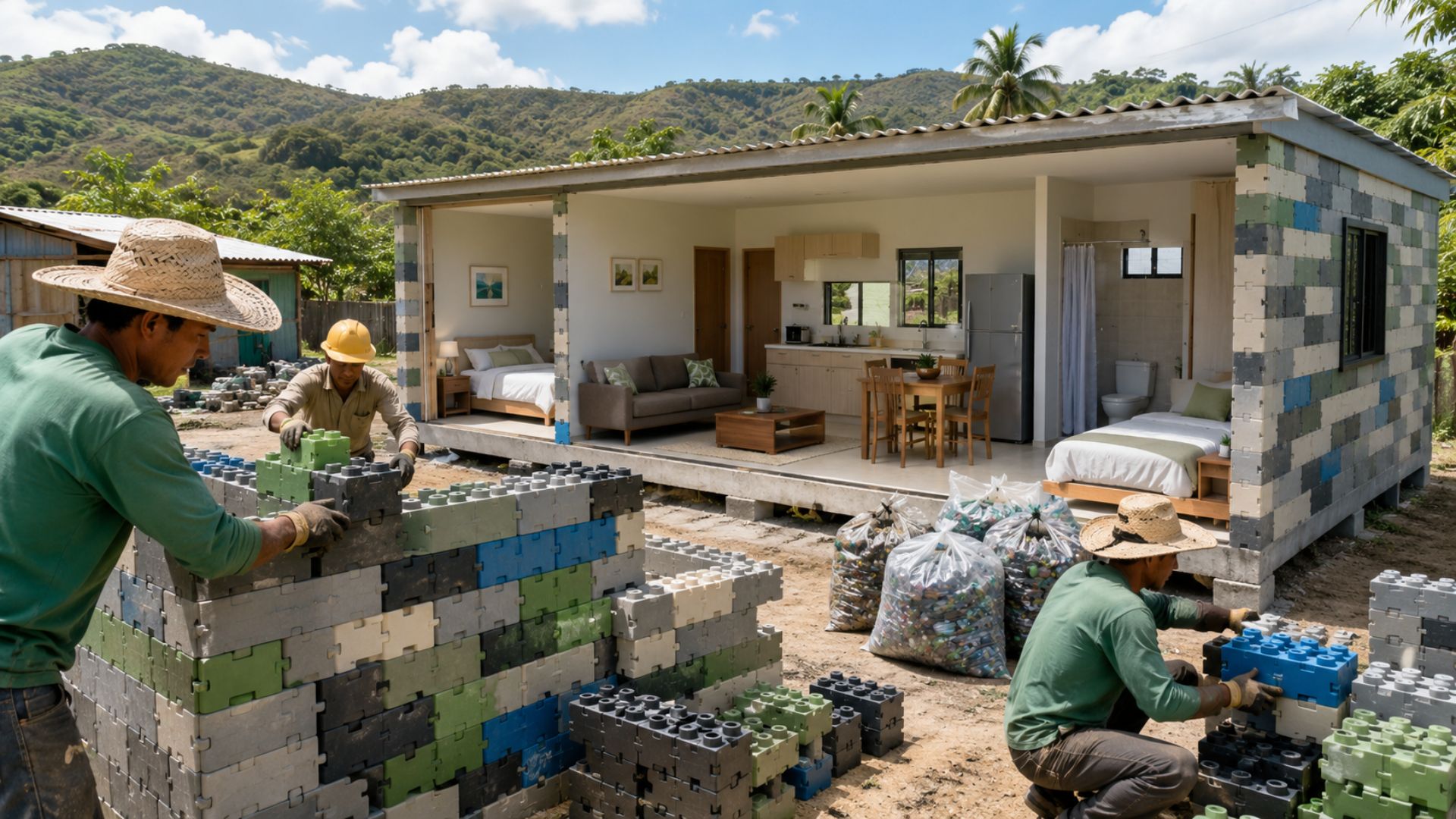
The Colombian company Conceptos Plásticos, founded in 2011, developed a system that transforms plastic waste into resistant, lightweight, and safe bricks. The technology has already built shelters for families displaced by armed conflict and is being applied in schools in Africa, with the support of UNICEF and the Norwegian Refugee Council.
Building a masonry house in Brazil usually takes months. Foundation, walls, concrete curing, and finishing extend the timeline. In Colombia, however, a different proposal is gaining strength and crossing borders: bricks made from recycled plastic capable of erecting an entire dwelling in five working days, without a single drop of cement or mortar between the blocks.
The system was developed by Conceptos Plásticos, created by businessman Fernando Llanos and architect Óscar Méndez. The duo patented a method that melts discarded plastic waste, molds modular pieces by extrusion, and creates blocks that fit together by pressure. The result combines low cost, agility, and a direct response to two chronic problems: housing deficit and plastic pollution.
How the idea of reusing plastic in the form of bricks was born

The story begins with a personal need. Fernando Llanos intended to build his own house in Cundinamarca, Colombia, but ran into the high cost of transporting materials from Bogotá.
-
Bolivian Female Construction Workers Form Association to Combat Discrimination and 38% Pay Gap in the Industry

-
Near Amsterdam, residents buy land and discover they must also build streets, manage drainage, handle waste, and grow food on half their plot.
-
Brazil’s WEG to Open New Factory in China by 2027, Expanding Production of Large Rotating Electric Machines and Low to Medium Voltage Motors in Rugao

-
Chinese Shipyard Secures $1 Billion in Orders for Low-Carbon Container Ships Amid Global Fleet Renewal Efforts


Frustration turned into research. The businessman began testing polymers as an alternative to conventional masonry. After several unsuccessful attempts, he met architect Óscar Méndez, who was studying the same topic at the university.
In 2011, the two founded Conceptos Plásticos and registered the system’s patent. The initial proposal was simple: to take advantage of the mountain of plastic waste dumped in landfills and waterways to manufacture construction components.
Instead of competing with clay bricks or concrete blocks, the company opted for a new format. The design was conceived to fit together without the need for specialized labor.
What differentiates these plastic bricks from traditional blocks

Each piece produced by the company weighs about three kilograms. The block is born from melted plastic molded by extrusion and arrives ready at the construction site.
There is no cement, mortar, or any chemical binder between the bricks. The fitting happens by pressure, in a system that resembles the building toy known worldwide. This eliminates the need for technical specialization and speeds up the pace of the work.
The technical characteristics, according to the company, go beyond practicality. The bricks offer thermal and acoustic insulation, keeping external heat out and dampening noise. They also receive flame retardant additives, which reduce the risk of fire.
The blocks were also dimensioned to comply with Colombian construction standards in seismic risk areas. This is a sensitive point in a country that experiences earthquakes.
How long does it take and how much does it cost to build a house using the system


A team of four people can assemble a 40-square-meter dwelling in five working days using the modular bricks. The standard project includes two bedrooms, a living room, a kitchen, and a bathroom.
The company’s estimated budget is around 6,800 dollars per unit. This value is below what a typical conventional masonry popular house usually costs.
The speed has a clear technical explanation: the absence of wet stages. Traditional constructions depend on concrete curing time, waiting for mortar to harden, and surface leveling.
In the modular system, the blocks arrive ready at the construction site and are stacked one on top of the other. The process is dry, reduces material waste, and minimizes debris disposal.
How much plastic each house removes from the environment
Conventional plastic can take 300 to 500 years to decompose in nature, according to data widely cited in environmental studies. The accumulation of this material in landfills, rivers, and oceans has become one of the biggest environmental challenges of the century.
Each home built with Conceptos Plásticos bricks consumes about six tons of plastic waste. Packaging, bags, and containers that would go to landfills, vacant lots, or waterways are removed from circulation.
The company also integrates waste pickers and cooperatives into the supply chain. Part of the raw materials comes directly from those who collect discarded material, generating income in low-income communities while supplying production.
In practice, the cycle begins with household waste. It passes through the hands of waste pickers and ends up becoming a wall inside an inhabited house.
Real-world applications and projects with international organizations
The largest project ever delivered by the company is in Guapi, in the department of Cauca, southern Colombia. In partnership with the Norwegian Refugee Council (NRC), shelters were built for 42 families displaced by the country’s internal armed conflict.
The construction consumed over 200 tons of recycled plastic and was completed in 28 days. The number is impressive when compared to the average time for conventional housing projects of the same scale.
The technology also crossed the ocean. UNICEF partnered to bring the same bricks to Ivory Coast, where the material is being used in the construction of schools in vulnerable communities.
Forbes magazine highlighted the project among the most creative solutions to address the housing deficit without aggravating environmental pressure on the planet.
What this model could mean for Brazil
In Brazil, civil construction is still dominated by ceramic and concrete blocks. The process involves high water consumption, debris generation, and extended construction time.
The country also ranks among the largest plastic waste generators in the world. Significant volumes are discarded without proper recycling, according to industry surveys.
The combination of these two scenarios creates space for technologies like the Colombian one to gain attention. Modular solutions that combine low cost, waste reduction, and speed can align with housing programs, social projects, and private initiatives.
The discussion about adapting plastic bricks to Brazilian construction standards and local climatic conditions, however, still needs to gain traction in public debate.
And you, would you live in a house made with recycled plastic bricks?
The experience of Conceptos Plásticos shows that rethinking basic materials can produce concrete answers to problems stalled for decades. Bricks made from discarded packaging simultaneously solve part of the waste generated in cities and part of the need for dignified housing.
And you, what do you think of this proposal? Would you buy a house built with recycled plastic bricks? Do you believe this model could be adapted to the Brazilian reality? Leave your comment, share your opinion, and tag someone who needs to know about this innovation.





-

1 person reacted to this.