






 Portuguese
  Spanish
  6 min of reading
  0 comments


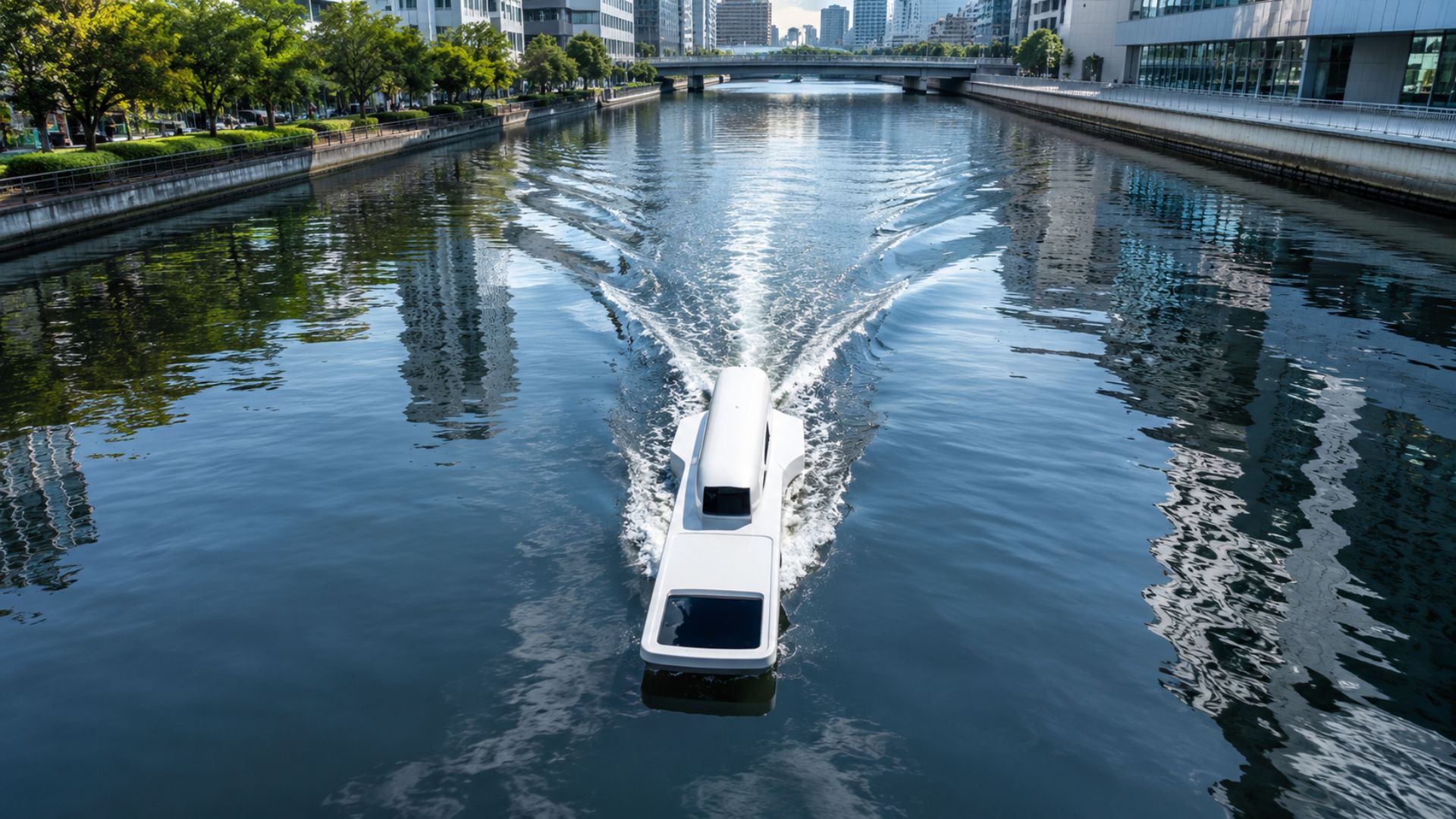
The work “Zip-Fastener Ship” was conceived in 2002, executed on a reduced scale in 2004, and brought to a 9-meter crewed version in 2020. Today it sails between the Azuma and Sakura bridges on the Sumida River in Tokyo. The artist is a professor at Musashino Art University and represented Japan at the 1st London Design Biennale.
Japanese artist and designer Yasuhiro Suzuki, born in Hamamatsu, Shizuoka Prefecture, in 1979, is the creator of the conceptual work known as “Zip-Fastener Ship”, a vessel shaped like a zipper slider designed so that the wake left in the water, as the boat moves, gives the impression that the river’s surface is being opened like a zipper. The work was conceived in 2002, first executed on a reduced scale in 2004, and brought to a 9-meter crewed version at the DESIGNART Tokyo 2020 festival, during the peak of the Covid-19 pandemic, when the Sumida River was practically empty of vessels. Since 2018, the zipper boat has annually participated in the Sumida River Sumi-Yume Art Project, sailing between the Azuma-bashi and Sakura-bashi bridges in central Tokyo. The new season of the work is scheduled for the Japanese autumn of 2026.
The idea, as told by the artist himself, was born from an accidental observation made from an airplane window.
What you will understand in this text
- What is the “Zip-Fastener Ship” and why it creates the illusion of water being opened.
- How the artist arrived at this image, seen by chance from an airplane.
- Why the work gained momentum in 2020, during the pandemic, when the Sumida River fell silent.
- Who is Yasuhiro Suzuki and why he is recognized as one of the most important Japanese conceptual artists of his generation.
- Where the work is today and how it can be seen.
The image that was born from the airplane window

The story told by Suzuki himself has a day, time, and window.
-
Survivor of 1966 SS Daniel J. Morrell Shipwreck in Lake Huron Recounts 38-Hour Ordeal in Extreme Cold

-
The Greatest Hoax in World Cup History? The Film That Denied Brazil’s 1958 Victory and Exposed How Fake Evidence Can Seem Convincing on TV
-
Fake South Korean Online Stores Offer Shopping Thrill Without Spending Money or Receiving Products
-
The War of Jenkins’ Ear: How a Severed Ear Sparked One of the 18th Century’s Most Unusual Conflicts


According to r7, in 2002, flying over Tokyo Bay, the artist observed the traffic of vessels in the port from above. The wakes left by the boats, seen at an angle, looked like strips of fabric being opened in the center by a slider. In the text he published on his official website, mabataki.com, Suzuki wrote, in a phrase frequently reproduced in interviews: “When I looked at Tokyo Bay from the airplane window, the ships and their wakes traveling on the sea looked like zippers. I wanted to build a huge zipper ship that people could ride, open the ocean, and see it from the mountain and the sky.”
The first execution was almost a tabletop experiment. In 2004, Suzuki built a scaled-down, radio-controlled version and conducted tests in lakes near Tokyo to check if the visual effect worked. It worked. The two parallel lines of the wake, seen from above, were exactly the zipper “teeth” being separated.
This was the point where the work ceased to be a sketch and became a project.
From model to passenger-carrying boat

The project’s escalation was slow. Suzuki spent years refining the design, testing materials, and adjusting the geometry.
The first full-size public version appeared in 2010, at the Setouchi International Art Festival, one of Japan’s main contemporary art biennials, held on the islands of the Seto Inland Sea. It was a medium-sized model, designed for short navigation, still without passenger transport capacity.
The definitive version, with 9 meters in length and passenger capacity, was finalized in 2020 for the DESIGNART Tokyo festival. The timing was almost poetic. The presentation took place amidst the pandemic, when the Sumida River, normally one of the busiest waterways in the Japanese capital, was unusually silent. Suzuki commented at the time, in an interview replicated by Gizmodo: “Until now, I had never perceived the ‘now’ of the river’s surface”.
The most commented technical detail of the boat’s interior also has a conceptual signature. The internal seats were arranged in an alternating pattern. Passengers sit facing each other, and their legs, when everyone is seated, form a design that mimics the metallic teeth of a zipper. As Suzuki described, quoted by Creative Bloq: “People sat facing each other and their legs ended up alternating, looking like metallic zipper teeth”.
The artist behind the work


For readers just discovering Yasuhiro Suzuki, some context is in order.
Suzuki graduated from the Department of Design at Tokyo Zokei University in 2001. Today, he is an Associate Professor in the Department of Spatial Design at Musashino Art University, one of Japan’s most prestigious art schools, and a Visiting Researcher at the Research Center for Advanced Science and Technology at the University of Tokyo. In 2014, he received the Mainichi Design Award, one of the highest honors in the industry in Japan. In 2016, he represented the country at the first edition of the London Design Biennial. He has also exhibited at the 4th Moscow Biennial and had solo shows at Art Tower Mito (2014) and the Hakone Open-Air Museum (2017).
Suzuki’s line of work has been consistent from the beginning. He transforms everyday objects into mediators between humans and nature. Among his most recognized works are:
- Blinking Leaves (2003): paper leaves printed with open eyes on one side and closed on the other, which seem to blink as they fall to the ground from a suspended funnel.
- Apple Kendama (2003): a version of the traditional Japanese kendama toy where the ball was replaced by an apple, alluding to Newton’s gravitational force.
- Bench of the Japanese Islands: a bench shaped like the Japanese archipelago seen from above.
- Air People (2007): life-sized human figures made of inflated PVC, in dialogue with the “star child” from the film “2001: A Space Odyssey”.
- A Spoon to Measure Time (2004): a spoon whose handle has temporal markings.
The artist’s obsession, repeated in interviews and essays, is the mitate, a Japanese concept that can be roughly translated as “allusion” or “double gaze”. It means perceiving, in a common object, something it is not, but could be.
The zipper boat is, perhaps, the most perfect application of the concept.
Where to see the work today
Since 2018, the Zip-Fastener Ship has participated in the Sumida River Sumi-Yume Art Project, known locally as “Sumiyume”, an annual public art initiative that occupies the banks of the Sumida River in central Tokyo. The route is fixed: the boat sails between the Azuma-bashi bridge (near the Asakusa district) and the Sakura-bashi bridge (near the Tokyo Skytree), a stretch that historically is one of the city’s symbolic borders.
According to information from the artist’s official website, updated in May 2026, the work will return to the Sumida this autumn. The boat also occasionally appears in other projects. In 2025, it was part of the exhibition “BLUE FRONT SHIBAURA”, honoring the architecture of Japanese Fumihiko Maki, with a derived installation that combined the zipper boat with references to an 18th-century ukiyo-e print by Harunobu Suzuki.
Suzuki announced that he is now working on a future version of the work focused on water molecules, with the intention of making visible, in another way, what remains hidden beneath the river’s surface.
Why this matters beyond Japan
There is also a dimension that often escapes international coverage.
Suzuki’s work is connected to a broader tradition of landscape art that goes from Hokusai and Hiroshige, still in the 19th century, to the movements of post-war Japanese public art. The difference is that Suzuki swaps ink and paper for vessels on a real scale. His intervention doesn’t paint the landscape. It temporarily rewrites the landscape, with physical objects that return to port at the end of the day. The work exists as it moves.
In a world increasingly dominated by digital images and algorithmic art, the zipper-boat bets on the opposite: beauty happens when the physical object meets the physical environment. It cannot be reproduced on screen. You have to see it with your own eyes.
And perhaps that’s why the work, even though conceived 22 years ago, continues to go viral on social media to this day.





Be the first to react!