






 Portuguese
  Spanish


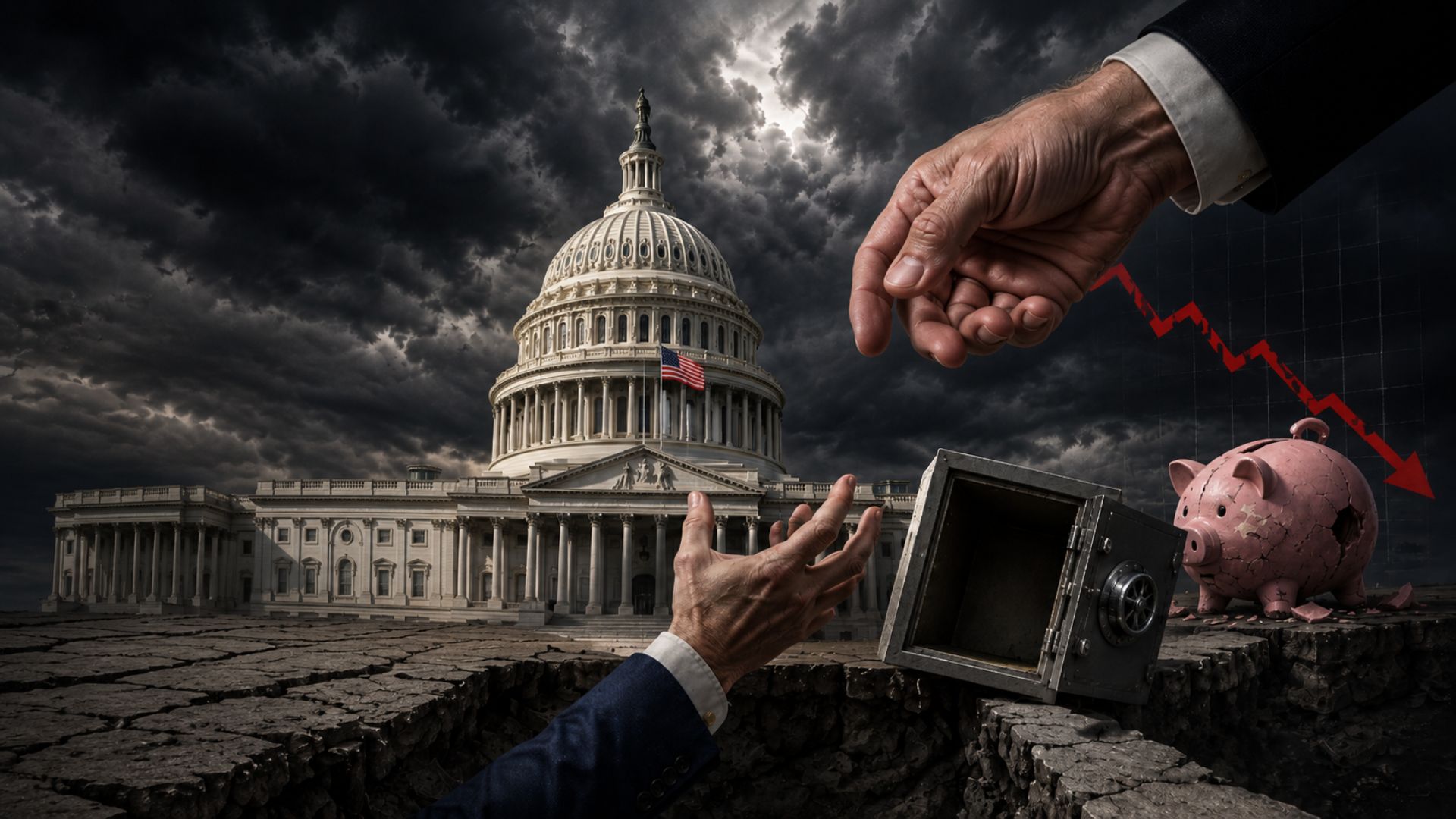
The projection is from the White House Office of Management and Budget. For each month of 2026, the American Treasury will need to issue more than US$ 166 billion in new debt. In interest alone, the United States government has already paid US$ 628 billion this fiscal year, an amount that rivals the combined budgets of Defense and Education.
The United States Treasury will have to borrow more than US$ 2 trillion over the current fiscal year, just to keep the American government running, according to official estimates released on May 5, 2026, by the Treasury Borrowing Advisory Committee. The White House Office of Management and Budget (OMB) projection for the 2026 federal deficit reached US$ 2.06 trillion, a number higher than the Congressional Budget Office (CBO) estimate, which set it at US$ 1.85 trillion. At this issuance rate, it means that for each month of this fiscal year, the American government will need to issue more than US$ 166 billion in new debt, equivalent to about R$ 920 billion at the current exchange rate. The United States national debt, which crossed the 100% of GDP barrier in March 2026, currently stands at US$ 38.91 trillion and is on track to exceed US$ 39 trillion later this year. Interest paid only between October 2025 and March 2026 totaled US$ 530 billion, an amount that rivals the Pentagon’s Defense budget. According to CBO calculations updated on May 8, debt service reached the impressive level of US$ 3 billion per day.
And the darkest detail of this equation is what hasn’t even been accounted for yet.
What you will understand in this text
- Why the American Treasury will have to borrow US$ 1.6 trillion more than expected, and which court decision created this hole.
- How American debt jumped from US$ 29 trillion to almost US$ 39 trillion in just a few years.
- Why interest, once considered a secondary expense, now exceeds the United States Defense budget.
- How Trump’s tariffs, which seemed to control the problem, left the Treasury more exposed.
- What this scenario means for Brazil, which also sees its own public debt growing at a record pace.
The US$ 88 billion per month bill

Here’s what measures what the American government spends today just to honor past debts.
-
Belo Horizonte Becomes First Brazilian City to Fund Housing, Utilities for 100 Homeless Families with $900,000 Initiative

-
Brazilian Joins Homeownership Consortium, Faces Decade of Dual Payments Totaling $141,000, Surpassing Traditional Mortgage

-
Land Rover to Halt Production in July, Putting 371 Jobs at Risk, as Chinese Automaker Negotiates to Convert Factory to 100,000 Vehicles Annually by 2027
-
Mexican Pest Threatens U.S. Cattle Herds at Historic Lows, Potentially Boosting Brazilian Beef Exports as Burger Prices Soar


According to the May 8 report from the Congressional Budget Office (CBO), the Treasury paid US$ 628 billion in net interest in the current fiscal year, which began in October 2025 and has consolidated data up to April. The previous amount, released at the end of March, was US$ 530 billion. In other words, in just about 30 days, the United States government added almost US$ 100 billion to its interest bill.
To get an idea of the burden, this is equivalent to:
- More than US$ 88 billion per month.
- About US$ 22 billion per week.
- Approximately US$ 3 billion per day, according to Fortune magazine’s calculation published on May 11.
The number directly rivals the United States Defense budget, which in 2025 was approximately US$ 850 billion for the entire year. At a proportional rate, the American government is paying, every day, more in interest than it spent on the entire Apollo program. And more than it allocates, combined, to the federal budgets for education and national defense.
As the Atlantic Council noted in a column signed by the think tank’s president, Frederick Kempe, on May 11: “This money is not building roads, funding research, training workers, or projecting military force. It is being transferred to bondholders, domestic institutions, foreign governments, and global investors, as the price of past borrowings.”
The Supreme Court decision that opened the hole

And here begins the chapter few Brazilians know about.
On February 20, 2026, the United States Supreme Court ruled, by a 6-3 vote, that President Donald Trump did not have the authority to impose tariffs using the International Emergency Economic Powers Act (IEEPA). The law, created in 1977, grants the president emergency powers to sanction economic enemies of the United States. Trump had interpreted the law as authorization to impose broad tariffs against virtually all American trading partners. The Court overturned it.
Four days later, on February 24, Trump resumed the tariff strategy through another legal avenue. He signed an executive order imposing a general 10% tariff on almost all imports, now using Section 122 of the Trade Act. Section 122 allows the president to impose temporary tariffs when the United States faces “large and serious balance of payments deficits.” But there’s a detail: the tariffs can only last 150 days.
The revenue generated by the tariffs so far has been substantial. According to the Tax Foundation, the tariffs apply to approximately US$1.2 trillion in annual imports. CBO data shows that government customs revenue rose 220% compared to the previous year. Between October and April 2025, the United States collected US$59 billion in tariffs. In the same period this year, the number jumped to US$190 billion.
But the clock is ticking on the tariffs established by Section 122. When they expire, the Treasury will lose this revenue source. And that’s where the most difficult calculation comes in.
The additional US$1.6 trillion that became urgent

According to technical analyses circulated after the Treasury Borrowing Advisory Committee meeting on May 5, the American Treasury may need to borrow an additional US$1.6 trillion to cover the fiscal hole left by the tariff defeat, plus another US$400 billion to pay additional interest. These amounts are above the US$2 trillion already projected as the standard deficit.
In practical terms, if the numbers are confirmed, the 2026 fiscal year could end with the American Treasury issuing between US$3.5 and US$4 trillion in new debt. An unprecedented amount in peacetime.
Maya MacGuineas, president of the Committee for a Responsible Federal Budget, described the trajectory as “alarming.” The Government Accountability Office, an independent technical arm of the American Congress, was more direct in a report published in April: it described the United States’ fiscal path as “unsustainable” and capable of generating “serious economic, security, and social challenges if not addressed.”
The debt jump in a decade
For the Brazilian reader following the topic, it’s worth reconstructing the jump.
In 2015, the United States national debt was approximately US$18 trillion. In 2020, at the end of Donald Trump’s first term and amidst the Covid-19 pandemic, it reached US$27 trillion. In 2025, Trump’s second term began with the debt at US$36 trillion. Today, in May 2026, it is US$38.91 trillion, close to the historic US$39 trillion mark.
The last time the United States government recorded an annual surplus was in 2001, during the last year of the Clinton administration. Since then, every year has ended in deficit. In March 2026, the debt crossed the symbolic barrier of 100% of GDP, a mark economists often cite as an inflection point in the fiscal sustainability of any economy. In July 2025, Trump signed HR 1, a package extending and expanding the tax cuts from his first term. The CBO estimated that the package alone will add US$3.4 trillion to the debt over the next ten years. As part of the agreement, the debt ceiling was raised at once to US$41.1 trillion, allowing the government to continue issuing bonds without needing to negotiate a new increase in Congress for some time.
The fiscal spiral
And here enters the technical concept that changes the entire interpretation.
When debt grows, the government needs to pay more interest. When it pays more interest, the deficit increases. When the deficit increases, the government needs to issue more debt. Each new dollar of American debt issued today increases tomorrow’s interest bill, which in turn requires new debt. This is what analysts call, in English, a fiscal spiral. In Portuguese, espiral fiscal.
For decades, analysts treated the fiscal spiral as a distant risk. The combination of low inflation, near-zero interest rates, and continuous international demand for American bonds sustained the system. But starting in 2022, three factors aligned to change the scenario.
The first was the rise in global inflation. The second was the Federal Reserve’s monetary tightening cycle, which raised basic American interest rates to their highest level in over two decades. The third was the structural deterioration of federal revenue, exacerbated by successive tax cut packages. The combination of these three factors transformed what was a risk into a current problem.
As former Treasury Secretary Robert Rubin observed in a Wall Street Journal column, cited by the Atlantic Council: “There is no special level at which debt goes from problematic to catastrophic. But the triple-digit mark is a potent symbol of the fiscal pressures that have been accumulating on the United States for decades.”
What this scenario means for Brazil
And here is the point that connects the topic with the Brazilian reader.
Brazil is also experiencing an accelerated expansion of its own public debt. According to data from the National Treasury, the Brazilian Federal Public Debt exceeded R$ 7.7 trillion in April 2026, a number that represents around 78% of GDP. The proportion is smaller than the American one in terms of GDP, but the pace of growth, considering the Brazilian government’s weaker revenue base, is concerning.
There is also an indirect dimension. When the American Treasury issues record volumes of debt, it competes with governments worldwide for foreign capital. To attract a larger volume of investors, the United States needs to offer higher interest rates on its bonds, which automatically pressures long-term interest rates worldwide, including in Brazil. Emerging countries pay more to finance themselves.
In other words, the more the United States goes into debt, the more Brazil also pays to go into debt.
What comes next
The next relevant meeting of the Treasury Borrowing Advisory Committee will take place in August, with a new updated projection. In parallel, Treasury Secretary, Scott Bessent, is expected to present a debt management plan to the American Congress in the second half of the year, with possible additional long-term bond issuances.
Internally, the 2028 American presidential campaign is already appearing on the horizon, and fiscal numbers are expected to become a central theme. Externally, traditional creditor countries (China, Japan, United Kingdom) continue to gradually reduce their holdings of American Treasury bonds in recent years, signaling that part of the world is slowly rethinking the dollar’s place as the undisputed global reserve.
The question that organizes the entire debate today, according to analyses from Foreign Affairs and the Council on Foreign Relations, is no longer whether the United States has a structural fiscal problem. It’s how long the international financial system will be able to continue carrying this problem without absorbing an impact.
And the number that defines the size of the problem continues to rise. US$ 3 billion per day.







Be the first to react!