






 Portuguese
  Spanish




The Generation of Solar and Wind Power Is One of Cemig’s Main Objectives, An Area Commonly Known as “Greenfield”
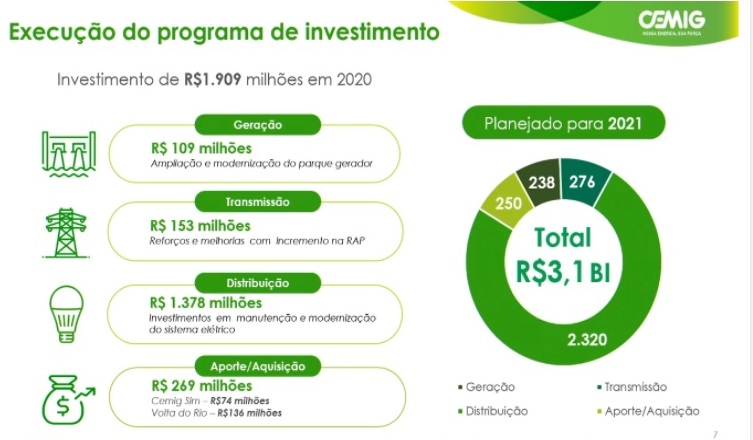
The Brazilian Cemig (Companhia Energética de Minas Gerais) plans to invest R$ 3.1 billion (US$ 540 million) in 2021, an increase of 62.4% compared to last year, the company announced on Monday during a webcast for investors. As in 2020, most of the capex (R$ 2.32 billion) will be allocated to the electricity distribution segment. The remainder will be invested in transmission (R$ 276 million), generation (R$ 238 million), and acquisitions.
One of the current government’s goals is to invest in wind and solar energy generation projects. In September 2020, the state-run Minas Gerais company launched a public call for acquiring advanced-stage projects.
“Our focus is on greenfield [projects], leveraging our technical and marketing capabilities, but that doesn’t mean we can’t look at mergers and acquisitions,” said Cemig’s president, Reynaldo Passanezi Filho, during the webcast.
-
Brazil’s 2026 Tax Refund: Record 9.58 Million Filers in Largest Payout Ever, But a Key Detail on Priority Recipients Draws Nationwide Attention

-
Itaú Alters Hybrid Work Model, Increasing Office Days from 2028, Prompting Employees to Adjust to New Routine
-
Facing Labor Shortage, Japan Plans to Invest $34 Million to Attract Foreign Workers in Construction, Healthcare, Industry, and Commerce

-
Brazilian City Makes Remarkable Leap, Becomes 4th Wealthiest in the Country with GDP of R$ 134.1 Billion




The company’s marketing director, Dimas Costa, stated that a significant portion of the generation projects to be acquired will be directed toward self-production.
“There is a great demand from our clients for this,” said the executive, highlighting that Cemig’s energy price target is around R$ 115/MWh and R$ 135/MWh for wind and solar energy, respectively.
Divestitures
About two months after selling its stake in Light, headquartered in Rio de Janeiro, Cemig announced that it had begun studying the divestment of Transmissora Aliança de Energia Elétrica (Taesa).
“It is very important for Cemig to focus on the businesses it knows best. We are going back to basics and want to have control [over the projects],” said Passanezi Filho.
Results of Cemig’s Investments in 2020
Cemig reported a net income of R$ 1.33 billion in the fourth quarter of 2020, a 136% increase compared to the previous year. For the entire year, its net income was R$ 2.86 billion, a decrease of 10.3% compared to 2019.
Net revenue totaled R$ 6.87 billion in the fourth quarter (+5.8% year-on-year) and R$ 25.2 billion for the year (-1% year-on-year).








