






 Portuguese
  Spanish


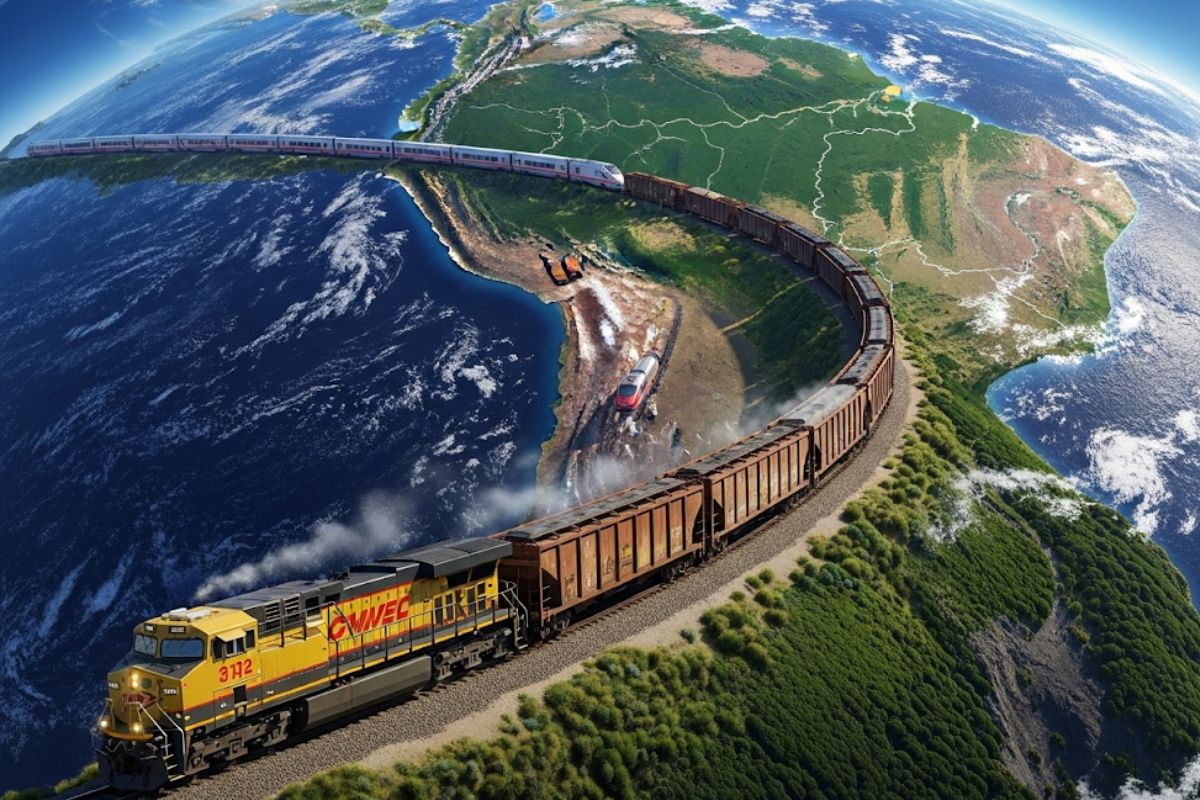

The Dream Is Becoming Reality in Building a New Railway in Brazil to Cross South America. Learn About the Segments, Partners, Economic Benefits, and Monumental Challenges of the Project.
The Bioceanic Railway represents an old South American dream. This is a new railway in Brazil and neighboring countries to connect the Atlantic and Pacific Oceans. This infrastructure project has the potential to redefine the economic geography of the continent, optimize exports, and deepen regional integration.
This article explores the saga of the Bioceanic Railway. We will analyze the segments under development in Brazil, international partnerships, the expected benefits and the immense challenges to be overcome for this dream to become reality.
The Evolution of the Bioceanic Railway
The idea of a transcontinental rail link in South America is not new. Proposals like the “Trans-South American Railway” date back to the 1950s. What was a distant dream has become a strategic imperative, propelled by the rise of Asian markets.
-
Viral Video of Giant Gold Nugget in Brazil’s Oiapoque Revealed as Painted Rock by French Guiana Miner

-
18th-Century Treasure Uncovered in Brazilian Amazon: 20 Réis Coin and Dutch Pipes Found at Construction Site
-
New York Resident Uncovers Complete Mastodon Jawbone in Backyard After Spotting Teeth Emerge from Ground
-
Young Treasure Hunter from Brazil’s Balneário Camboriú Finds $22,000 in Jewelry with Metal Detector, Aims for $1 Million, and Returns iPhone Found in Ocean


Initiatives like IIRSA (Initiative for the Integration of South American Regional Infrastructure) and Cosiplan (South American Council for Infrastructure and Planning) provided platforms for planning. However, progress has often been fragmented. The lessons learned from previous projects are crucial for the success of the current initiative.
The New Railway in Brazil with the Segments of FIOL and FICO

Brazil plays a central role in this project. The Brazilian government, through various administrations, has shown strong engagement, including sections of the Bioceanic in the New PAC. The construction of this new railway in Brazil is based on two crucial projects:
West-East Integration Railway (FIOL): At 1,527 km, it will connect the future Port South (BA) to Figueirópolis (TO). Segment I was auctioned to Bamin. Segment II is under construction by Infra S.A. Segment III is in study.
Midwest Integration Railway (FICO): Designed to run from Mara Rosa (GO) to Acre, on the border with Peru. Segment I (Mara Rosa-Água Boa) is under construction by VALE S.A. as a counterpart for the renewal of another concession. FICO is vital for transporting grain production from the Midwest.
Bioceanic Railway: China, Peru, Bolivia, and South American Integration
The Bioceanic Railway is set within a complex geopolitical landscape. China’s participation is a determining factor, offering capital and technical expertise. The Chinese interest is to ensure efficient access to South American commodities like soy and iron ore.
Peru stands out as the main partner on the Pacific coast, with the megaport of Chancay, funded by the Chinese, being the likely terminal. Bolivia has also expressed interest in joining the project. Meanwhile, the Bioceanic Route of Capricorn, based on road transport, will connect Brazil, Paraguay, Argentina, and Chile, showing that continental integration is advancing on multiple fronts.
The Immense Technical, Environmental, and Social Challenges of the New Railway in Brazil
Experts and technical studies point to monumental challenges. Crossing the Andes Mountains and the Amazon Rainforest imposes unprecedented engineering hurdles, requiring long tunnels and high bridges, which increases costs.
The environmental risks are immense. The route crosses critical biomes such as the Amazon and the Cerrado, threatening deforestation, habitat fragmentation, and impacts on biodiversity. Social impacts are also a major concern. Indigenous and traditional communities may have their territories and ways of life affected. The governance of the project, which involves multiple countries, demands robust coordination and long-term political commitment to overcome the challenges.
What Does Brazil Gain from the New Transcontinental Railway?
The promise of economic gains is the main driver of the project. Studies project a reduction of 10 to 17 days in the transit time of products from Brazil to Asia. Freight costs could be reduced by up to 30% for grain production from Mato Grosso, for example.
This new railway in Brazil aims to catalyze the agricultural and mining sectors of the interior of the country. By providing a more efficient export route, it can unlock even greater productive potential. Additionally, it can stimulate regional development, generating jobs, attracting investment, and improving infrastructure in historically isolated areas.


