






 Portuguese
  Spanish


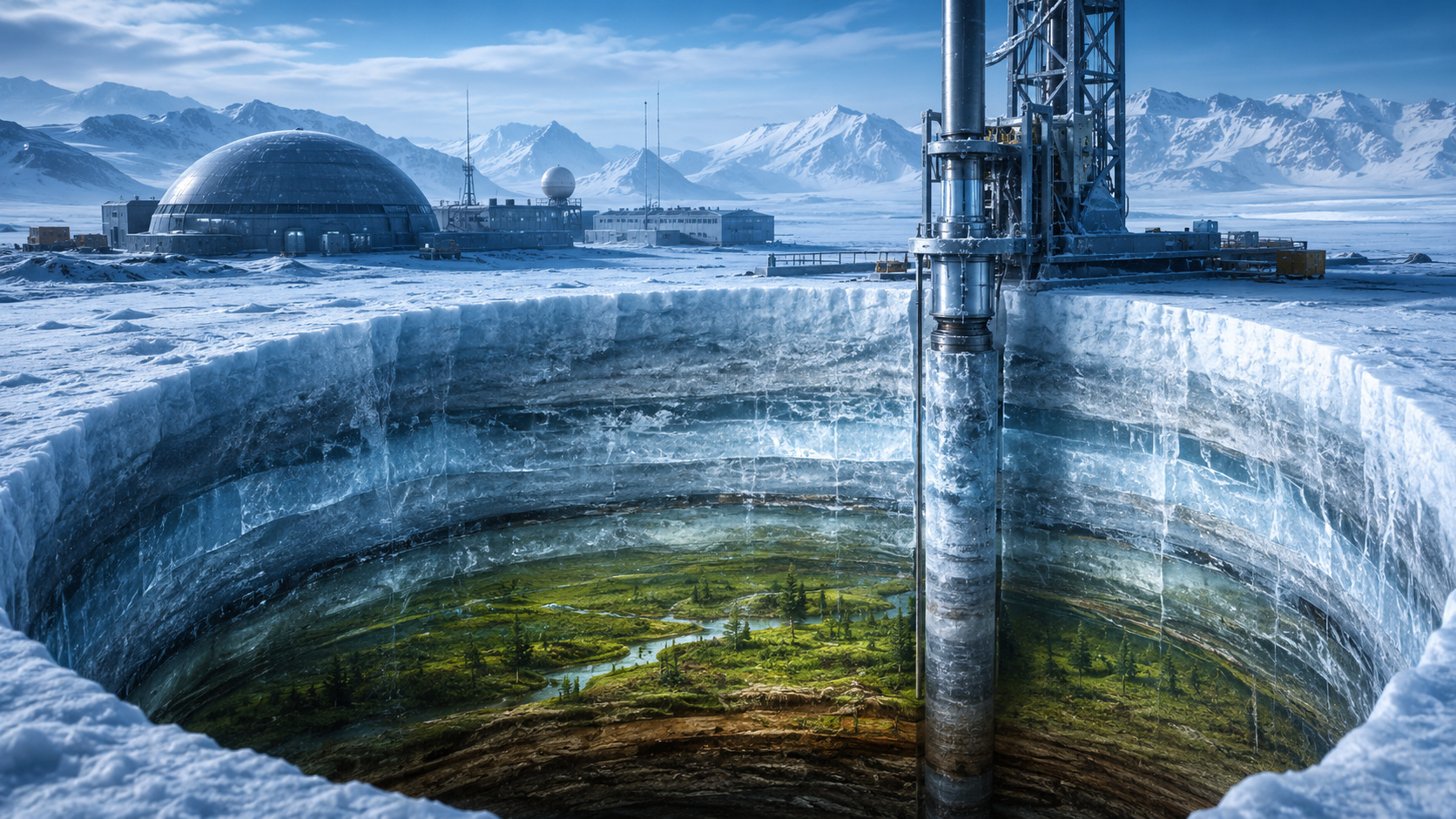
Sediments under Greenland’s ice revealed leaves and mosses from 416,000 years ago and indicate that part of the island was ice-free in a warmer climate.
For decades, a forgotten sample in a freezer helped conceal one of the most surprising climate discoveries ever made in the Arctic. Sediments extracted from beneath nearly 1.4 km of ice in Greenland revealed that part of the island was once covered by vegetation, mosses, and tundra exposed to the open air in a relatively recent period of geological history. The material came from Camp Century, a secret military base built by the United States during the Cold War under the Greenland ice sheet. The analysis of the sediments showed that the region remained ice-free about 416,000 years ago, during a natural warming period known as Marine Isotope Stage 11 (MIS 11).
Camp Century was built inside the ice during the Cold War and ended up preserving a climate capsule hidden for hundreds of thousands of years
Camp Century was created by the United States Army Corps of Engineers in the late 1950s. The facility was excavated directly into the ice sheet of northwest Greenland and even operated with a small nuclear reactor.


During drilling conducted in the 1960s, scientists drilled through approximately 1,389 meters of ice before reaching sediments located beneath the ice cap. After mechanical problems, part of the material ended up stored and remained forgotten for decades.
-
Breakthrough in Clean Energy: Scientists Develop Battery-Free Artificial Photosynthesis Using Only Sunlight to Generate Chemical Energy

-
Revive Old Photos: Gemini’s Little-Known Feature Uses AI to Restore Damaged Images in Seconds with a Professional Six-Step Recovery Process

-
Young Brazilian Inventor Develops Microplastic Filter, Wins Scholarship to Study in China, and Implements Solution to Improve Water Quality in Southern Brazil

-
Brazilian Teen Develops Cost-Effective Natural Fungicide from Kitchen Herb, Wins Top Prize at World’s Largest Science Fair


When the samples were rediscovered and analyzed with modern techniques, researchers realized they were not just looking at ancient mud, but at preserved traces of an ecosystem that existed before the return of the ice.
Leaves, mosses, and tundra fragments found under almost 1.4 km of ice showed that Greenland once had green landscapes
By examining the sediments in the laboratory, researchers found preserved vegetation remains, including leaf fragments, mosses, and signs of an ancient tundra environment. The material indicated that the region had remained exposed to the open air for a significant period of time.

Luminescence techniques and isotopic analyses allowed the reconstruction of when those sediments were last under sunlight. The results pointed to about 416 thousand years ago, with a margin of error of approximately 38 thousand years.
According to the researchers, the area remained ice-free for thousands of years before the ice cap advanced again and buried the landscape under enormous ice thicknesses.
Study indicates that part of Greenland’s ice cap disappeared when carbon dioxide was much lower than it is now
One of the aspects that most caught scientists’ attention was the comparison between the climate of that period and the current one. The MIS 11 interval occurred naturally, driven mainly by Earth’s orbital changes and the amount of solar energy received at high latitudes.

At that time, atmospheric levels of carbon dioxide remained between approximately 265 and 280 parts per million (ppm). Today, the global concentration exceeds 420 ppm and continues to rise due to human emissions of greenhouse gases.
For the researchers, the fact that a significant part of Greenland lost ice in a world with CO2 much lower than today reinforces the ice cap’s sensitivity to prolonged climate changes.
The partial disappearance of ice raised the oceans and helps scientists estimate risks for modern coastal cities
Studies indicate that the melting associated with that period contributed to a global sea level rise of at least 1.5 meters, potentially reaching approximately 6 meters when considering the highest estimates.
The models used by the researchers show that the Greenland ice sheet had to shrink drastically to allow the Camp Century region to remain exposed. In some areas, the retreat would have reached hundreds of kilometers.

As Greenland currently stores enough ice to raise the oceans by several meters if it completely melts, understanding ancient episodes of retreat has become one of the main tools to assess future scenarios.
The ancient “green Greenland” became one of the strongest pieces of evidence about the fragility of large polar ice caps
The authors of the study classified the sediments of Camp Century as one of the most direct geological evidence ever found that large sectors of Greenland were ice-free during warm periods of the past.
The case also drew attention because the discovery emerged from an almost lost sample. What seemed like just frozen mud forgotten in storage ended up revealing an entire landscape buried under nearly one and a half kilometers of ice.
Today, while satellites monitor the accelerated melting of polar regions, those leaves and mosses preserved under Greenland serve as a message sent by an ancient planet: a world where part of the island had already turned green long before there were factories, cars, or modern coastal cities threatened by rising seas.






Be the first to react!